
The Reason You’re Here
Whether you’re a startup founder or marketer, this page shows you exactly how to attract strangers and turn them into paying users, even in the absolute madhouse that is 2026.
Without publishing endless content and praying traffic and engagement turn into pipeline.
Just like these startups did:
Before we break down how this works, here’s proof that the mechanism below has already worked across multiple SaaS models.

👆 Rob generated 282 demos in just weeks for his B2B SaaS sales team at a $16.50 cost per demo, with a 24% page-to-demo conversion rate.

👆Marisha increased free trials by 3× while also improving trial-to-paid conversion by 23%, using a single asset that educated and pre-sold users before they entered the product.

👆Rachel ranked her EdTech product in high-intent ChatGPT search results, driving 1,000+ applications for a $9K paid program. Without relying on traditional content calendars, funnels or lead magnets.
Different products. Different motions. Same underlying mechanism.
Intent before interaction.
More on these stories later..
Get a DFY, High-Intent Blueprint for Your SaaS — $49 →
The Blog Slog is Dead.

What do I mean by the “blog slog”?
It’s the old SaaS inbound playbook: publish dozens of SEO articles, hope a few rank, hope the right people read them, and really hope those readers eventually turn into trails or demos.
Let’s be honest. That strategy was already on life support:
-
Most posts never ranked.
-
The ones that did brought low-intent visitors.
-
And only a tiny fraction ever produced pipeline.
It was a slow, expensive, high-effort grind for unpredictable results.
Then AI put a nail in the coffin.
AI Overviews now answer queries without sending traffic to websites.
ChatGPT/Gemini/Perplexity bypass traditional SERPs entirely.
AI-generated content made “SEO articles” instantly commoditized.
Traditional inbound didn’t evolve.
AI buried it.
And that’s exactly why the High-Intent Inbound™ framework exists.
It’s a new model built for how people actually discover, trust, and buy software today.
You Don’t Need More Awareness. You Need More Pipeline. Fast.
With the old model dead, here’s what actually works now..
Forget everything your last content marketer told you.
You’re an early-stage SaaS startup. You’re not at your Series D (yet).
You don’t have the luxury of outspending competitors and you can’t spend 12 months publishing educational content and hoping good leads start showing up.
But you need more qualified inbound leads. Now.
People who have the right problem, understand your product’s value, and are ready to commit.
You need an asset that creates readiness to buy before people ever see a demo.
that’s exactly what the High-Intent Inbound™ framework does.
What is High-Intent Inbound™?
High-Intent Inbound™ is a unique approach that replaces traditional inbound content calendars with one belief-shifting, direct-response asset designed to educate, pre-sell, and convert cold traffic into qualified SaaS demos, trials, and customers.
Paid social drives quick wins to your funnel, then AI + organic search build results month after month.

⭐ Why the High-Intent Inbound™ Engine Works
One Direct-Response Asset to Rule Them All
High-Intent Inbound™ is built around a single asset. A direct-response “Inbound Sales Letter” — that replaces your entire TOFU → MOFU → BOFU funnel.
Instead of dozens of blog posts, lead magnets, nurture sequences, and landing pages, you focus on one asset that:
-
Educates about your unique mechanism
-
Shift buyer beliefs before trials or demos ever happen
-
Answer objections in advance
-
Convert cold traffic because the decision already feels made
This is why it works when traditional inbound no longer does.
Traditional inbound optimizes for exposure first, conviction later.
High-Intent Inbound™ reverses that sequence — conviction first, conversion second.
Your asset pre-sells prospects, making demos and trials more effective at converting to paid.
And instead of optimizing for one channel, you repurpose the same asset across search and social to drive paying users, not clicks.
Paid social gives that asset reach now.
AI + organic search gives it visibility long-term.
One asset. One system. Full-funnel coverage.
Same Mechanism. Different SaaS Motions.
For Product-Led SaaS
In product-led companies (where the primary conversion is a free trial), most teams assume low trial-to-paid conversion is an activation problem.
Often, it’s not.
It’s a belief problem.
Users enter the trial without a clear mental model of:
-
why the product matters
-
what problem it uniquely solves
-
what success should look like
High-Intent Inbound™ works because it educates users on the mechanism and shifts belief before the trial starts.
The product simply confirms what they already believe.
The trial stops being an exploration phase and becomes a validation phase.
For Sales-Led SaaS
In sales-led companies (where the primary conversion is a demo), the same problem shows up.
Prospects book demos without conviction, so sales teams are forced to educate, reframe, and persuade live on the call.
High-Intent Inbound™ works because it delivers the mechanism and belief shift before the demo happens.
By the time the prospect talks to sales, they already understand:
-
why previous solutions failed
-
what changed
-
why this approach makes sense now
The demo stops being a persuasion event and becomes a confirmation conversation.
Do your sales team a big favor, feed them pre-sold leads.
Want to See What This Would Look Like for Your SaaS?
YES, Build Me The High-Intent Blueprint — $49
The Kicker: This Won’t Work for Everyone
It ONLY works for SaaS products that are UNIQUE.
As an early stage startup there are four things you need to know before you begin convincing strangers to buy your stuff:
- What is your product: You need to know your product’s category (e.g. CRM, LMS, HCM, ESP…) OR the primary use case or problem it solves for e.g. easily schedule meetings without the back-and-forth emails (Calendly).
- Who is it for: You need to have your precise ICP (ideal customer profile) nailed down.
- What is the alternative: You should know the current way(s) your target customers solve their problem before discovering your product.
- Why is it better: This is the big one.. You need to know how your product different and how it gets results faster/easier/cheaper than their current way.
If you know these things about your “macro offer” (what you’re selling) your positioning is solid.
And this framework is going to work For you.
If you’re 100% clear on these things?
No sweat. That’s why I’ve structured the Lead Surge Blueprint + Strategy Call.
We’ll tear down your current offer (in the best way possible) and rebuild it for scale. So that you can be sure this will work for you.
Yes Justin, Rebuild My Offer for Scale: DFY Blueprint Just $49 →
Keep in mind – you’re ALSO going to need a little ad budget.
This is a “blended” inbound strategy. So you’ll need to put some skin in the game with paid social to get the most out of it.
You’re going to need to be able to comfortably spend at least $1-$3K for ads in month 1 if you expect to see results.
You’ll need this breathing room for early testing so you can learn what works and get the message right.
Here’s how it works:
How The High-Intent Inbound Engine™ Works
-
Pick Your Micro Offer → The small, irresistible “first step” that attracts the right ICP and sets the direction for your entire funnel.
-
Build Your Core Funnel Asset → One high-impact asset that educates, pre-sells, and turns curiosity into conviction.
-
Test Paid Social Angles → Use a small, startup-friendly budget to find your winning hook, create new demand, and acquire users fast.
-
Capture Existing Demand via AI + Organic Search → Your core asset becomes the “answer” AI platforms surface when buyers are ready to act.
“Short-term leads. Long-term authority. One system.”
Let’s break this down:
1. Pick Your Micro Offer → Hijack your in-market audience with a better, stronger offer.
Your prospects already see ads, landing pages, and funnels from your competitors.
Your first job is simple:
See what they see — then build something stronger.
Focus on competitors who:
-
sell to the same ICP
-
solve the same use case
-
currently have more market share
This means digging into what they’re actually running, not guessing.
You’ll need to audit their:
-
paid social ads (Meta, LinkedIn)
-
Google search ads
-
landing pages
-
high-intent organic results
-
AI search results (ChatGPT, Perplexity, Gemini)
Tools like Ahrefs, SEMRush, and public ad libraries will show you exactly what they’re using to drive trials and demos.
Then ask two questions:
1. What “micro offer” are they using to drive trials/demos?
2. How do we beat it so your ICP feels stupid saying no?
💡 What a Good Micro Offer Actually Does
Your macro offer is your product.
Your micro offer is a small, irresistible step that moves prospects toward it.
It’s not meant to close the sale —
it creates motion.
A strong micro offer:
-
solves a surface-level pain
-
reveals the deeper problem your product solves
-
attracts only the right ICP
-
sets the tone for your entire funnel
Get this right and the rest of your inbound system becomes dramatically easier.
Most founders guess this step. And that’s why their inbound doesn’t scale.
If you want to skip days of competitor research and know exactly which micro offer will convert for your product, I’ll build it for you:
Tell Me Exactly Which Micro Offer I Should Build — $49 →

2. Build Your Core Funnel Asset → “Pre-Sell” Your Product at Scale
Your asset only needs to do one job:
👉 Turn curiosity into conviction.
Most founders get this wrong because they treat it like content, SEO, or a landing page.
It’s none of those.
It’s NOT “Content.”
Traditional content goes wide, not deep.
-
100 blog topics
-
shallow answers
-
irrelevant or mismatched CTAs
Traditional blogs don’t convert because the message never leads anywhere.
High-Intent Inbound™ Asset flips that completely.
You go deep on one pain, one belief shift, one offer.
It’s NOT “SEO” (in the old sense)
No keyword stuffing.
No topic clusters.
No trying to rank for 300 keywords.
Yet, when you do this right, you do rank for insanely valuable terms…
Just like the post your reading right now did (yes, this page is an example of the high intent inbound™ strategy in action).
This guy ranked FIRST on Google in under FOUR DAYS of posting it against all the big shots with 2-3X my domain authority. And I built ZERO links.
Why did it rank?
Not because of extensive keyword research, links or authority.
It’s because:
A) It solved the pain better than anyone else
B) Everything tied back to one valuable micro offer


It’s NOT a Traditional Landing Page Either
Landing pages sell features.
Blogs sell education.
Your asset sells belief.
You’re creating one un-gated, long-form asset that
-
names the prospect’s pain
-
teaches them how to evaluate solutions
-
names your mechanism as the inevitable answer
-
filters out bad leads
-
drives trials/demos from cold traffic
Each section of this asset is engineered to overcome a specific barrier — from disbelief to inertia — so the reader *arrives at desire and action with no resistance left.
It’s basically a sales letter combined with the power of real education. And the market loves it.
The Right Format for Your Core Asset:
Your “core asset” can take multiple forms:
-
Direct-response narrative
-
Video sales letter
-
Quiz funnel
-
Case study
-
Interactive walkthrough
-
Thought-leadership / Sales Letter Combo
The right vehicle depends on your product, ICP, and resources — I’ll help you choose the most leverage-filled one.
✔️ Want Me to Personally Review Your Offer?
If your funnel isn’t converting cold traffic, the weak link is almost always the offer.
I’ll tear down your current offer (in the best way possible) and rebuild it for scale — so your entire inbound engine hits harder and converts faster.
Yes, Tear Down My Offer (In the Best Way Possible) — Only $49 →
Sample High-Intent Funnel strategies for an EdTech business:

What Makes High-Intent Inbound™ Convert So Well
These assets aren’t blog posts or landing pages — they’re belief-shifting documents designed to turn a cold reader into a ready buyer.
-
Design supports the story, not the brand aesthetic.
-
Every section exists to eliminate a psychological barrier: skepticism, confusion, inertia, doubt.
-
The narrative moves the reader from:
“I’m not sure this will work for me” → “This is exactly what I’ve been looking for.” -
The writing prioritizes clarity, specificity, and momentum — short paragraphs, concrete outcomes, and a logical progression that builds conviction.
Once you understand this, the copy framework becomes obvious:
High-Intent Inbound™ Funnel Copy Flow — Explained Simply
This asset is going to use classic, proven direct-response copy principles that have stood the test of time.
This isn’t new stuff.
The copywriting frameworks we use for these assets have been used for decades to sell products and services since the Mad Men days (Schwartz, Halbert, Kennedy, Ogilvy, etc.).

1. HOOK
This is where you grab attention instantly.
Call out your ideal customer and the specific result they want.
It should make them think, “That’s me — and that’s what I need.”
👉 Example: “Turn your expert interviews into content that converts — without hiring a marketing team.”
2. PROOF
Right after you grab attention, you earn trust.
Show quick credibility — a recognizable client, big metric, or impressive outcome.
This proves you’re not another “idea,” but someone who gets real results.
👉 Example: “Used by SaaS teams that grew 5× paid users and earned 29× ROI from content.”
3. PAIN
Now you meet the reader where they’re stuck.
Describe their current frustration clearly — the bottlenecks, waste, or missed goals they face daily.
When done right, they feel seen.
👉 Example: “You know you should be creating content, but there’s no time — and agencies don’t get your product.”
4. AGITATE
Twist the knife slightly — make the pain feel urgent.
Explain what happens if they don’t fix it.
This builds emotional momentum and gets them ready for change.
👉 Example: “So your blog sits stale, your competitors own the conversation, and your best ideas never reach your buyers.”
5. BELIEF SHIFT (INSIGHT)
This is the turning point — show them why the old way no longer works.
Introduce a key market insight or shift in thinking that reframes the problem.
👉 Example: “Content isn’t about volume anymore — it’s about velocity of insight.”
6. MECHANISM
Now reveal your unique system or approach that solves the problem differently.
Give it a name — that makes it feel tangible and ownable.
👉 Example: “The Journeyengine Thought Leadership Engine™ turns founder interviews into channel-ready content.”
7. RESULTS / PROOF
Show the transformation.
Use real metrics, stories, and before/after examples that demonstrate your mechanism works.
👉 Example: “+155% organic traffic, 4× trials, and +23% conversion for an EdTech SaaS.”
8. SCARCITY / CLOSE
Finally, make taking action feel urgent and specific.
Add time, quantity, or exclusivity — and restate the benefit of acting now.
👉 Example: “Only 20 beta seats available. Join free before pricing opens at $900/mo.”
✅ In short:
HOOK their attention → PROVE you’re credible → make them FEEL the pain → SHIFT their belief → introduce your unique MECHANISM → back it up with RESULTS → close with clear, limited action.
Want Me to Write Your Hook + Topic?
It’s the most important part of the whole system — by far.
If the hook misses, everything else breaks.
Let me craft your perfect funnel topic and winning headline live on a 1:1 call.
Justin, Craft My Perfect Funnel Topic + Headline — $49 →
Once you create this asset you need to promote it. Everywhere.
3. Rapidly Test Paid Traffic Angles → Find Your Winning Hook
In 2026, creative is the targeting.
The algorithm will find your audience — if your angle hits hard enough.
Most SaaS teams test features.
Features don’t scale cold traffic.
“Angles” do.
Your job is to test beliefs, not buttons.
What’s an Angle?
An angle is a new lens that reframes your product around:
-
a pain they already feel
-
a belief they hold
-
a frustration they want solved
-
a desire they won’t say out loud
-
a shift in the market they don’t yet understand
You’re not changing the product —
you’re changing the story.
Test weekly:
-
new visuals
-
new hooks
-
new proof snippets
-
new emotional frames

⭐ The 3 Angles Every SaaS Startup Should Start With
1. Pain Reversal
Flip their biggest frustration back at them.
2. New Way vs. Old Way
Show why the old method fails — then introduce your shift.
3. Fast-Path-to-Result
They don’t want your tool.
They want speed, clarity, and certainty.
These three uncover winners fast — without burning budget.
Most teams fail because instead of testing the underlying beliefs that drive action, they just guess or copy whatever competitors are doing.
Getting this right does take time.
But here’s your shortcut
Instead of guessing:
I’ll build your first 3 winning angles for you.
Tailored to your product.
Informed by your ICP.
Reverse-engineered against competitors.
Mapped to your belief-shift topic.
Ready to test immediately.
Want me to save you 10–20 hours and prevents thousands in wasted ad spend?
Yes, Show Me Which Ad Angles to Test First — $49 →
4. Capture Existing Demand with AI + Organic Search → Become the Default Answer
When today’s buyers are “in-market,” they don’t just Google you.
They ask ChatGPT.
They check Reddit threads.
They search “best X software” listicles.
They look for recommendations, not blog posts.
And here’s the part most SEOs get completely wrong:
Early-stage SaaS companies can rank for BOFU terms like
“best speech therapy software,” “best LMS,” or “best online MBA”…
without a huge budget or a year of waiting.
We’ve done it repeatedly — for brand new products — using a simple, proven system.

⭐ The “Cheat Code” for BOFU + AI Search Visibility
Instead of trying to rank lots of disparate content, we rank brand mentions accompanied by transactional terms across an ecosystem of pages buyers actually trust.
Here’s the 3-part system:
- Forum Threads That Act as Demand Magnets
-
Tier 1 Roundups: High-Authority Listicles Featuring Your Brand
-
Tier 2 Mentions-Focused Link Building

1. Forum Threads That Act as Demand Magnets
Reddit, Quora, and niche forums create:
-
authentic discussions
-
trust signals for buyers
-
long-lived rankings for BOFU queries
-
source data LLMs pull from
One good thread can often outperform 20 blog posts.
2. Tier 1 Roundups: High-Authority Listicles Featuring Your Brand
These listicles:
-
rank quickly for BOFU keywords
-
get scraped by AI engines
-
appear in AI Overviews
-
provide the exact comparison context buyers want
-
link directly to your sales/demo page
This is your fastest path to showing up where buying decisions happen.

3. Tier 2 Mentions-Focused Link Building
Once your brand appears in Tier 1 listicles, Tier 2 links:
-
boost authority
-
reinforce your ranking footprint
-
strengthen both the listicle and your ISL asset
-
increase visibility in AI (ChatGPT/Gemini/Perplexity)
-
accelerate BOFU keyword wins
You’re not trying to rank one page —
you’re ranking an entire recommendation ecosystem.
This is how you beat competitors 10–100x your size.
⭐ Want Me to Put Together This AEO Strategy For Your Product?
I’ll show you:
-
the exact BOFU terms your buyers search
-
where AI already pulls recommendations
-
which listicles and forums matter for your category
-
how to secure Tier 1 placements
-
how to build Tier 2 authority
-
and how your inbound asset fits into the ranking cluster
You’ll walk away knowing exactly how to win across Google, ChatGPT, Gemini, and Perplexity.
Yes, Show Me Exactly What I Should Rank In AI + Search — $49 →
🚀 When Should I Expect Results?
Most inbound strategies take 6–12 months before anything happens.
High-Intent Inbound™ is different.
Month 1 — Fast Wins
Because you launch paid social + a high-intent direct-response asset, you’re going to get real signal quickly:
-
Lower cost per trial or demo
-
First profitable ad angles
-
Pipeline lift in Week 3–4
-
Clarity on which buyer segments convert best
-
Qualitative insights (comments, replies, shares) you can use immediately
This is why early-stage SaaS founders love this model —
you don’t wait half a year to see if something works.
📈 Months 2–3 — Results Start to Compound
While the paid social angles begin to scale, your content simultaneously starts appearing where it matters:
-
Tier 1 listicles begin ranking
-
Tier 2 publisher posts build authority
-
Your brand shows up in AI Overviews
-
ChatGPT/Perplexity/Gemini begin mentioning you by name
-
Early BOFU keywords start climbing
This is where the flywheel actually begins turning —
but unlike old-school inbound, you’re already getting results BEFORE the compounding kicks in.
🧠 Month 4+ — You Become the “Default Answer”
By this stage:
-
AI search tools pull from your asset
-
Forums and thread placements reference your brand
-
BOFU queries begin sending meaningful traffic
-
Paid social scale becomes cheaper because the algorithm now “knows” who converts
-
Organic visibility stacks on top of paid — not instead of it
This is how you get the dual benefit:
⚡ Fast pipeline now➕ Compounding visibility over time
No slow ramp.
No “wait six months to see if it worked.”
No dependency on keyword volume alone.
Just buyers → pipeline → profitable scale.
Want a personalized version of this plan mapped to your product, your ICP and offer?
I’ll build you a custom, 90-day lead Surge Blueprint guaranteed to drive more paid users for your business.
Justin, Map My 90-Day Results Plan! — $49 →
Why This All Works
- You’re not giving a theory, your showing actual PROOF your product will achieve what you say you will in helping your users kill their pain
- The decision maker doesn’t need to waste time opting-in and raising their hand to become a lead. Nobody’s got time for that! Everything’s out there in the open and un-gated. After they’ve read it they want it or they don’t. And if this is done properly it’s very likely they will.
- You’re dominating visibility for people who are ready to buy. By being clever about your placements
Now you’re probably wondering…
“This all sounds good, but are people actually getting results with this model?”
What Results Should I Expect?
Check out three real High-Intent Inbound™ case studies:
Marisha was on the content hamster wheel..
On the advice of her last content agency Marisha was posting endless educational content every week in the hopes of generating more “top of funnel awareness” from speech language pathologists for her EdTech product.
We helped her “flip her funnel” and build a core asset focused on SLPs and district administrators who were already in-market for speech therapy software.
The result?
Quick Rankings for in-market searches in Traditional and AI search results:
You can see in this Ahrefs screenshot the “Intents” labeled with “T” for “Transactional” and “C ” for “commercial” which are the keywords people actually use when they’re ready to buy.
It’s actually highly accurate.. and shows you how quickly we were able to rank one page for 47 of these keywords.

Rankings for transactional “solution” searches in AI search results:

Multi-Digit Growth in Quality SaaS Trials

Hitting $16.50 Cost per Demo for a $5,000+ B2B SaaS product
By running traffic to a core asset that educates and pre-sells we’re able to drive demo requests for as little as $16.50 per demo, like we recently did for an HRTech product.
By testing 5 new angles every week we were able to help Meta’s algorithm find what resonated and deliver ads to with the ideal customer profile. This is the best (only) way to win with Meta’s new “Andromeda” update.
Then we used “frog tongue” retargeting to send people who entered the funnel but didn’t convert back to case studies and direct response demo offers.
The results were daily demos on the books for outstanding CpA’s within the first month running the campaign:


Ranking for Impossible Terms in ChatGPT and Gemini
Online MBA programs are an incredibly crowded and competitive category.
By all SEO / GEO logic a new tech startup like Quanitc shouldn’t be able to outrank 100+ year old .edu goliaths like Harvard and Wharton MBA.
But that’s exactly what we did!
By controlling the narrative using UGC, forums and third party publisher roundups we were able to dominate AI and traditional search results for smart long-tail in-market queries where the brand could actually compete with category leaders.
For example:
- What are the most affordable online emba programs
- What are the best online EMBA programs for the tech industry
- What are the best online EMBA programs that qualify for tuition reimbursement
And more (see blow for the receipts)!


These LLM results directly drove 1,000+ applications for the $9,000 program:

Alright Already, Justin — I Want These Results. Build My Dang $49 Blueprint! →
Hear From the SaaS Founders and Marketers who Already Flipped their Funnels:


DISCLAIMER: I have to tell you…results like this are not typical when first starting a High-Intent Inbound™ campaign.
I’ve been doing this digital marketing stuff for 15+ years. My business has been running for 6+ years. And I’ve scaled many SaaS products during that time. Most people start out acquiring 1-2 users per week using our model, then scale up as their ad spend and organic traffic scales over time.
If you’d like to see how to set this up… so that you can bring in more of your best customers every month with less work… you have two options:
Option 1
Take the step-by-step process I laid out here, look at all my content, and take a stab at it on your own.
There is no “secret”. These are direct response copywriting concepts that have been used for since the Mad Men era to sell products. There’s tonnes of books and resources out there (including all the stuff on this website) that you can use to do it on your own.
High-Intent Inbound™ is a simple way to build funnels with strong copy that sells SaaS products. We’ve just figured out a clever way for early-stage startups can promote everywhere your buyers are in 2026: across social media, search and answers engines (LLMs) without breaking the bank.
Option 2
You can grab our High Intent Inbound Strategy and start converting new users today.
This service is run end-to-end by me (Hey, I’m Justin, my picture is below 👋).
After working with a ton of early stage SaaS products I built this strategy process to hack a quick understanding of your product and market so you can immediately hit the ground running with this type of inbound campaign.
Hi, I’m Justin.
Fractional Inbound Growth Lead @ JourneyEngine

After earning an MBA and spending a decade in enterprise advertising, I launched JourneyEngine to do what I love most —help cool early-stage SaaS startups get more paying users.
I have 15+ years of experience. I’ve served as a fractional Head of Growth for 47 startups, helping multiple founding teams scale from $1M to $40M ARR and reach nine-figure exits using a framework I developed called The High-Intent Inbound Engine™.
If you’re serious about building an inbound engine that drives trials, demos, and real growth for your SaaS product — I’d love to help. 🚀
Want to See What High-Intent Inbound™ Looks Like for Your Product?
Claim your free High-Intent Inbound strategy and get your personalized inbound visibility audit — see exactly where you’re losing in-market demand (and how to fix it fast).
⚠️ Heads Up — Limited Availability
Note: Justin works directly with just 4 SaaS clients at a time to execute the full service. If this page is live, a slot’s still open — but probably not for long.
If you want in on this cycle, now’s the time to act.
Yes, I Want Justin to Personally Craft My Lead Surge Blueprint — Only $49 →
Get the High-Intent Inbound™ Asset AI Builder – Just $5 →
You’ll receive the High-Intent inbound AI Builder to your email in 60 seconds.
The Reason You’re Here
Whether you’re a marketing team of one or a startup founder juggling everything, this page is going show you exactly how to attract strangers and make them want to buy your SaaS product in 2026.
Just like these startups did:
More on these stories later..
Your Inbound Marketing is Broken.
Your SaaS product isn’t struggling for more users. It’s struggling with outdated, one-channel inbound strategies that focus too much on “fluffy” outcomes.
Your potential users are spread across Google, ChatGPT, and social media. And if you only invest in one channel, you’re not going to get the volume you need to grow.
But you probably already know that.
Chances are, you’ve hired an “SEO expert” or a PPC agency, spent thousands or tens of thousands and got little more than empty promises and the classic; “we just need more time”.
You’re here because you need help with one (or all) of the following:
- Increase the volume and quality of the leads your product receives.
- Run paid social ad campaigns that build demand and reduce your cost per trial, demos and paid user.
- Show up in Google and AI search platforms when your customers actually want to buy (ChatGPT, Perplexity, Gemini).
You Don’t Need More Awareness. You Need More Pipeline. Fast.

Forget everything your last content marketer told you.
You’re an early-stage SaaS startup. You’re not at your series D and you haven’t hit $10M ARR (yet).
You don’t have the luxury of outspending competitors.
And you don’t have the time or patience to educate the market with endless content.
You need qualified inbound leads — now.
People who have the right problem, understand your product’s value and are ready to commit.
That’s exactly what High-Intent Inbound™ is for.
Most startups hire a paid social specialist to build ads funnels and then hire content marketer to post educational content for the blog.
The great thing about this system is that it combines all the benefits of those into one.
ONE direct response funnel that educates, pre-sells, and filters prospects. So every lead you get is high-intent and high-quality.
Instead of just optimizing it for search or social you’ll repurpose it visible across ALL search and social to drive paying users, not clicks.
The Kicker: This Won’t Work for Everyone
It ONLY works for SaaS products that are UNIQUE.
In other words, the stronger your “macro offer” (what you’re selling) the better this is going to work.
As an early stage startup there are four things you need to know about your product:
- What is your product: You need to understand what category your product is in (e.g. CRM, LMS, HCM, ESP…) or at least the primary use case or problem it solves for e.g. easily schedule meetings without the back-and-forth emails (Calendly).
- Who is it for: You need to have your ICP (ideal customer profile) nailed down. If you don’t know the specific type of customer most likely to benefit from your product and become a long-term user you’ll be spread too thin.
- What is the alternative: What is the current way(s) your target customers solve their problem before discovering your product? That means competitor’s products as well as other processes.
- Why is it better: This is the big kicker.. You need to know how your product different and how it gets results faster/easier/cheaper than their current way.
Not 100% clear on these things?
No sweat. That’s why I’ve structured the High-Intent AI builder + bonuses to help coach you through the positioning process so that you can be sure this will work for you.
Get the High-Intent Inbound™ Asset AI Builder – Just $5 →
You’re ALSO going to need to cough up some ad budget.
This is a “blended” inbound strategy. Meaning you’ll need to put a little skin in the game with paid social to get the most out of it.
Realistically, you’re going to need to be able to comfortably spend at least $3,000 for ads if you expect to see results fast.
You’ll need this breathing room for early testing so you can learn what works and get the message right.
Here’s how it works:
How The High-Intent Inbound Engine™ Works
- High-Intent Strategy → Hijack your in-market audience with a stronger offer than competitors.
- Funnel Build → Create one core asset that pre-sells your product and converts curiosity into conviction.
- Paid Ads Angles → Find your winning hook, create new demand and acquire users with a startup-friendly budget (short-term result).
- Bottom of Funnel SEO + GEO → Capture existing demand by ranking for the terms people search for when they’re ready to buy (mid-term result).
“Short-term leads. Long-term authority. One system.”
Let’s break this down:
1. Hijack your in-market audience with a better, stronger “micro” offer.
💡 The Role of the Micro Offer
In the previous section, we covered your macro offer — the product you’re ultimately selling.
Your micro offer is the intermediary step that gets prospects moving toward it.
I know what you’re thinking; “But Justin, a lot of companies are doing these “lead magnets”. They don’t convert to paying users”.
But here’s the thing – they’re doing them wrong.
A good micro offer solves a small, surface-level problem while revealing a deeper one — the kind your core product is designed to fix.
It’s meant to create motion, but only from people with a high-intent to purchase your product.
Examples in the next section..
🎯 High-Intent Strategy
The first step is to get a clear picture of the ads and funnels your prospects already see when they’re ready to take action.
You’ll need to find your top competitors or category leaders.
The ones who you know for a fact are:
A. Selling to the same ICP (ideal customer profile)
B. Selling the same category of product or addressing the same use case
C. Currently control a bigger market share than your business does
If you don’t already know pop your product category + primary use cases into Google + ChatGPT and see which competitor products come up.
Take inventory of their:
- Paid Social and Search Ads
- Landing Pages
- High-Intent Organic Search Results (the ones that rank for “commercial or “transactional” keywords)
You can go deep into these with competitive research tools like Ahrefs and SEMRush plus scraping all the public ad libraries (Meta, Google, LinkedIn).
And you’re doing this to answer two questions:
1. What “micro offer” are they using to get people into trails and demos?
2. How can I make a better one? One that your customers (in the words of Alex Hormozi) “will feel stupid saying no to”.
Want this done for you?
lucky you — It’s all part of the process we’ve included in the AI builder.
Get the High-Intent Inbound™ Asset AI Builder – Just $5 →
2. Build Your Core Funnel Asset → “Pre-Sell” Your Product
Your asset needs to do one job: convert curiosity into conviction.
It’s NOT “Content”
The problem with content marketing for the past 10+ years is that businesses have been using their blog to answer a bunch of questions purely to educate potential customers.
Conversion was an afterthought. Maybe they’d throw in a call to action, but it was never the focus of these “top of funnel” pages.
The posts would never convert like they’re supposed to, but at least they got traffic.
Well, AI has killed all of that. Now you’re going to start that “ToFu” traffic dropping off your website.
Which is why we need to move toward “direct response” vs pure education.
The idea here isn’t to come up with 100 topics.
It’s to go “deep” not “wide”.
It’s NOT “SEO” (in the traditional sense)
The idea isn’t to stuff your content with keywords and scrape together answers your customers can get anywhere just to get more traffic.
That’s an outdated strategy in 2026 and frankly a waste of your time and money.
I’m not saying your asset won’t rank for highly valuable search terms. If you do it right, it will.
Just like the one your reading right now did (yes, this page is a perfect example of the high intent inbound™ strategy in action).
Just check out the rankings on this bad boy.
It ranked FIRST on Google in under FOUR DAYS of posting it against all the big shots with 2-3X my domain authority. And I built ZERO links.
But that’s NOT because I did a ton of keyword research and stuffed a bunch of silly keywords in here.
Instead, my goal is –
A: Solve the readers pain about ONE topic, better than anyone else who’s written about it.
B: Tie EVERYTHING in the article back to my micro offer.
It’s NOT a “Landing Page”
This also isn’t like a home page, product feature page or your standard paid ads landing page..
It’s something different. A combination off all of those.. only better.
You’ll start with one inbound funnel that go’s very deep on a single pain and a single offer that solves that pain so well the readers will feel dumb not taking it.
You’re going to be creating an un-gated asset that educates your ICP on how to solve their problem.
The outcome of this asset will be to get conversions; more engaged leads, trials, demos or paying accounts.
This asset combines the educational benefits of a traditional blog post with the qualification and demand capture benefits of a sales letter.
You have some options here for the mechanism:
- Direct Response Hook
- Video Sales Letter Offer
- Quiz Funnel
- Case Study
- Etc
The right offer will depend on your product, industry, ideal customer profile, the content resources you already have in place.
And lucky for you the High Intent Inbound AI builder is going to help you build the perfect offer for your business.
Get the High-Intent Inbound™ Asset AI Builder – Just $5 →
Sample High-Intent Funnel strategies for an EdTech business:
High-Intent Inbound™ Funnel Copy Flow — Explained Simply
Regardless of the mechanism, we’ll use the same copy framework for your funnel.
This asset is going to use classic, proven direct-response copy principles that have stood the test of time.
This isn’t new stuff.
The copywriting frameworks we use for these assets have been used for decades to sell products and services since the Mad Men days (Schwartz, Halbert, Kennedy, Ogilvy, etc.).

1. HOOK
This is where you grab attention instantly.
Call out your ideal customer and the specific result they want.
It should make them think, “That’s me — and that’s what I need.”
👉 Example: “Turn your expert interviews into content that converts — without hiring a marketing team.”
2. PROOF
Right after you grab attention, you earn trust.
Show quick credibility — a recognizable client, big metric, or impressive outcome.
This proves you’re not another “idea,” but someone who gets real results.
👉 Example: “Used by SaaS teams that grew 5× paid users and earned 29× ROI from content.”
3. PAIN
Now you meet the reader where they’re stuck.
Describe their current frustration clearly — the bottlenecks, waste, or missed goals they face daily.
When done right, they feel seen.
👉 Example: “You know you should be creating content, but there’s no time — and agencies don’t get your product.”
4. AGITATE
Twist the knife slightly — make the pain feel urgent.
Explain what happens if they don’t fix it.
This builds emotional momentum and gets them ready for change.
👉 Example: “So your blog sits stale, your competitors own the conversation, and your best ideas never reach your buyers.”
5. BELIEF SHIFT (INSIGHT)
This is the turning point — show them why the old way no longer works.
Introduce a key market insight or shift in thinking that reframes the problem.
👉 Example: “Content isn’t about volume anymore — it’s about velocity of insight.”
6. MECHANISM
Now reveal your unique system or approach that solves the problem differently.
Give it a name — that makes it feel tangible and ownable.
👉 Example: “The Journeyengine Thought Leadership Engine™ turns founder interviews into channel-ready content.”
7. RESULTS / PROOF
Show the transformation.
Use real metrics, stories, and before/after examples that demonstrate your mechanism works.
👉 Example: “+155% organic traffic, 4× trials, and +23% conversion for an EdTech SaaS.”
8. SCARCITY / CLOSE
Finally, make taking action feel urgent and specific.
Add time, quantity, or exclusivity — and restate the benefit of acting now.
👉 Example: “Only 20 beta seats available. Join free before pricing opens at $900/mo.”
✅ In short:
HOOK their attention → PROVE you’re credible → make them FEEL the pain → SHIFT their belief → introduce your unique MECHANISM → back it up with RESULTS → close with clear, limited action.
It’s narrative-driven, not layout-driven.
→ Design supports the story, not the brand aesthetic.
It’s built around belief transformation.
→ The reader must move from:
“I don’t think this will work for me,” → “This is exactly what I’ve been looking for.”
Every section exists to eliminate resistance.
→ Each part — hook, story, mechanism, proof, CTA — maps to a psychological barrier (skepticism, confusion, inertia, etc.).
The writing tone prioritizes clarity and conviction over creativity.
→ It uses concrete outcomes, visual specificity, and rhythm to keep attention (short paragraphs, conversational cadence).
Once you create this asset you need to promote it. Everywhere.
3. Rapidly Test Paid Traffic Angles → Find Your Winning Hook
In 2025, creative IS the new targeting. You need to test a LOT of ad “angles”.
Ten years ago, ad specialists spent hours toiling away in ad servers to find the right audience.
Today, if your ad angles resonates, the platform will find the right audience. And they’ll convert.
An ad angle is simply a different belief lens — a way of showing your product through a new emotional or psychological hook.
The ad with the most powerful framing wins the lowest CPMs, the highest CTRs, and the best customers.
That’s why testing new creative angles is everything. And You need to be testing a new combination of your ad variables at least weekly:
- Image / video
- Headline
- Body copy
4. Bottom of Funnel SEO + GEO → Rank for “In Market” Keywords and Capture Existing Demand
When today’s buyers are “in-market” they don’t just go to search engines. They also check ChatGPT, UGC and relevant forums for recommendations on the best solution for their specific use case.
Most SEOs will tell you it’s impossible for an early-stage startup to rank for queries like; “best speech therapy software,” “best enterprise learning platform,” or to appear in an LLM-generated recommendation for “what are my best options for an affordable online MBA”.
At least not within a year. And definitely not without a huge budget.
Well, they’re wrong.
We’ve ranked all of those queries for brand new startups, on bootstrap budgets, by using a simple “cheat-code”. It’s a blend of:
- Forum threads → authentic discussions on Reddit and Quora that rank, build trust and are used in LLM source data.
- Third-party roundups → getting listed by directories and listicles on niche-relevant, authority publishers that rank quickly.

‘Mentions’-focused link building → earning contextual backlinks that signal authority to both Google and AI engines.
Why This All Works
- You’re not giving a theory, your showing actual PROOF your product will achieve what you say you will in helping your users kill their pain
- The decision maker doesn’t need to waste time opting-in and raising their hand to become a lead. Nobody’s got time for that! Everything’s out there in the open and un-gated. After they’ve read it they want it or they don’t. And if this is done properly it’s very likely they will.
- You’re dominating visibility for people who are ready to buy. By being clever about your placements
Now you’re probably wondering…
“This all sounds good, but are people actually getting results with this model?”
Here’s What Happens When You “Flip Your Funnel”
Marisha was on the content hamster wheel..
On the advice of her last content agency Marisha was posting endless educational content every week in the hopes of generating more “top of funnel awareness” from speech language pathologists for her EdTech product.
We helped her “flip her funnel” and build a core asset focused on SLPs and district administrators who were already in-market for speech therapy software.
The result?
Quick Rankings for in-market searches in Traditional and AI search results:
You can see in this Ahrefs screenshot the “Intents” labeled with “T” for “Transactional” and “C ” for “commercial” which are the keywords people actually use when they’re ready to buy.
It’s actually highly accurate.. and shows you how quickly we were able to rank one page for 47 of these keywords.
Rankings for transactional “solution” searches in AI search results:
Multi-Digit Growth in Quality SaaS Trials
Hitting $16.50 Cost per Demo for a $5,000+ B2B SaaS product
By running traffic to a core asset that educates and pre-sells we’re able to drive demo requests for as little as $16.50 per demo, like we recently did for an HRTech product.
By testing 5 new angles every week we were able to help Meta’s algorithm find what resonated and deliver ads to with the ideal customer profile. This is the best (only) way to win with Meta’s new “Andromeda” update.
Then we used “frog tongue” retargeting to send people who entered the funnel but didn’t convert back to case studies and direct response demo offers.
The results were daily demos on the books for outstanding CpA’s within the first month running the campaign:
Ranking for Impossible Terms in ChatGPT and Gemini
Online MBA programs are an incredibly crowded and competitive category.
By all SEO / GEO logic a new tech startup like Quanitc shouldn’t be able to outrank 100+ year old .edu goliaths like Harvard and Wharton MBA.
But that’s exactly what we did!
By controlling the narrative using UGC, forums and third party publisher roundups we were able to dominate AI and traditional search results for smart long-tail in-market queries where the brand could actually compete with category leaders.
For example:
- What are the most affordable online emba programs
- What are the best online EMBA programs for the tech industry
- What are the best online EMBA programs that qualify for tuition reimbursement
And more (see blow for the receipts)!
These LLM results directly drove 1,000+ applications for the $9,000 program:
Hear From the SaaS Founders and Marketers who Already Flipped their Funnels:
DISCLAIMER: I have to tell you…results like this are not typical when first starting a High-Intent Inbound™ campaign.
I’ve been doing this digital marketing stuff for 15+ years. My business has been running for 6+ years. And I’ve scaled many SaaS products during that time. Most people start out acquiring 1-2 users per week using our model, then scale up as their ad spend and organic traffic scales over time.
If you’d like to see how to set this up… so that you can bring in more of your best customers every month with less work… you have two options:
Option 1
Take the step-by-step process I laid out here, look at all my content, and take a stab at it on your own.
There is no “secret”. These are direct response copywriting concepts that have been used for since the Mad Men era to sell products. There’s tonnes of books and resources out there (including all the stuff on this website) that you can use to do it on your own.
High-Intent Inbound™ is a simple way to build funnels with strong copy that sells SaaS products. We’ve just figured out a clever way for early-stage startups can promote everywhere your buyers are in 2026: across social media, search and answers engines (LLMs) without breaking the bank.
Option 2
You can grab our High Intent Inbound AI funnel builder and start converting new paid users today.
I built this AI builder (Hey, I’m Justin, my picture is below 👋).
After working with a ton of early stage SaaS products and helping many scale past $10M ARR I built this system to help as many early-stage SaaS businesses as possible hit the ground running with inbound marketing.
The AI builder is packed with value. There’s no catch.
Of course I’m trying to get you to trust me more and that’s the point!
But there’s no need to purchase anything else from me if you don’t want to. I guarantee thing alone is going to take you to the next level.
Get the High-Intent Inbound™ Asset AI Builder – Just $5 →
Hi, I’m Justin.
Fractional Inbound Growth Lead @ JourneyEngine
After earning an MBA and spending a decade in enterprise advertising, I launched JourneyEngine to do what I love most —help cool early-stage SaaS startups get more paying users.
I have 15+ years of experience. I’ve served as a fractional Head of Growth for 47 startups, helping multiple founding teams scale from $1M to $40M ARR and reach nine-figure exits using a framework I developed called The High-Intent Inbound Engine™.
If you’re serious about building an inbound engine that drives trials, demos, and real growth for your SaaS product — I’d love to help. 🚀
Get the AI Builder Today for Just $5 and You’ll Also Receive These Bonuses for Free
1. Positioning Canvas + Trainings
I’ve compiled proven positioning frameworks from the best in the business that will help make sure your “macro offer” is structured for success.

Get the High-Intent Inbound™ Asset AI Builder – Just $5 →
2. Customer Interview Templates + Trainings
This will give you an entire process to collect all the proof you need from your best customers and repurpose it into high-converting assets for your High-Intent Inbound funnel.

Yes! I Want The AI Builder + Bonuses →
3. Team Onboarding Documents + Process
If you’re working with a team this will give you everything you need to bring them together and get them on board with High-Intent Inbound.

Yes! I Want The AI Builder + Bonuses →
Get the “High-Intent Inbound” AI Builder + All 3 Bonuses
✔️ High-Intent Inbound AI Builder
✔️ Positioning Canvas + Video Training
✔️Customer Interview Templates + Video Training
✔️Team Onboarding Documents + Video Training
Get Everything Above Today For Just $5
1 Year, 100X ROI Guarantee

Here’s a simple promise:
The High-Intent Inbound AI Builder will help you start building your own high converting assets today.
If you can’t make at least 100x ROI with the output, or you’re not satisfied with the AI Builder for ANY reason…
…just let my team know with a quick email, and they’ll send you a refund for your purchase. This is a one-year money-back guarantee AND 100x return on investment guarantee!
The Reason You’re Here
Whether you’re a startup founder or marketer, this page shows you exactly how to attract strangers and turn them into paying users, even in the absolute madhouse that is 2026.
Without publishing endless content and praying traffic and engagement turn into pipeline.
Win in 2026 With Inbound Marketing for SaaS Companies, Just Like These Folks Did:
Before we break down how this works, here’s proof that the mechanism below has already worked across multiple SaaS models.
👆 Rob generated 282 demos in just weeks for his B2B SaaS sales team at a $16.50 cost per demo, with a 24% page-to-demo conversion rate.
👆Marisha increased free trials by 3× while also improving trial-to-paid conversion by 23%, using a single asset that educated and pre-sold users before they entered the product.
👆Rachel ranked her EdTech product in high-intent ChatGPT search results, driving 1,000+ applications for a $9K paid program. Without relying on traditional content calendars, funnels or lead magnets.
Different products. Different motions.
Same underlying mechanism: intent before interaction.
More on these stories later..
The Blog Slog is Dead.
What do I mean by the “blog slog”?
It’s the old SaaS inbound playbook: publish dozens of SEO articles, hope a few rank, hope the right people read them, and really hope those readers eventually turn into demos.
Let’s be honest. That strategy was already on life support:
-
Most posts never ranked.
-
The ones that did brought low-intent visitors.
-
And only a tiny fraction ever produced pipeline.
It was a slow, expensive, high-effort grind for unpredictable results.
Then AI put a nail in the coffin.
AI Overviews now answer queries without sending traffic.
ChatGPT/Gemini/Perplexity bypass traditional SERPs entirely.
AI-generated content made “SEO articles” instantly commoditized.
Inbound didn’t evolve.
AI buried it.
And that’s exactly why the High-Intent Inbound™ framework exists.
It’s a new model built for how people actually discover, trust, and buy software today.
You Don’t Need More Awareness. You Need More Pipeline. Fast.
With the old model dead, here’s what actually works now.
Forget everything your last content marketer told you.
You’re an early-stage SaaS startup. You’re not at your Series D (yet).
You don’t have the luxury of outspending competitors to dominate “top of mind awareness.”
You also can’t spend 12 months publishing educational content and hoping good leads start showing up.
You need more qualified inbound leads. Now.
People who have the right problem, understand your product’s value, and are ready to commit.
You need an asset that creates readiness to buy before people ever see a demo.
that’s exactly what the High-Intent Inbound™ core asset does.
What is High-Intent Inbound™?
High-Intent Inbound™ replaces traditional content calendars with one belief-shifting, direct-response asset designed to educate, pre-sell, and convert cold traffic into qualified SaaS demos, trials, and customers.
Paid social drives quick wins, then AI + organic search build results month after month.

⭐ Why the High-Intent Inbound™ Engine Works
The Core Direct-Response Asset
High-Intent Inbound™ is built around a single asset. A direct-response “Inbound Sales Letter” — that replaces your entire TOFU → MOFU → BOFU funnel.
Instead of dozens of blog posts, lead magnets, nurture sequences, and landing pages, you focus on one asset that:
-
Educates about your unique, proprietary mechanism
-
Shift buyer beliefs before trials or demos ever happen
-
Answer objections in advance
-
Convert cold traffic because the decision already feels made
This is why it works when traditional inbound no longer does.
Traditional inbound optimizes for exposure first, conviction later.
High-Intent Inbound™ reverses that sequence — conviction first, conversion second.
Your asset pre-sells prospects, making demos and trials more effective at converting to paid.
And instead of optimizing for one channel, you repurpose the same asset across search and social to drive paying users, not clicks.
Paid social gives that asset reach now.
AI + organic search gives it visibility long-term.
One asset. One system. Full-funnel coverage.
Same Mechanism. Different SaaS Motions.
Here’s how it plays out depending on how your company converts users.
For Product-Led SaaS
In product-led companies (where the primary conversion is a free trial), most teams assume low trial-to-paid conversion is an activation problem.
Often, it’s not.
It’s a belief problem.
Users enter the trial without a clear mental model of:
-
why the product matters
-
what problem it uniquely solves
-
what success should look like
High-Intent Inbound™ works because it educates users on the mechanism and shifts belief before the trial starts.
The product simply confirms what they already believe.
The trial stops being an exploration phase and becomes a validation phase.
For Sales-Led SaaS
In sales-led companies (where the primary conversion is a demo), the same problem shows up.
Prospects book demos without conviction, so sales teams are forced to educate, reframe, and persuade live on the call.
High-Intent Inbound™ works because it delivers the mechanism and belief shift before the demo happens.
By the time the prospect talks to sales, they already understand:
-
why previous solutions failed
-
what changed
-
why this approach makes sense now
The demo stops being a persuasion event and becomes a confirmation conversation.
Do your sales team a big favor, feed them pre-sold leads.
The Kicker: This Won’t Work for Everyone
It ONLY works for SaaS products that are UNIQUE.
As an early stage startup there are four things you need to know before you begin convincing strangers to buy your stuff:
- What is your product: You need to understand what category your product is in (e.g. CRM, LMS, HCM, ESP…) or at least the primary use case or problem it solves for e.g. easily schedule meetings without the back-and-forth emails (Calendly).
- Who is it for: You need to have your ICP (ideal customer profile) nailed down. If you don’t know the specific type of customer most likely to benefit from your product and become a long-term user you’ll be spread too thin.
- What is the alternative: What is the current way(s) your target customers solve their problem before discovering your product? That means competitor’s products as well as other processes.
- Why is it better: This is the big kicker.. You need to know how your product different and how it gets results faster/easier/cheaper than their current way.
If you know these things about your “macro offer” (what you’re selling) your positioning is solid.
This is going to work for you.
Not 100% clear on these things?
No sweat. That’s why I’ve structured the Lead Surge Blueprint + Strategy Call.
We’ll tear down your current offer (in the best way possible) and rebuild it for scale. So that you can be sure this will work for you.
Yes Justin, Rebuild My Offer for Scale: DFY Blueprint →
Keep in mind – you’re ALSO going to need a little ad budget.
This is a “blended” inbound strategy, meaning you’ll need to put some skin in the game with paid social to get the most out of it.
Realistically, you’re going to need to be able to comfortably spend at least $3K for ads if you expect to see results in the short-term.
You’re going to need this breathing room for early testing so you can learn what works and get the message right.
Here’s how it works:
How The High-Intent Inbound Engine™ Works
-
Pick Your Micro Offer → The small, irresistible “first step” that attracts the right ICP and sets the direction for your entire funnel.
-
Build Your Core Funnel Asset → One high-impact asset that educates, pre-sells, and turns curiosity into conviction.
-
Test Paid Social Angles → Use a small, startup-friendly budget to find your winning hook, create new demand, and acquire users fast.
-
Capture Existing Demand via AI + Organic Search → Your core asset becomes the “answer” AI platforms surface when buyers are ready to act.
“Short-term leads. Long-term authority. One system.”
Let’s break this down:
1. Pick Your Micro Offer → Hijack your in-market audience with a better, stronger offer.
Your prospects already see ads, landing pages, and funnels from your competitors.
Your first job is simple:
See what they see — then build something stronger.
Focus on competitors who:
-
sell to the same ICP
-
solve the same use case
-
currently have more market share
This means digging into what they’re actually running, not guessing.
You’ll need to audit their:
-
paid social ads (Meta, LinkedIn)
-
Google search ads
-
landing pages
-
high-intent organic results
-
AI search results (ChatGPT, Perplexity, Gemini)
Tools like Ahrefs, SEMRush, and public ad libraries will show you exactly what they’re using to drive trials and demos.
Then ask two questions:
1. What “micro offer” are they using to drive trials/demos?
2. How do we beat it so your ICP feels stupid saying no?
💡 What a Good Micro Offer Actually Does
Your macro offer is your product.
Your micro offer is a small, irresistible step that moves prospects toward it.
It’s not meant to close the sale —
it creates motion.
A strong micro offer:
-
solves a surface-level pain
-
reveals the deeper problem your product solves
-
attracts only the right ICP
-
sets the tone for your entire funnel
Get this right and the rest of your inbound system becomes dramatically easier.
Most founders guess this step. And that’s why their inbound doesn’t scale.
If you want to skip days of competitor research and know exactly which micro offer will convert for your product, I’ll build it for you:
Tell Me Exactly Which Micro Offer to Build →
2. Build Your Core Funnel Asset → “Pre-Sell” Your Product at Scale
Your asset only needs to do one job:
👉 Turn curiosity into conviction.
Most founders get this wrong because they treat it like content, SEO, or a landing page.
It’s none of those.
It’s NOT “Content.”
Traditional content goes wide, not deep.
-
100 blog topics
-
shallow answers
-
irrelevant or mismatched CTAs
Traditional blogs don’t convert because the message never leads anywhere.
High-Intent Inbound™ Asset flips that completely.
You go deep on one pain, one belief shift, one offer.
It’s NOT “SEO” (in the old sense)
No keyword stuffing.
No topic clusters.
No trying to rank for 300 keywords.
Yet, when you do this right, you do rank for insanely valuable terms…
Just like the post your reading right now did (yes, this page is a perfect example of the high intent inbound™ strategy in action).
This guy ranked FIRST on Google in under FOUR DAYS of posting it against all the big shots with 2-3X my domain authority. And I built ZERO links.
Why did it rank?
Not because of extensive keyword research, links or authority.
It’s because:
A) It solved the pain better than anyone else
B) Everything tied back to one valuable micro offer
It’s NOT a Landing Page, Either
Landing pages sell features.
Blogs sell education.
Your asset sells belief.
You’re creating one ungated, long-form funnel that:
-
reframes the prospect’s pain
-
teaches them how to evaluate solutions
-
positions your product as the inevitable answer
-
filters out bad leads
-
drives trials/demos from cold traffic
It’s a sales letter combined with the power of real education — and the market loves it.
The Right Format for Your Core Asset
Your “core asset” can take multiple forms:
-
Direct-response narrative
-
Video sales letter
-
Quiz funnel
-
Case study
-
Interactive walkthrough
-
Thought-leadership / Sales Letter Combo
The right vehicle depends on your product, ICP, and resources — I’ll help you choose the most leverage-filled one.
✔️ Want a Personalized Strategy for Your Core Offer?
If your funnel isn’t converting cold traffic, the weak link is almost always the offer.
I’ll tear down your current offer (in the best way possible) and rebuild it for scale — so your entire inbound engine hits harder and converts faster.
Yes, Tear Down My Offer (In the Best Way Possible) →
Sample High-Intent Funnel strategies for an EdTech business:
What Makes High-Intent Inbound™ Convert So Well
These assets aren’t blog posts or landing pages — they’re belief-shifting documents designed to turn a cold reader into a ready buyer.
-
Design supports the story, not the brand aesthetic.
-
Every section exists to eliminate a psychological barrier: skepticism, confusion, inertia, doubt.
-
The narrative moves the reader from:
“I’m not sure this will work for me” → “This is exactly what I’ve been looking for.” -
The writing prioritizes clarity, specificity, and momentum — short paragraphs, concrete outcomes, and a logical progression that builds conviction.
Once you understand this, the copy framework becomes obvious:
High-Intent Inbound™ Funnel Copy Flow — Explained Simply
This asset is going to use classic, proven direct-response copy principles that have stood the test of time.
This isn’t new stuff.
The copywriting frameworks we use for these assets have been used for decades to sell products and services since the Mad Men days (Schwartz, Halbert, Kennedy, Ogilvy, etc.).
1. HOOK
This is where you grab attention instantly.
Call out your ideal customer and the specific result they want.
It should make them think, “That’s me — and that’s what I need.”
👉 Example: “Turn your expert interviews into content that converts — without hiring a marketing team.”
2. PROOF
Right after you grab attention, you earn trust.
Show quick credibility — a recognizable client, big metric, or impressive outcome.
This proves you’re not another “idea,” but someone who gets real results.
👉 Example: “Used by SaaS teams that grew 5× paid users and earned 29× ROI from content.”
3. PAIN
Now you meet the reader where they’re stuck.
Describe their current frustration clearly — the bottlenecks, waste, or missed goals they face daily.
When done right, they feel seen.
👉 Example: “You know you should be creating content, but there’s no time — and agencies don’t get your product.”
4. AGITATE
Twist the knife slightly — make the pain feel urgent.
Explain what happens if they don’t fix it.
This builds emotional momentum and gets them ready for change.
👉 Example: “So your blog sits stale, your competitors own the conversation, and your best ideas never reach your buyers.”
5. BELIEF SHIFT (INSIGHT)
This is the turning point — show them why the old way no longer works.
Introduce a key market insight or shift in thinking that reframes the problem.
👉 Example: “Content isn’t about volume anymore — it’s about velocity of insight.”
6. MECHANISM
Now reveal your unique system or approach that solves the problem differently.
Give it a name — that makes it feel tangible and ownable.
👉 Example: “The Journeyengine Thought Leadership Engine™ turns founder interviews into channel-ready content.”
7. RESULTS / PROOF
Show the transformation.
Use real metrics, stories, and before/after examples that demonstrate your mechanism works.
👉 Example: “+155% organic traffic, 4× trials, and +23% conversion for an EdTech SaaS.”
8. SCARCITY / CLOSE
Finally, make taking action feel urgent and specific.
Add time, quantity, or exclusivity — and restate the benefit of acting now.
👉 Example: “Only 20 beta seats available. Join free before pricing opens at $900/mo.”
✅ In short:
HOOK their attention → PROVE you’re credible → make them FEEL the pain → SHIFT their belief → introduce your unique MECHANISM → back it up with RESULTS → close with clear, limited action.
Want Me to Write Your Hook + Topic?
It’s the most important part of the whole system — by far.
If the hook misses, everything else breaks.
Let me craft your perfect funnel topic and winning headline live on a 1:1 call.
Justin, Craft My Perfect Funnel Topic + Headline →
Once you create this asset you need to promote it. Everywhere.
3. Rapidly Test Paid Traffic Angles → Find Your Winning Hook
In 2026, creative is the targeting.
The algorithm will find your audience — if your angle hits hard enough.
Most SaaS teams test features.
Features don’t scale cold traffic.
“Angles” do.
Your job is to test beliefs, not buttons.
What’s an Angle?
An angle is a new lens that reframes your product around:
-
a pain they already feel
-
a belief they hold
-
a frustration they want solved
-
a desire they won’t say out loud
-
a shift in the market they don’t yet understand
You’re not changing the product —
you’re changing the story.
Test weekly:
-
new visuals
-
new hooks
-
new proof snippets
-
new emotional frames
⭐ The 3 Angles Every SaaS Startup Should Start With
1. Pain Reversal
Flip their biggest frustration back at them.
2. New Way vs. Old Way
Show why the old method fails — then introduce your shift.
3. Fast-Path-to-Result
They don’t want your tool.
They want speed, clarity, and certainty.
These three uncover winners fast — without burning budget.
Most teams fail because instead of testing the underlying beliefs that drive action, they just guess or copy whatever competitors are doing.
Getting this right does take time.
But here’s your shortcut:
Instead of guessing:
I’ll build your first 3 winning angles for you.
Tailored to your product.
Informed by your ICP.
Reverse-engineered against competitors.
Mapped to your belief-shift topic.
Ready to test immediately.
Want me to save you 10–20 hours and prevents thousands in wasted ad spend?
Yes, Show Me Which Ad Angles to Test First →
4. Capture Existing Demand with AI + Organic Search → Become the Default Answer
When today’s buyers are “in-market,” they don’t just Google you.
They ask ChatGPT.
They check Reddit threads.
They search “best X software” listicles.
They look for recommendations, not blog posts.
And here’s the part most SEOs get completely wrong:
Early-stage SaaS companies can rank for BOFU terms like
“best speech therapy software,” “best LMS,” or “best online MBA”…
without a huge budget or a year of waiting.
We’ve done it repeatedly — for brand new products — using a simple, proven system.
⭐ The “Cheat Code” for BOFU + AI Search Visibility
Instead of trying to rank lots of disparate content, we rank brand mentions accompanied by transactional terms across an ecosystem of pages buyers actually trust.
Here’s the 3-part system:
- Forum Threads That Act as Demand Magnets
-
Tier 1 Roundups: High-Authority Listicles Featuring Your Brand
-
Tier 2 Mentions-Focused Link Building
1. Forum Threads That Act as Demand Magnets
Reddit, Quora, and niche forums create:
-
authentic discussions
-
trust signals for buyers
-
long-lived rankings for BOFU queries
-
source data LLMs pull from
One good thread can often outperform 20 blog posts.
2. Tier 1 Roundups: High-Authority Listicles Featuring Your Brand
These listicles:
-
rank quickly for BOFU keywords
-
get scraped by AI engines
-
appear in AI Overviews
-
provide the exact comparison context buyers want
-
link directly to your sales/demo page
This is your fastest path to showing up where buying decisions happen.
3. Tier 2 Mentions-Focused Link Building
Once your brand appears in Tier 1 listicles, Tier 2 links:
-
boost authority
-
reinforce your ranking footprint
-
strengthen both the listicle and your ISL asset
-
increase visibility in AI (ChatGPT/Gemini/Perplexity)
-
accelerate BOFU keyword wins
You’re not trying to rank one page —
you’re ranking an entire recommendation ecosystem.
This is how you beat competitors 10–100x your size.
⭐ Want Me to Put Together This AEO Strategy For Your Product?
I’ll show you:
-
the exact BOFU terms your buyers search
-
where AI already pulls recommendations
-
which listicles and forums matter for your category
-
how to secure Tier 1 placements
-
how to build Tier 2 authority
-
and how your inbound asset fits into the ranking cluster
You’ll walk away knowing exactly how to win across Google, ChatGPT, Gemini, and Perplexity.
Yes, Show Me Exactly What to Rank In AI + Search
Why This All Works
- You’re not giving a theory, your showing actual PROOF your product will achieve what you say you will in helping your users kill their pain
- The decision maker doesn’t need to waste time opting-in and raising their hand to become a lead. Nobody’s got time for that! Everything’s out there in the open and un-gated. After they’ve read it they want it or they don’t. And if this is done properly it’s very likely they will.
- You’re dominating visibility for people who are ready to buy. By being clever about your placements
Now you’re probably wondering…
“This all sounds good, but are people actually getting results with this model?”
🚀 When Should You Expect Results?
Most inbound strategies take 6–12 months before anything happens.
High-Intent Inbound™ is different.
Month 1 — Fast Wins
Because you launch paid social + a high-intent direct-response asset, you’re going to get real signal quickly:
-
Lower cost per trial or demo
-
First profitable ad angles
-
Pipeline lift in Week 3–4
-
Clarity on which buyer segments convert best
-
Qualitative insights (comments, replies, shares) you can use immediately
This is why early-stage SaaS founders love this model —
you don’t wait half a year to see if something works.
📈 Months 2–3 — Results Start to Compound
While the paid social angles begin to scale, your content simultaneously starts appearing where it matters:
-
Tier 1 listicles begin ranking
-
Tier 2 publisher posts build authority
-
Your brand shows up in AI Overviews
-
ChatGPT/Perplexity/Gemini begin mentioning you by name
-
Early BOFU keywords start climbing
This is where the flywheel actually begins turning —
but unlike old-school inbound, you’re already getting results BEFORE the compounding kicks in.
🧠 Month 4+ — You Become the “Default Answer”
By this stage:
-
AI search tools pull from your asset
-
Forums and thread placements reference your brand
-
BOFU queries begin sending meaningful traffic
-
Paid social scale becomes cheaper because the algorithm now “knows” who converts
-
Organic visibility stacks on top of paid — not instead of it
This is how you get the dual benefit:
⚡ Fast pipeline now➕ Compounding visibility over time
No slow ramp.
No “wait six months to see if it worked.”
No dependency on keyword volume alone.
Just buyers → pipeline → profitable scale.
Want a personalized version of this plan mapped to your product, your ICP and offer?
I’ll build you a custom, 90-day lead Surge Blueprint guaranteed to drive more paid users for your business.
Justin, Map My 90-Day Results Plan!
What Results Should You Expect? (Real Case Studies):
Marisha was on the content hamster wheel..
On the advice of her last content agency Marisha was posting endless educational content every week in the hopes of generating more “top of funnel awareness” from speech language pathologists for her EdTech product.
We helped her “flip her funnel” and build a core asset focused on SLPs and district administrators who were already in-market for speech therapy software.
The result?
Quick Rankings for in-market searches in Traditional and AI search results:
You can see in this Ahrefs screenshot the “Intents” labeled with “T” for “Transactional” and “C ” for “commercial” which are the keywords people actually use when they’re ready to buy.
It’s actually highly accurate.. and shows you how quickly we were able to rank one page for 47 of these keywords.
Rankings for transactional “solution” searches in AI search results:
Multi-Digit Growth in Quality SaaS Trials
Hitting $16.50 Cost per Demo for a $5,000+ B2B SaaS product
By running traffic to a core asset that educates and pre-sells we’re able to drive demo requests for as little as $16.50 per demo, like we recently did for an HRTech product.
By testing 5 new angles every week we were able to help Meta’s algorithm find what resonated and deliver ads to with the ideal customer profile. This is the best (only) way to win with Meta’s new “Andromeda” update.
Then we used “frog tongue” retargeting to send people who entered the funnel but didn’t convert back to case studies and direct response demo offers.
The results were daily demos on the books for outstanding CpA’s within the first month running the campaign:
Ranking for Impossible Terms in ChatGPT and Gemini
Online MBA programs are an incredibly crowded and competitive category.
By all SEO / GEO logic a new tech startup like Quanitc shouldn’t be able to outrank 100+ year old .edu goliaths like Harvard and Wharton MBA.
But that’s exactly what we did!
By controlling the narrative using UGC, forums and third party publisher roundups we were able to dominate AI and traditional search results for smart long-tail in-market queries where the brand could actually compete with category leaders.
For example:
- What are the most affordable online emba programs
- What are the best online EMBA programs for the tech industry
- What are the best online EMBA programs that qualify for tuition reimbursement
And more (see blow for the receipts)!
These LLM results directly drove 1,000+ applications for the $9,000 program:
Alright Already, Justin — I Want These Results. Build My Dang Blueprint! →
Hear From the SaaS Founders and Marketers who Already Flipped their Funnels:
DISCLAIMER: I have to tell you…results like this are not typical when first starting a High-Intent Inbound™ campaign.
I’ve been doing this digital marketing stuff for 15+ years. My business has been running for 6+ years. And I’ve scaled many SaaS products during that time. Most people start out acquiring 1-2 users per week using our model, then scale up as their ad spend and organic traffic scales over time.
If you’d like to see how to set this up… so that you can bring in more of your best customers every month with less work… you have two options:
Option 1
Take the step-by-step process I laid out here, look at all my content, and take a stab at it on your own.
There is no “secret”. These are direct response copywriting concepts that have been used for since the Mad Men era to sell products. There’s tonnes of books and resources out there (including all the stuff on this website) that you can use to do it on your own.
High-Intent Inbound™ is a simple way to build funnels with strong copy that sells SaaS products. We’ve just figured out a clever way for early-stage startups can promote everywhere your buyers are in 2026: across social media, search and answers engines (LLMs) without breaking the bank.
Option 2
You can grab our High Intent Inbound Strategy and start converting new users today.
This service is run end-to-end by me (Hey, I’m Justin, my picture is below 👋).
After working with a ton of early stage SaaS products I built this strategy process to hack a quick understanding of your product and market so you can immediately hit the ground running with this type of inbound campaign.
Hi, I’m Justin.
Fractional Inbound Growth Lead @ JourneyEngine
After earning an MBA and spending a decade in enterprise advertising, I launched JourneyEngine to do what I love most —help cool early-stage SaaS startups get more paying users.
I have 15+ years of experience. I’ve served as a fractional Head of Growth for 47 startups, helping multiple founding teams scale from $1M to $40M ARR and reach nine-figure exits using a framework I developed called The High-Intent Inbound Engine™.
If you’re serious about building an inbound engine that drives trials, demos, and real growth for your SaaS product — I’d love to help. 🚀
Want to See What High-Intent Inbound™ Looks Like for Your Product?
Claim your free High-Intent Inbound strategy and get your personalized inbound visibility audit — see exactly where you’re losing in-market demand (and how to fix it fast).
⚠️ Heads Up — Limited Availability
Note: Justin works directly with just 4 SaaS clients at a time to execute the full service. If this page is live, a slot’s still open — but probably not for long.
If you want in on this cycle, now’s the time to act.
Yes, I Want Justin to Personally Craft My Lead Surge Blueprint
Starting a B2B SaaS business is exciting, but figuring out how to market your product can feel overwhelming.
What do you focus on first? How do you explain what your product does? Why should people care?
Today I sat down with Rob Kaminski, co-founder of Fletch, a product marketing agency that works with startups just like yours.
Rob and his partner Anthony (who I spoke with just last week) are absolute MASTERMINDS in product marketing, positioning and messaging for early-stage B2B startups.
In this guide, we are going to walk you through Rob’s best tips, including the exact step-by-step Fletch frameworks he uses to help startups position their messaging for market dominance.
Let’s dig in!
What is Product Marketing (and What it Isn’t for SaaS Companies)
People often misunderstand what product marketing actually is.
Some think it’s just another type of marketing—like brand marketing—but the two are very different.
At its core, product marketing is just what it sounds like: you’re marketing the product. This is different from brand marketing, which focuses on promoting the company itself. While both are important, they serve very different purposes.

For an early-stage SaaS startup, product marketing should be the priority.. Full stop.
Think about it this way: you’re looking for product-market fit. That means you need to focus on getting people excited about your product—what it does, the problems it solves, and why it’s worth their time.
As Kaminski points out; “You’ll never get people excited about your brand if they’re not excited about your product.”
Rob Kaminski sums it up like this:
“Product marketing actually talks about the product and the problem the product solves. For most early-stage startups, this should should make up 99% of your marketing [messaging]”.
– Rob Kaminski
Building Your SaaS Positioning Strategy
Positioning is the foundation of good SaaS product marketing, yet it’s a common stumbling block for startups.
Without clear positioning, your marketing efforts will be scattered and it’ll be harder to get your audience to understand why your product matters.
As Rob Kaminski explains, good positioning doesn’t just help your product stand out—it also filters out people who aren’t a good fit.
“When you try to speak to everyone, you end up speaking to no one”
– Rob Kaminski

Here’s a concise summary of why building positioning is an essential first step in product marketing:
Why Positioning Should Come First in Product Marketing
Broad positioning leads to weak marketing, because trying to appeal to everyone makes your message generic and forgettable.
The solution is to get specific by anchoring your positioning around clear, actionable criteria. This involves narrowing your audience using “positioning anchors,” such as:
- Use Case: Focus on a specific problem your product solves.
- Persona or Team: Target decision-makers or specific roles.
- Industry: Tailor your message to a vertical or niche.
Adding these anchors makes your marketing resonate with the right people. You’ll see:
✅ Better engagement from prospects.
✅ Lower customer acquisition costs.
✅ A pipeline filled with better-fit customers.
Strong positioning not only makes your marketing more effective but also simplifies your team’s efforts, ensuring every piece of content connects with the right audience.
But how can you get your positioning to hit the mark?
Rob recommends using a framework like Fletch’s Product Marketing Canvas to get clarity on your positioning.
The Fletch Positioning & Messaging Canvas Explained

The Positioning & Messaging Canvas is a tool has been iterated over many client engagements to ensure it meets real-world needs.
Here’s how it works:
The canvas helps startups answer critical positioning questions in a structured way. It’s designed to ensure clarity in messaging by focusing on two main areas:
- Positioning – Defining what the product is, who it’s for, and how it’s different.
- Supporting Messaging – Creating a clear and compelling narrative to communicate the positioning.
Key Sections:
- Positioning Strategy Summary: This top-level section clarifies whether the product is taking a “category-based” or “use case-based” positioning approach:
- Category-Based: For mature markets with well-known competitors. The product differentiates by doing the same thing better (e.g., Figma as an interface design tool).
- Use Case-Based: For newer markets where existing solutions are less defined. The product positions itself as solving a specific problem better than any alternatives (e.g., Calendly replacing email back-and-forth for scheduling).
- Competitive Alternative: Defines what the product replaces, such as manual processes, other tools, or outdated systems. For example, Toro TMS moved from generic trucking management software to being tailored for bulk haulers, focusing on dispatching as a key differentiator.
- Differentiation Summary: Summarizes why the product is better, addressing the limitations of the alternative (“why that sucks”), explaining how it’s different (“how you do it differently”), and showing the benefits (“why that’s better”).
- Supporting Messaging: This section connects the positioning to practical content, like homepage headers, use case descriptions, or pain points addressed in sales decks. It ensures the product’s unique value is immediately clear to the audience.
The canvas framework forces founders to focus on a single audience or use case, which helps them Improve clarity in their marketing, stand out against competitors and give their team confidence in the product’s positioning and messaging.
Go-to-Market Strategy for SaaS Products
Your go-to-market (GTM) strategy is how you connect your product with the people who need it most. For SaaS startups, it’s not just about having a big launch—it’s about creating a system that consistently reaches, engages, and converts the right audience.
Rob Kaminski emphasizes that a successful GTM strategy starts with understanding your audience.
Instead of trying to reach everyone, focus on the group that’s already aware of their problem and actively looking for a solution.
“Do things you can actually do to an audience you have connections with already, or else it’s going to be super fricking hard”
– Rob Kaminski
This approach aligns with the concept of stages of awareness. In marketing, customers fall into five categories of the “journey:
- Problem Unaware: They don’t know they have a problem.
- Problem Aware: They’ve identified a problem but haven’t sought solutions.
- Solution Aware: They know solutions exist and are exploring options.
- Product Aware: They’re comparing products.
- Most Aware: They’re ready to buy.

As an early-stage SaaS company, your goal is to focus on the Solution Aware group.
These are the people who know they have a problem and understand that a solution exists. Why? Because they’re the easiest to convert. Trying to educate people who aren’t even aware of their problem (Problem Unaware) is expensive and time-consuming.
This focus also connects to the idea of narrowing in on your Serviceable Obtainable Market (SOM).
While your Total Addressable Market (TAM) might include everyone who could benefit from your product, your SOM is the subset of people you can realistically reach today. Rob stresses that this narrow focus is critical for early-stage startups with limited resources.
Here’s how to build a focused GTM strategy:
- Pick One Channel: Choose the channel where your Solution Aware audience already spends their time. For example, if they’re active on LinkedIn, focus your efforts there.
- Target One Market Segment: Identify a specific group within your SOM and tailor your messaging to them.
- Commit and Iterate: Stick with one approach, refine it as you learn, and build on your successes over time.
Pick one thing.. do it well, and then expand once you’ve nailed it.
SaaS Product Development and Launch Strategies
Launching a SaaS product isn’t just about releasing features—it’s about making sure your product gets into the hands of the right people and starts solving their problems immediately.
A well-thought-out launch strategy ensures you’re not just building hype but also laying the groundwork for long-term success.
Rob Kaminski emphasizes the importance of aligning your launch strategy with your overall positioning and go-to-market focus.
“Your market and what you decide to build…they’re going to dictate your strategy more than your vision. It doesn’t matter what you want to do; it matters how your market wants to find, evaluate, buy, and use products”
– Rob Kaminski
For early-stage SaaS startups, this often means concentrating on a small, reachable segment and ensuring your messaging and launch activities resonate with them.
SaaS Positioning Case Studies: “Niching Down”
Toro TMS Case Study: Focusing on a Niche for Impact
Rob Kaminski shared the story of Toro TMS, a trucking management software company that struggled to gain traction while marketing broadly to all trucking companies.

After reworking their positioning, they narrowed their focus to bulk haulers, a niche audience with specific dispatching challenges.
By tailoring their messaging and launch strategy around this audience, they created a clear and compelling value proposition. This new focus helped Toro TMS establish credibility in a competitive market while giving their team confidence to move forward.
Connect4Education Case Study: Repositioning a Courseware Platform for Market Dominance
Justin Thomas, founder of JourneyEngine, shared a similar success story.
Connect4Education, an EdTech company, initially positioned their courseware for the entire higher education market but struggled to stand out.
After a repositioning effort, they honed their focus on the music instruction segment—their strongest-performing niche.
By targeting this specific audience, they aligned their messaging, boosted engagement, and positioned themselves as a leader in a key market segment.
Measuring Success in Product Marketing
Rob Kaminski’s perspective on product marketing goals and tracking is somewhat unorthodox.
While other marketers chase ROI metrics, Rob calls for a focus on clarity, alignment, and long-term impact.
The Problem with Chasing ROI
In the marketing world, especially among agencies, ROI is often used as a sales hook.
Agencies frequently offer “ROI guarantees” to build confidence with prospective clients. While these guarantees sound great on paper, they’re often unrealistic and difficult to track in real-world campaigns.
Instead of focusing on flashy promises, what truly determines success is something harder to measure:
- Are the right customers engaging with your product?
- Does your messaging resonate with your audience?
- Are you building trust and credibility over time?
These are the principles Rob emphasizes as more valuable than short-term ROI guarantees that rarely tell the whole story.
Success in product marketing isn’t always about numbers—it’s about how well your message connects with the right audience and filters out the wrong ones.
The Product Marketing Metrics Most People Use
Most SaaS companies start by tracking these key metrics:
- Customer Acquisition Cost (CAC): How much it costs to gain a customer.
- Conversion Rates: The percentage of leads that move through your sales funnel.
- Customer Retention and Churn: How long customers stay and how often they leave.
- Lead Volume: The total number of new prospects coming in.
- Time to Value (TTV): How quickly users experience the benefits of your product.
These are helpful benchmarks, but Rob argues they don’t tell the full story, especially for early-stage startups.
Rob’s Approach: Thinking Beyond Numbers
- Positioning as a Pre-Filter
Good positioning filters in the right customers and filters out the wrong ones. For example, AG5 saw their inbound leads drop after refining their positioning, but the quality of their pipeline improved, leading to more revenue and better alignment. - Clarity Over Short-Term Metrics
Product marketing isn’t about quick wins. Rob emphasizes optimizing for clarity and alignment rather than immediate conversions. Customers who resonate with clear messaging are more likely to stick around, reducing churn and increasing long-term value. - Qualitative Feedback > Quantitative Data
Many insights come from customer conversations rather than dashboards. Tools like Gong or casual LinkedIn exchanges reveal how prospects perceive your product and what resonates. - The Long Game
Measuring the success of positioning can take 18–36 months. Early signs, like better audience engagement or positive customer feedback, matter more than immediate revenue growth. Rob says, “You can’t track everything perfectly, but you can trust the process.”
While typical metrics like CAC or lead volume are helpful for tracking broad trends, they don’t capture the full value of product marketing.
Rob’s approach encourages startups to focus on clarity, resonance, and long-term alignment. By filtering for the right audience and gathering real-world feedback, you’ll set the stage for sustainable success—even if it takes time to show up in the data.
Key Takeaways: Building Your SaaS Product Marketing Strategy
Product marketing is often misunderstood, but as Rob Kaminski’s insights have shown, it’s one of the most critical pieces for SaaS success.
It’s not about following flashy trends or chasing every metric—it’s about creating clarity, building trust, and focusing on the long game.
From positioning your product to refining your messaging and developing a focused go-to-market strategy, the key takeaway is this: simplicity wins.
Trying to appeal to everyone or do too much at once only leads to confusion and wasted resources. Instead, start small, focus on solving a clear problem for a specific audience, and iterate as you grow.
Rob’s philosophy is clear:
- Positioning comes first: Good positioning isn’t about drawing in more leads—it’s about attracting the right ones.
- Quality over quantity: Success isn’t measured in vanity metrics; it’s about meaningful engagement and better-fit customers.
- Trust the process: Product marketing is a long-term investment, and the real impact often takes time to show.
Whether you’re launching your first SaaS product or refining your marketing strategy, the goal is to connect with your audience in a way that resonates. Focus on their problems, align your messaging with their needs, and let your product’s value shine through.
Ready to take the next step? Apply these principles to your own product marketing strategy and see the difference it makes.


Struggling to drive qualified traffic and generate leads from your content?
You’re not alone. It’s becoming increasingly challenging to capture attention, engage audiences, and drive meaningful results with content.
The market is bloated and saturated. Everyone is competing for attention.
If you find yourself feeling uncertain about the type of content to create, or questioning the effectiveness of SEO in 2023, then you’re in the right place.
In this blog post, we’re about to unlock the secrets to crafting compelling product-led content.
Content that not only generates leads. But also positions your company as a respected thought leader in your industry.
It’s our full strategy at Journey Engine. We’ve been doing SEO and content marketing for over 10 years; experimenting, learning and trying to get better along the way.
Product led content is BY FAR the best framework we’ve seen.
What is Product Led Content? (the meaning)
Product-led content is focused on helping customers solve their biggest, most pressing pain points. While showcasing how your product will assist them.
It achieves this through story selling, showcasing benefits and providing educational value.
But it has to be graceful. Here’s a good example…
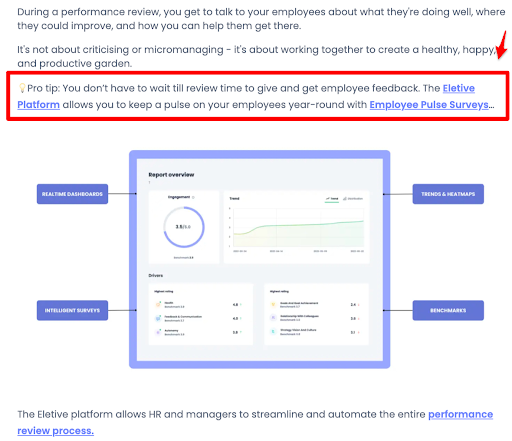
Highlight how you solve customer problems
Eletive sells employee engagement software. See how we’ve positioned their platform as a (solution) for infrequent performance reviews (problem)?
THAT is what we’re aiming for here.
Product led content isn’t just designed to drive organic traffic from search engines, though.
Most importantly it’s sales enablement.
By integrating your products seamlessly within informative and engaging pieces of content, you can showcase their value in real-world scenarios.
The goal behind creating product-led content is to drive user engagement, generate leads, and ultimately convert those leads into paying customers.
Product marketing vs content marketing
Traditional content marketing usually either sells, eductates or entertains, but rarely does all of those things at the same time.
In the past, most marketers started with sales pages that are entirely focused on the product’s features.
Then they move into creating content that’s interesting to their audience, but has little to do with the product.
Traditional content marketing is overly focused on developing topics that the biggest share your market will find interesting enough to click.
Let’s say you sell a voice based virtual english tutor for kids. Traditional content marketing topics could be…
-
“5 Essential Tips for Enhancing Your Child’s English Language Skills”
-
“The Importance of Early English Language Development in Children”
Granted this TOFU content can sometimes generate a ton of clicks. But those clicks are usually nothing more than a vanity metric.
Worse yet, these “upper funnel” topics often don’t have any relation to a problem that your product solves.
On the other hand product led content will generate traffic and pipeline. And done right it becomes an evergreen asset.
Key Components of Effective Product-Led Content
-
Educational Value: Your target audience should learn something new from every piece of product-led content you produce. Whether it’s an article about industry trends or a tutorial video demonstrating how to use one aspect of your software solution effectively – always aim to educate first.
-
Showcase Benefits: Clearly demonstrate how using your product will solve problems or improve outcomes for users by showcasing its key benefits throughout each piece.
-
User Stories & Case Studies: Share success stories from existing clients who have seen positive results after implementing your solution in their organization – this adds credibility and social proof that can help sway potential buyers towards choosing you over competitors.
-
Actionable Insights: Your readers should be able to take away actionable tips they can apply immediately after consuming the information provided within each piece – whether it’s through step-by-step guides or practical examples of best practices.
Product Marketing Content Types
We aren’t limited to blog posts. There are several content marketing types we can utilize…
-
Tutorials and How-to Guides: Teach users to use your product effectively.
-
Case Studies: Show real client success stories to build trust and highlight your product’s value.
-
Demos & Webinars: Interact with interested parties, showcasing your product in real-time.
-
Videos & Animated Explainers: Use visual media to quickly convey your product’s benefits.
-
Email Campaigns: Nurture leads with tailored content promoting specific aspects of your product.
-
Blog Posts & Articles: Establish thought leadership and improve SEO rankings.
Now, let’s now look at some live examples. So you can see product led content in action!
Product-Led Content Marketing Examples
Our client Quantic is an app-based MBA program developed by the team who created Rosetta Stone.
When the product went to market, their team was very excited to talk about their unique pedagogy.
They spent years building into the platform. And that became the main focus of their website and content.
Unfortunately, this isn’t the way to approach higher education content marketing. Their student prospects weren’t overly concerned with pedagogy. Some may have not even known the definition of “pedagogy”.. (it means learning methodology btw).
This is a classic example of “selling the shovel” not the hole.

Sell the Hole.. Not the Shovel.
The “hole” is the end goal. It’s what people really want. They don’t care about the shovel itself (pedagogy); they only care about the hole it can create (higher salary, better prospects, career advancement, etc.).
So, if you can sell the idea of the hole, you can tap into people’s deepest desires and emotions.
We did this by developing content “pillars” and “clusters”.
Each major pain point from the ICP represents a pillar. Clusters represent all the different ways the product can help solve each of those pain points.
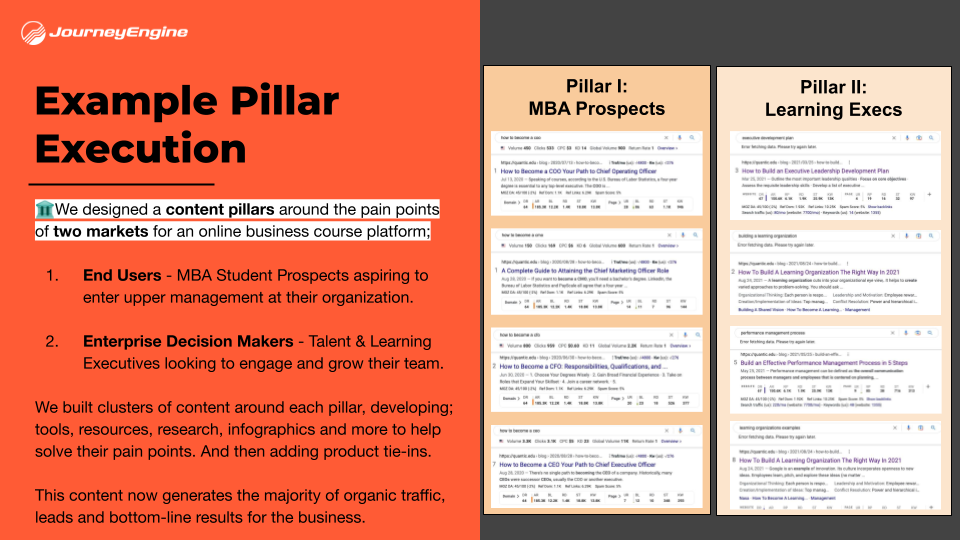
Design content pillars around your ICP (ideal customer profile)
Quantic.edu has two ICP’s;
-
MBA student prospects (end users)
-
Talent & Learning Executives (enterprise b2b decision makers)
The content we created for these ICP’s was slightly different
ICP #1 – MBA prospects
Their main pain point was their difficulty advancing into executive positions.
We created expert guides on how to enter the C Suite. Then we positioned the product (Quantic MBA) as the ideal solution by showing case studies of Quantic alumni who had achieved these titles after graduating from the program.
Position your product as the ideal solution
We wrote expert guides for enterprise learning execs on how to build an executive leadership development plan.
Then we “story-sold” Quantic as the ideal program for executive development, by strategically dropping case studies into the content.
“Story-sell” your Product
Want more detail on the exact process we used? You can read the full campaign case study below:
We increased this EdTech product’s revenue by 20X — through organic traffic!
✅ Page 1 Ranking on Target Keywords for all Content Pillars.
? 3X the Organic Site Traffic (Hockey-Stick Growth)
? PPC Value Upwards of $100K per Month (Ahrefs).
? 20X Increase in Conversion Value (per Google Analytics).
? 29X ROI for JourneyEngine’s Content + SEO Service.
Want to learn how we did it, step-by-step?
Another example of product led content from the HR Tech space is our client Workvivo.
We wrote an expert guide on how to do an internal communications Audit. Then embedded a webinar on how to use their product to do that.
You can see the full case study and results of that campaign here.
More Examples of Product-Led Content in Action:
1. HubSpot’s Inbound Marketing Certification Course
HubSpot’s Inbound Marketing Certification Course is a prime example of product-led content marketing. This free course not only educates users on inbound marketing techniques but also demonstrates the power and utility of HubSpot’s suite of tools throughout the learning process.
2. Canva Design School
The Canva Design School offers an extensive library of design tutorials, articles, and resources that teach users how to create visually stunning graphics using Canva’s platform. By providing valuable information and tips, they encourage users to explore their tool further.
3. Grammarly Blog & Browser Extension
Grammarly’s blog presents informative articles about grammar rules, writing tips, productivity hacks – all while subtly promoting its browser extension as a helpful solution for improving one’s writing skills.
4. Slack Tips Blog Posts
Slack shares tips on using its platform more effectively through blog posts that offer practical advice and demonstrate how specific features can enhance productivity for users.
Duolingo offers engaging stories designed to help language learners practice reading comprehension skills while showcasing the benefits of using their app regularly for learning new languages.
How To Create A Product-led SEO Content Strategy
We like to think of product-led content as advanced SEO.
The goal of Beginner/basic SEO is to generate the most possible organic traffic.
That process starts and ends in keyword research tools. The entire purpose of the campaign is to optimize keywords with the highest traffic potential. Often the product customer facing teams aren’t even involved in the process.
That’s backward.
The goal of Product-led content is to generate revenue pipeline from organic traffic.
It’s the future of content marketing.
You start with a deep understanding of customer pain points. Then develop different clusters of content that are around solving those pain points specifically. After you do that, you’ll validate those topics with the best possible keywords that are specifically related to those topics.
We will go into more detail on how to do that in this section. You can also discover our full process in the video below…
Step 1: Forecast the Desired Result and Set Goals
When you’re planning how to allocate marketing resources, starting with a forecast is a smart move.
You should be able to project the impact a campaign will have on your bottom-line over the short and long term.
That way you can know how much to spend.
Our agency developed a forecast process that uses data points from the competitors and the company’s analytics data to show them the size of their market, how much of it they should expect to capture with product-led content and the resulting revenue.
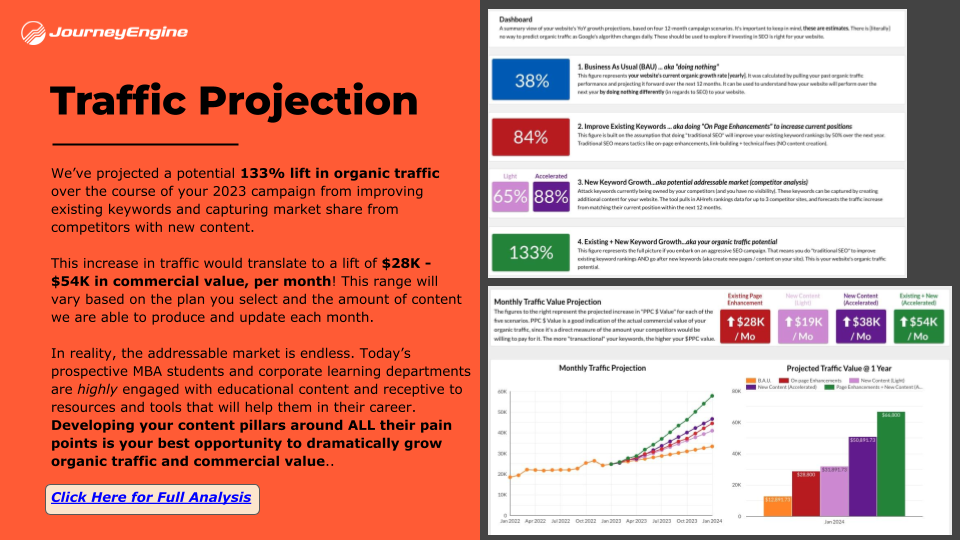
Want your own Product-Led ROI Forecast?
-
Learn what Product-Led content can do for your business
-
Discover the Biggest Opportunities for Your Website
-
Forecast Traffic and ROI from your Campaign
-
Sell-through Product-Led Content to your Team
We run that report for free for every prospect, before starting any campaign.
It qualifies the value of the campaign to us and for them.
We need to know that the campaign is going to be sustainable over the long haul, in order for it to be worthwhile for any of us.
Only move onto the next section once you’ve established product-led content will generate ROI for you.
Step 2: Identify your Prospect’s Pain Points
Nail down the biggest pain points for each ICP. That’s the goal here.
The best way to do that is by talking to the customers and getting information from them.
In the absence of being able to talk to the customers, the best way possible to get this information is to have a really good relationship with the following people…
-
The sales team: they’re talking to prospects every day. And know every objection
-
The support team: they’re dealing with the problems customers have every day
-
The success team: they know how your product helps customer overcome their problems
Form a really tight relationship with these people.
Get direct quotes from them about what the customers biggest problems are, and how the product can best solve those problems.
Step 3: Build Topic Clusters Around Your ICP’s Pain Points
Product-led content is designed to help prospects with pain points that can be solved by the product.
It’s not enough for the topic to just be something the audience is interested in.
Example: an internal communications software targeted to HR managers.
Bad content: ”The top 133 conferences in the USA for HR professionals” ❌
Good content: “How to do an internal communications audit” ✅
The first topic is relevant to that audience, and it would probably drive lots of traffic. But it’s not really a product-led topic, because it doesn’t have much to do with what the product solves.
In a product-led strategy, every topic should always:
-
Directly drive demand for the product
-
Double as sales enablement
If your sales team wouldn’t want to show it to a prospect, it’s probably not a topic we’d consider for the product-led strategy.
How does product-led content impact the customer journey, and what role does it play in the sales funnel?
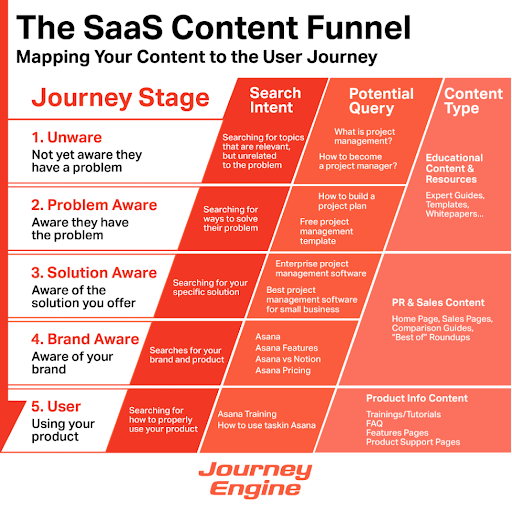
Map Your Content to the User Journey
You can look at at the customer journey as the various stages of awareness;
1. Unaware: Not aware they have a problem
2. Problem Aware: know their problem and looking to fix it
Content Tactic: Develop educational content to help solve their problem and introduce your product as a critical part of the solution.
3. Solution Aware: looking for a product like yours to solve their problem
Content Tactic: Create program, features and benefits pages detailing exactly how your product will solve their problem.
4. Product Aware: know about your product and evaluating it against others
Content Tactic: Create stories of existing customers and use cases of others who have solved the same problem.
For the internal communications software example, you could create a 10 topic cluster around Internal communications audits.
The goal is to find what people are searching for in each of the awareness stages and develop content for them.
Aim for a range of “content types”, ranging from blog posts to white papers.
Selecting the right mix of content types depends on what your goals are, and what content your site is currently lacking.
For example, if we’re going to publish 5 blog posts on internal communications software, then it makes sense to also create/publish a case study that you can embed in each of those blog posts to show authority.
And another piece of gated content so you can drive leads.
Everything words together.
Keyword research is part of the process, but it’s secondary.
You use keyword research to optimize these topic clusters, through the lens of finding queries that can be tied to problems your product solves.
?Pro tip: we’ve actually even seen zero volume keywords sometimes generate the most bottom-line value for businesses. So take the information from your SEO tools with a grain of salt.
Once you have your list of 10 topics you can move onto creating/publishing that content on your site.
Step 4: Create Content Using Your Team’s Original Perspectives
The teams with the pulse on customers are the sales, success, and support teams.
You used them in step two to tease out pain points. That helped inform your topic selection.
Now you’re going to use them again when writing the content. Why?
They possess valuable knowledge about real pain points and customer needs.
So as long as your content team can interface with these stakeholders?
It’s literally impossible to create “flat” content.
Your writers will be tapping into information that’ll help them create content that genuinely helps and engages their target audience.
Doing things this way ensures your product-led content is both informative and engaging.
Furthermore, your content is more likely to rank on Google.
Google’s latest update is entirely focused on “EEAT” – Experience, Expertise, Authoritativeness and Trust. They want to rank content that’s based on original perspectives of people within your organization. That’s perfect for the product-led approach, since your process starts with your team’s perspectives.
By sharing content that provides exceptional value for free, you can establish yourself as trusted authority in your industry.
Tips for Creating Valuable, Product-Led Content
-
Showcase real-life applications: Demonstrate how your product can be used in various scenarios or industries by sharing case studies or customer testimonials.
-
Create educational content: Offer value through guides, webinars, or courses that help customers learn more about your industry while highlighting your product’s features and benefits.
-
Utilize social proof: Share success stories from satisfied customers to build trust and credibility with potential users.
-
Incorporate interactive elements: Use quizzes, polls, or surveys to engage your audience while subtly promoting your product as a solution for their needs.
-
Create Clear Calls-to-Action (CTAs): Include clear CTAs in strategic locations throughout your blog posts, articles, and other pieces of content. These could be buttons or text links encouraging readers to sign up for a free trial, download an eBook or whitepaper related to the topic at hand or even schedule a demo.
Step 5: Use Your Product-Led Content to Generate Leads
There are a few different perspectives on generating leads with content.
Some businesses prefer not to use an explicit “device” for lead generation. They leave all of their content “un-gated” and never explicitly ask for contact info within the content other than a CTA to schedule a demo.
This feels more natural and isn’t pushy as other tactics, but you won’t generate THAT many MQL’s.
⭐ We recommend using gated content in the form of content upgrades like downloadable PDFs, guides, whitepapers and courses. Once a lead signs up they become an MQL. We then nurture those MQL’s into demos with a follow-up email sequence.
A good example of this is Ramp (fastest growth in SaaS in history). They use a public interactive product demo (and “explore product” as their CTA).
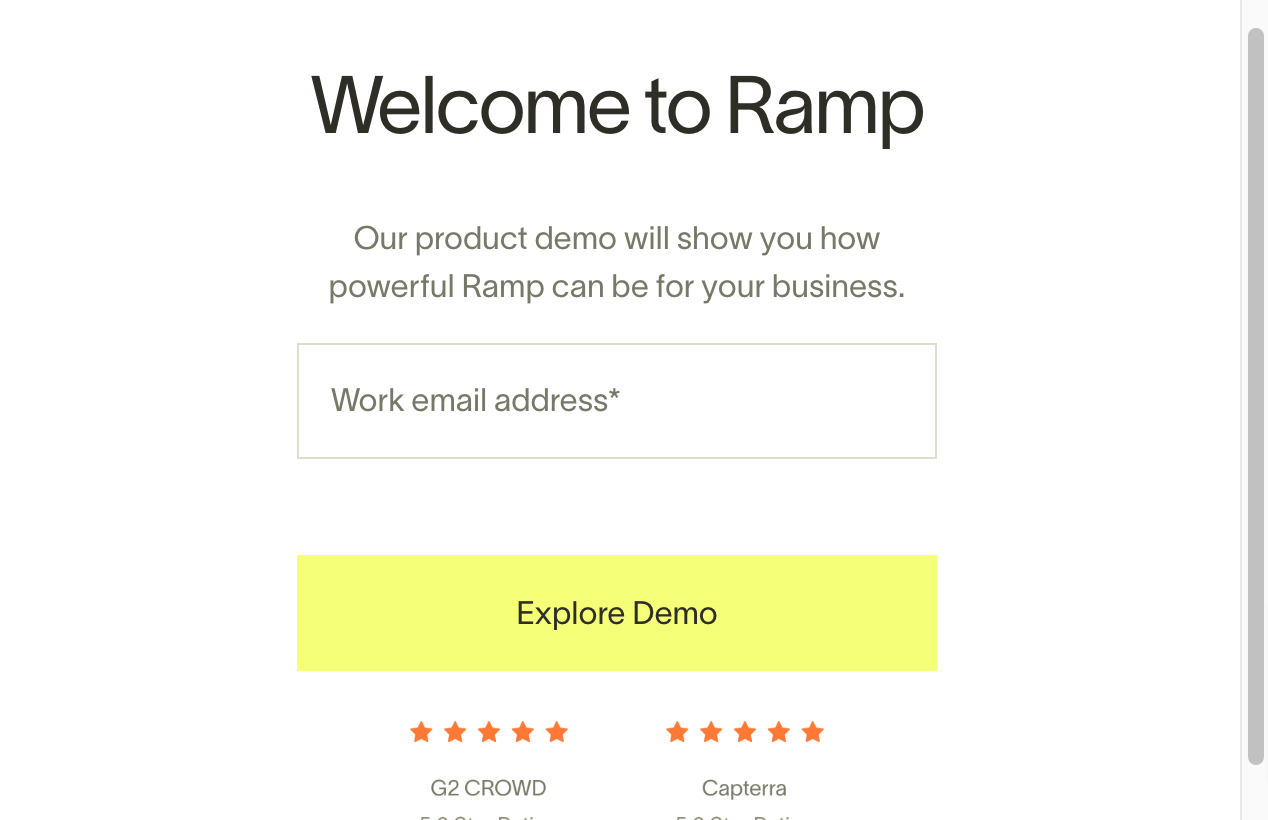
Use interactive product demos to generate leads
Ramp used a public, interactive demo to grow faster than any product in SaaS history!
Another powerful and emerging method to generate leads is with an interactive demo. That lets your market self-test the product.
You can use a solution like navattic.com or Walnut.io to implement these.
Step 6: Measure Campaign ROI
It’s time to make it rain!
If you’ve implemented everything in this guide so far, you’ll be putting out content that is better than 99.9% of what’s out there.
Now you need to track the result of your efforts…
At the base level you want to be able to track the traffic, leads and projected lifetime revenue of each piece of content you publish.
Doing this properly requires marrying your site analytics and CRM data.
You’ll need to compare that value against all the associated marketing spend to get your final ROI.
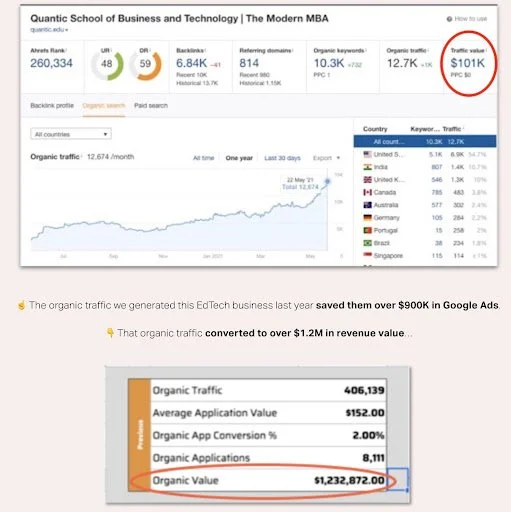
“Track the traffic, leads and lifetime revenue of each piece of content you publish.”
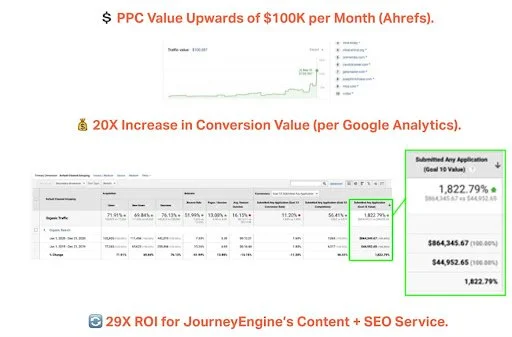
Marry your site analytics and CRM data to calculate conversion value.
Compare that value against marketing spend to get your final ROMS (Return on Marketing Spend).
If you’re evaluating a vendor or employee, things are a little more difficult. But I’d also recommend factoring in “return on process”.
Have they built a program into your business process that you own?
Can you use it to develop, test and improve your content forever?
Does it improve efficiencies, reduce and eliminate other internal costs over time?
If so, then you should certainly consider hiring them.
At Journey Engine we aim to give you a high ROI and return on process. If you’d like to “try before you buy” you can schedule your free traffic projection here.
It’s your first step towards working with us 🙂
Conclusion
Product-led content is a powerful strategy that helps businesses stand out online, attract customers, and achieve results.
It goes beyond traditional marketing by addressing customer pain points and showcasing how your product solves them. This type of content educates, engages, and converts leads into customers.
To build a product-led SEO content strategy, you need to understand customer pain points, create relevant topic clusters, and engage your sales, support, and success teams.
Hopefully this guide will help you do that successfully.
But we’re happy to provide assistance if needed. Simply email justin@journeyengine.com. Make the subject line “traffic projection”.
Want Your Own Product-Led Content Strategy and ROI Forecast?
-
Learn what Product-Led content can do for your business
-
Discover the Biggest Opportunities for Your Website
-
Forecast Traffic and ROI from your Campaign
-
Sell-through Product-Led Content to your Team
FAQ
1. What is a product-led strategy?
A product-led strategy refers to an approach where businesses prioritize their products as the main growth driver. By delivering exceptional user experiences, offering self-service options, and using data-driven insights for improvement, companies can acquire new customers organically and foster long-term loyalty.
2. What does it mean to be product-led?
“Product-led” describes an organizational mindset where the focus lies on developing high-quality products that deliver value to users. In this model, customer satisfaction takes precedence over aggressive sales tactics; thus allowing word-of-mouth referrals and organic growth to drive business success.
3. What is product content?
Product content encompasses all types of information related to a specific item or service offered by a company. It includes descriptions, specifications, images, videos, tutorials, or any other material aimed at educating consumers about its features and benefits in order to facilitate informed purchasing decisions.
At Journey Engine, we believe that product-led content is essential for businesses looking to succeed in today’s market. By creating content that is centered around your products and services, you can educate potential customers, build trust, and ultimately drive conversions. To learn more about how we can help you create effective product-led content, contact us today.
Where do you see product led content going in the age of AI?
Product-led content is the only model for the age of AI.
AI can now generate good quality curated content pieces, instantaneously.
At the same time Google has increased their focus on “experience and expertise” in determining the quality of your content. Essentially, they want to know that the perspectives in your content are generated from people within your business.
If you’re not basing your content on inputs and original thought from your team then it’s going to be very difficult to compete with companies who are. You’re competitors can instantaneously duplicate that level of content.
AI can help you fill in the blanks, but unless you’re driving it with your own originality the product is always going to be boring and banal.
If possible, I recommend interviewing members of your customer-facing teams about how your product solves critical pain points. You can repurpose their original perspectives into written word – this makes for quality, original perspectives and content that’s impossible for your competitors to duplicate.
If you’re fed up with long sales cycles, ignored outreach, and deals that stall inside buying committees… Here’s the District Sales Narrative™ that’s helping EdTech companies land $50K–$500K+ district contracts, by getting buy-in before the first sales call ever happens.
This is the Approach Behind Thousands of District EdTech Contracts
I’m about to walk you through the same framework we use to help early-stage EdTech businesses like SLPNow, which surpassed 1,000 district contracts last year:

We call it the District Sales Narrative™.
It’s a content-driven system that does the selling before anyone from your team ever gets on a call.
One core asset. One unified message.
Designed to move a district buying committee from “who are you?” to “we need to talk” — on their timeline, not yours.
It works because it was built for the only sale that matters in EdTech:
The consensus sale.
Let me show you why most EdTech go-to-market motions fail to create it… and what replaces them.
The Pain of Selling to School Districts in 2026
For EdTech founders today, the emotional toll of selling to districts is real.
With budget uncertainty, political noise, and 5,000+ AI written cold messages hitting the average district decision-maker per semester, getting to the consensus you need to get your product adopted is harder to earn than ever.
You built something that genuinely improves student outcomes.
You’ve seen it work in classrooms firsthand.
Teachers and users love it..
But getting a district to actually buy feels like pushing a boulder uphill; through budget cycles, committee reviews, political noise, and radio silence.
The District Sales Narrative™ exists to help you stop chasing and start attracting.
It’s a unified message that does the pre-selling for you.
So when a district finally gets on a call, they’re already to a mental “yes”.
We’ve been building inbound pipeline for EdTech companies since 2017:


With this system, We’ve seen EdTech businesses get:
✔️ 1,000+ district contracts using a single content framework applied across organic search and paid social.
✔️ 282 demos in weeks at a $16.50 cost per demo with a 24% page-to-demo conversion rate.
✔️ 1,000+ applications from ChatGPT alone for a $9K program by ranking in search results without content calendars or lead magnets.
✔️ 3X more free trials and improved trial-to-paid conversion by 23% from a single educational sales asset.


Not because of more creepy cold outreach.
Not because of attending more trade shows.
Not because more teachers were selling on their behalf.
It was all because they created one, unified narrative.
Content intellectual property, built around;
- A named enemy districts can rally against
- A unique framework to get the outcome they want
- Actual educator stories with proof of district-level outcomes.
The narrative will educate and pre-sell your district prospects before the first conversation ever happens.
This SAME system works whether you are:
✔️ Selling K–12 curriculum to schools and district offices
✔️ Marketing EdTech SaaS products to Directors of IT and Instruction
✔️ Selling SPED software to Special Education Directors
✔️ Building SEL programs to Student Services Directors
✔️ MTSS platforms for Directors of Outcomes and Intervention
✔️ Assessment or data tools for Directors of Accountability and Research
Or any other solution that makes K12 district administrators, school staff and students’ lives easier or better.

Heads Up: This Won’t Work for Every EdTech Company…
The District Sales Narrative™ approach only works if:
- You sell a purpose-built EdTech product to school districts (K–12)
- You already have district implementations — not just a pilot or two
- You have happy clients with real district-level outcomes you can point to
- You understand who your buyer is at the district level — their title, their role in the buying committee
- You’re willing to invest at least $3K/mo in distributing the narrative — across paid, organic, events, or a combination
This is NOT for you if:
- You’re pre-revenue or have no district traction yet
- Your go-to-market is purely consumer or teacher-direct with no district sales motion
- You’re looking for a quick hack — this is a systematic, long-term approach
- You don’t have outcomes data or advocates willing to go on record
Not there yet? Focus on landing your first 5–10 district pilots and collecting outcomes data from each one. Get at least a few advocates on record.
This page will still be here when you’re ready.
Now, if you do have a product with district wins (or at least pilot results you can replicate)… and at least a small budget to get the story out there… then pay close attention to every word below.
The District Sales Narrative™ Solves 3 Problems for Companies That Sell to Schools
Problem 1: “We can’t break through the noise to get district’s attention”
Is your team sending cold emails to district admins and getting silence? Or running ads that get ignored alongside thousands of other vendors?
The Problem: The average district decision-maker receives upwards of 5,000 cold marketing messages per semester. Your outreach isn’t bad.. it’s invisible.
The Solution: A District Sales Narrative™ built around outcomes and peer proof that earns the click — because it looks like something compelling enough to read, not another vendor pitch.
Problem 2: “Educators see our content but still don’t become leads”
They’re clicking through.. landing on your pages.. Maybe even reading them. But nothing happens. No demo request, no reply, no next step.
The Problem: Your content reads like tech marketing. Educators can smell it. They want outcomes, peer stories, and proof — not feature lists and technical jargon.
The Solution: The District Sales Narrative™ leads with district advocates and real outcomes instead of product pitches — so the content passes the sniff test and actually creates demand.
Problem 3: “Our deals stall inside the buying committee”
You get initial interest from one stakeholder, only to watch the deal die when it hits IT, budget review, or a superintendent too distracted by school board politics to engage.
The Problem: District purchasing is a consensus sale. If your content only speaks to one title, you’ll never move the full committee.
The Solution: One District Sales Narrative™ that addresses every stakeholder’s concerns — outcomes for curriculum leads, compliance for IT, implementation feasibility for administrators — in a single shareable asset.
Marketing to Schools: Old Way vs New Way

How to Sell to School Districts: The District Sales Narrative™ System Step-by-Step
This isn’t just a blog article. It’s not a one-off landing page.
It’s a go-to-market content system built around one unified narrative that runs through everything your EdTech business does.
Here’s how it works:
Step 1: Craft Your District Sales Narrative™ (Content IP)

Before you write a word of copy, you need two things locked in:
A. Name The Enemy (Old Way).
This is not your competitor.. It’s a broken model.
A legacy or alternative approach that’s costing districts the outcomes they care about.
Why this matters: without a named enemy, district admins default to blaming themselves. “Maybe we’re not implementing well enough.” “Maybe we need more PD.”
The result is paralysis.
Name the real enemy and you give them something to rally around instead. You shift blame off their shoulders and onto a system that wasn’t built for the outcomes they’re being held accountable for.
B. Show Your Mechanism (New Way).
Your unique framework for fixing what the enemy broke. Step-by-step, in language a curriculum director would use — not a product manager.
Example: MEandMine, a gamified MTSS platform selling to school districts can name their enemy “crisis-reactive therapy” — a model where schools only address student mental health after something goes wrong.
Their mechanism is the “Early Risk Detection”: a proactive framework that builds emotional awareness before a crisis hits. Every district admin knows the reactive model is broken. Now they have a name for it, and a better way.

Together, that’s your Content IP. The enemy + mechanism pairing becomes the through-line for everything; your core asset, your ads, your founder’s LinkedIn, your sales deck, your conference talks. It’s what your founder builds their brand on.
Not features. The enemy and the fix. That’s what the market rallies around.
 |
“You get to a mental ‘yes’ when your fear of not adopting becomes greater than your fear of, I’m gonna screw up if I do adopt this.”
Jennifer Levanduski, Co-Founder @ The Rising Tide Partners
|
Step 2: Build Your District Sales Letter (Long-Form)

This is the anchor. A single long-form direct-response asset that takes a district decision-maker from “I have no idea who you are” to “I need to get my team on a call with these people” — in one read.
It does four things:
A. Makes district users the heroes.
Their testimonials, their data, their stories — front and center. Video when possible. District buyers trust peers, not vendors.
“These are educators, they have a very high ‘sniff-o-meter’ about things. And if you are trying to produce standard SaaS blog content, they’re going to sniff through it.”
– Jennifer Levanduski, Co-Founder @ The Rising Tide Partners

B. Names the enemy everyone can rally against.
Remember, you’re not criticizing the reader, you’re validating their frustration with a system that’s failing them.
C. Shows proof of the desired district outcome — visually.
Use data a district admin can absorb in 30 seconds. Before/after comparisons with data specific to districts like theirs works best.
Levered Learning packaged their district-level state test data into a simple visual showing their classrooms outperforming state and district averages, then built a guarantee around it:

 |
“We’re actually guaranteeing that if your teachers meet our basic implementation benchmarks, your raw scale score growth on the state test will be at least 15% higher than the state average. If it doesn’t, we’ll keep working with you for free until it does.”
Mitch Slater, Co-Founder @ Levered Learning
|
That’s the kind of proof + objection handling that moves a district buying committee.
And you can take this further with primary research.
MEandMine partnered with Stanford to run an efficacy study on their SEL framework, giving them peer-reviewed proof that no competitor could replicate.

Gamified Self-Regulation and AI Risk Detection in Student Mental Health: Pilot Study Results (April 21, 2025). Available at SSRN
Jennifer’s team at Kiddom surveyed 1,300+ educators and published a “State of Curriculum” report that generated two years of content and instant credibility.

*Sample result from the Kiddom Annual State of Curriculum Report
And it’s even better if you can personalize those results for individual districts and create “fomo” (fear of missing out).
|
“Of the 60 school districts in Iowa, 30 of them are already doing [Y] and you’re not one of them — all right, I’ll take the call because I want to understand what’s going on.”
Jennifer Levanduski, Co-Founder @ The Rising Tide Partners
|
D. Reveals your unique framework for getting the desired outcome.
Your mechanism — explained simply, step-by-step. Paired with implementation reassurance so they know you’ve thought through the calendar, the training, the IT concerns — all of it.
This is where the reader thinks: “Of course this is how it should work.”

Step 3: Distribute It Everywhere (Short-Form + Sales Alignment)
The core asset is the destination. But it’s not where most people encounter your message first.
Your Content IP gets broken into mini-narratives — smaller pieces that each touch on a different pain point or angle — distributed across every channel that reaches district decision-makers. And your sales team uses the same language.

Founder/executive content: Your CEO talks publicly about the enemy and mechanism. Interviews, LinkedIn posts, conference talks — all reinforcing the same belief shift. This isn’t thought leadership for vanity. It’s demand creation with a destination.
Paid social: Short, high-curiosity ads on Meta and LinkedIn promoting the core asset to specific district titles.
Short-form content: YouTube clips, podcast excerpts, social proof snippets — all derived from the core narrative, all linking back to it.
Conferences + regional shows: The narrative becomes your pre-show and post-show asset.
Direct mail: A well-placed postcard or mailer driving to the core asset cuts through digital noise in a way cold email never will.
ABM sequences: Personalized outreach that references specific cohort data, paired with mini-narratives.
Organic / AI search: The core asset becomes what AI search surfaces when a district leader searches for solutions in your category.
Sales collateral and pitch decks use the same enemy, mechanism, and proof structure. When a prospect moves from reading the narrative to talking to a rep, there’s zero dissonance.
Sales reps are trained on the Content IP. Discovery calls, demos, and follow-ups all pick up where the narrative left off.
The result: a district decision-maker encounters the same coherent story whether they’re reading your content, talking to your rep, or hearing your CEO at ISTE.
One narrative. Every surface. That’s the system.
Why This Approach Works for Marketing to School Districts
District decision-makers want proof, not pitches. You’re showing them how similar districts improved outcomes — through the voices of the educators who actually used it. Not features. Not jargon. Evidence. And educators respect evidence above everything.
The consensus problem gets solved before the call. The core narrative addresses every stakeholder’s concerns in one shareable asset. When one director sends it to another, the pre-selling continues without your team in the room.
Mitch Slater, CEO of Levered Learning and a 20-year classroom veteran turned EdTech founder, learned this the hard way:
|
“A lot of times we were trying to sell when we should have been trying to educate. Instead, get people interested and understanding what you do so that when they do see you at a conference, they have context. You’re much more likely to convert those one-on-one conversations when they understand who you are.”
Mitch Slater, Co-Founder @ Levered Learning
|
That’s what your District Sales Narrative is built to do:
- Create context
- Build consensus
- Make the next conversation an easy, natural sell
Hear From an EdTech VP Who’s Been Through It
Anita Horsley, VP of Product Management at Connect 4 Education, came to JourneyEngine with a challenge most EdTech companies know well. A great product, a small team, and an online presence that wasn’t pulling its weight.
 |
“Journeyengine has been literally the best vendor I’ve worked with. They do what they say they’re going to do, when they say they’re going to do it. A lot of people can exude confidence in what they do.. but they actually can do it.”
Anita Horsley, VP of Product Management @ Connect 4 Education
|
Selling Education Products Comes Down to One Thing: Consensus Before the Call
Districts are buying. They’re just buying differently.
They’re buying from companies who feel safe, who have proof, who understand the calendar, and who make the cost of inaction feel worse than the risk of adoption.
The District Sales Narrative™ is one system.
Designed to win consensus.
That does all of this before your team ever gets on a call.
DISCLAIMER: The results shared on this page came from EdTech and SaaS companies with validated, proven products and some existing district demand. Results vary based on product-market fit, offer strength, and distribution budget. Our clients see measurable improvement within 60–90 days of deploying their District Sales Narrative™ with controlled traffic, then scale from there.
Now, You Have Two Options:
If you’d like to start landing more district contracts with content that actually creates consensus and pipeline, here’s what you can do:
Option 1: Do It Yourself
Take the step-by-step framework on this page and build your own District Sales Narrative™.
I’ve laid out everything here: the credibility stack, the enemy naming, the mechanism, the proof stacking, the implementation reassurance. It’s all teachable.
Direct-response copywriting applied to K12 District buying psychology isn’t a secret. It’s just a discipline.
Option 2: Let Us Build and Test It For You
Work with our team 1-on-1 to get your District Sales Narrative™ built, deployed, and validated. So you can see real results before committing to scale.
Together, we will:
- Develop your Content IP — name the enemy and define your mechanism
- Write your long-form District Sales Letter
- Build the proof stack — district outcomes, advocate stories, data visuals
- Create short-form mini-narratives for paid, organic, and ABM distribution (depending on your promo budget)
- Align your sales collateral and talk tracks to match the narrative
- Route controlled traffic and measure what converts
Test-Drive Your District Sales Narrative™ Risk-Free
Don’t just take our word for it. See for yourself how this performs first.
Step one is a short discovery call to confirm this test makes sense for you.
[Book Your District Sales Narrative™ Blueprint Call →]
If it’s a good fit, we’ll build your core District Sales Narrative™ asset, align your Content IP across channels, and route controlled traffic to it. Here’s what we’ll cover on the call:
Competitive Pattern Break
We’ll map how your direct competitors position and distribute their offers across search and social. Then identify how your sales letter’s hook can break that pattern to win your ideal customer’s attention.
Outcome: Leave knowing exactly how to zig where others zag.
Offer Pressure Test
We’ll break down (in the best way possible) the offers and pages you’re currently using to drive trials or demos, and diagnose their ability to persuade readers your product is the obvious choice.
Outcome: Get clarity on what’s working and what’s leaking now.
Initial Sales Letter Angles
We’ll run through 2–3 concrete sales letter angles worth testing — including the belief shifts, hooks, and objections each one is designed to handle.
Outcome: Confidence in where this is headed and the logic behind it.
Is This Test Worth Running?
We’ll give you a grounded view of what this test could realistically unlock over the next 60–90 days — and whether it’s worth testing now.
Outcome: Know whether this is worth testing, based on unit economics.
Ready to see if your product is a fit?
No pitch deck. No pressure. Just a strategic conversation about whether this system makes sense for your product and your pipeline.
JourneyEngine builds High-Intent Inbound systems for SaaS and EdTech companies. We’ve helped companies scale from early traction to $220M+ ARR using direct-response content that creates pipeline — not just traffic.
How does your site stack up against 860 top competitors?
How are your HR Tech SEO and Content Marketing campaigns performing?
You may already know that it can be daunting to answer that questions.. but not anymore!
We analyzed 860 HR Tech websites, in depth. And used over 4,250 data points to build you a free benchmarking tool.
By the end of this article you’ll know:
-
How your site’s SEO stacks up against the other 860 HR tech websites (you can filter down into companies you’re on a level playing field with)
-
Specific actions you can take to boost your rankings
If you’re a HR Tech Founder or Marketer strap in. You’re going to get an incredible amount of value from this. There’s no resource like it on the internet.
I’m going to show you how to use the tool in this article. But the video version is below if you prefer that…
How We Created The Tool
We analyzed 860 HR tech websites. Here’s what we looked at…
-
Employee headcount (LinkedIn)
-
Company funding (Crunchbase)
-
Domain rating (Ahrefs)
-
Organic traffic (Ahrefs)
Employee headcount and company funding are pretty self explanatory.
The metrics related to your SEO efforts are domain rating and organic traffic.
Here’s what they mean…
Domain rating definition
Your site’s potential to rank for competitive keywords.
It’s a scale from one to 100, and the higher you are on that scale, the more power you have to rank in search engines.
A website with 0 DR will NOT rank for anything.
A website with 100 DR will rank page 1 for the most competitive keywords. Every piece of content is a surefire “win” right out the gate.
Organic Traffic definition
Your non-paid traffic from search engines every month.
It’s essentially the “free traffic” Google sends to your site.
Splitting The Data
We split the domain rating and organic traffic metrics into quartiles.
Domain rating quartiles
-
Zero – 14
-
15 – 35
-
36 – 57
-
Over 57
Organic traffic quartiles (monthly organic sessions)
-
Zero
-
1 – 375
-
376 – 7,600
-
Over 7,600
This gave us an even distribution for the entire 860 website data set.
You can benchmark based on any metric. But we believe you’ll get the most value from this if you benchmark based on your domain rating.
Why?
You can see whether you’re leveraging your domain “juice” (DR) into traffic effectively.
It stands to reason that websites with a high domain rating should have high organic traffic.
Our tool will quickly show you if you are underperforming or overperforming vs your competition.
This will help you understand which content and promotional strategies will be most suitable.
Now let’s look at 4 examples:
-
Low DR
-
Low/Medium DR
-
Medium/High DR
-
High DR
Before we begin you need to find your company’s domain rating.
Type the name of your company into the search bar.

For example: lever.co.
If you did that, you’d see that lever.co has a domain rating of 90.
Once you know your DR, you can skip to the section that is most applicable to you.
Example 1 (Low DR: 0 – 14)
The majority of these companies have no funding or very little funding. And for the most part they have between one and 10 employee headcounts.

But here’s the most interesting part…
64% (139) of the websites we’ve analyzed have absolutely no organic traffic at this level.
76 sites have between one and 375 organic sessions
4 websites have somewhere between 376 and 7,600 organic sessions per month
Companies at the bottom of this scale will have to use a different marketing strategy to those at the top.
For example, let’s say your company has 7,600 organic sessions.
Congratulations! That is really impressive.
That means you have almost no websites linking to your site. But you’re still able to drive a chunk of traffic.
In my best estimate that means you have a lot of brand awareness i.e. there are a lot of people searching for your brand name. Because at this level, you’re not going to get very much traction with content in organic search.
Recommendation:
If you’re at the bottom of the organic traffic scale: Use a Digital PR campaign to raise awareness and authority. With a higher DR score you’ll be able to better compete for organic traffic, leads and revenue in this space.
If you’re at the top of the organic traffic scale: You should start publishing long form blog posts. So you can start ranking for non-brand keywords as well.
Example 2 (Low / Medium Domain Rating: 15 – 35)
The majority of sites (95.3%) have between one and 7,600 sessions.
Your company should have at least the median organic traffic of 86.5.
But ideally I’d want to be in this space. Between 376 and 7,600 sessions per month…

There’s A LOT of room for improvement if you have 0 or under 375 organic sessions per month.
But even if you have under 7,600, there’s still room to improve and get to a more elite level.
Recommendation:
Take a look at the better performers in your quartile.
Plug them into the SEO software of your choice.
Try to pick apart their content strategy.
Example 3 (Medium / High Domain Rating: 36 – 57)
The median level of traffic for this group is 1,500 organic sessions.
But interestingly most (70%) of websites have between 376 and 7,600 plus sessions per month.
So you definitely want to have between 1,500 and 7,600 organic sessions.
At this level, your website has probably been around for about a year. You can see the majority of these companies are funded and also have a high headcount.

Recommendation:
For websites below 1,500 organic sessions: Revisit your content strategy. You are probably making a fatal error in regards to the type of content you’re putting out.
For websites above 1,500 organic sessions: Some of the elite sites in our dataset are probably still outcompeting you. A few adjustments will help you decrease the gap and edge-out those top competitors. For example, increasing your time on page or utilizing video more.
Example 4 (High Domain Rating: Over 57)
At this point the majority of companies are well funded. And have a higher company headcount.
At this level, you should be getting at least 7,600 sessions per month.
But ideally you’re getting more than 34k organic sessions per month.

Recommendation:
For websites below 7,600 organic sessions: Revisit your content strategy. You are probably making a fatal error in regards to the type of content you’re putting out.
For websites with 7,600 – 34,000 organic sessions: Publish content more frequently. Accelerate your content calendar. So you can start climbing the rankings faster.
For websites that are getting more than 34k sessions per month:
Focus on 5-10 websites that are getting more organic traffic than you (especially from non-brand keywords)
Use the top pages feature on AHrefs
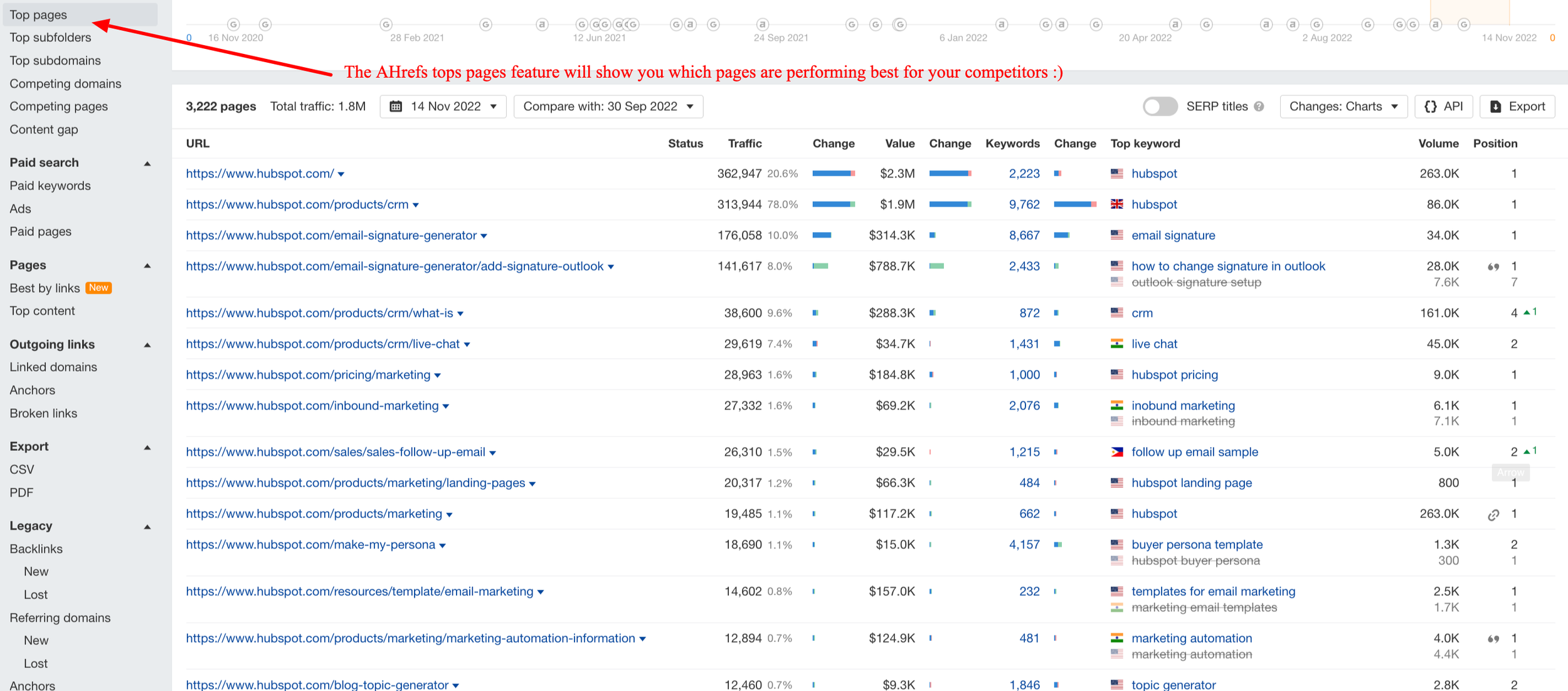
Pick out 5-10 of their top performing content pieces (that you haven’t published articles on already i.e. content gaps)
Create a competing content piece. But make it better so it has a higher chance of ranking first!
You Can Benchmark Based On Any Metric!
Now you’ve seen 4 examples of how you can benchmark based on domain rating.
But you can also benchmark based on these other variables:
-
Organic traffic
-
Headcount
-
Company funding
For example, if you’re getting 1- 375 organic sessions per month, you can see roughly what your domain rating should be.
If your domain rating is lower than the average for this group, then it’s possible that you should be promoting your website differently. For example by taking a different approach to link building.
To filter by company headcount or funding you need to use the sliding scales.
For example, there are 62 websites with 2.8 – 27 million dollars in funding.
You can also filter for a headcount. For example 11 to 50. That gives us 30 websites that are similar to yours based on this variable.
Anytime you’d like to reset just press the reset button in the top right hand corner of the tool.
Special Offer – Free Organic Traffic Projection
Our dashboard is great for getting a top level look at roughly where your organic traffic should be.
But it’s certainly not the be-all-end-all in terms of benchmarking.
At JourneyEngine we help HR Tech companies land more customers from organic traffic.
I want to prove that to you, in just a few minutes.
Our engineering team built a tool that accurately forecasts the results of an SEO campaign (before you spend any money or time on it).
I filmed a quick video running through it
I’d love to run this analysis on your website, free of charge.
However, the tool can’t function without a few data inputs which I’d need to get from you.
To take me up on this offer send an email to justin@journeyengine.com. Make the subject line “I want a free traffic projection”.
We will promptly reply with next steps.