
In SaaS, the user’s early experience is mission-critical.
It sets the tone for how users perceive your product—and whether they’ll stick around long enough to love it.
That’s where “product-led onboarding” comes in. It’s about guiding users to value—fast.
According to Ramli John, author of multiple popular books on the topic including; Product-Led Onboarding and most recently EUREKA: The Product Onboarding Playbook for B2B Companies, great onboarding feels more like a helpful friend than a product tour. It’s personalized. It’s purposeful. And it starts before users even sign up..
Instead of treating onboarding as a post-signup checklist, Ramli encourages us to “zoom out”. Every touchpoint—your landing page, your emails, even your ads—shapes a user’s expectations.
If there’s a gap between what they expect and what they experience, that’s friction. And friction kills momentum.
In this guide, you’ll learn the basics of creating a product-led onboarding experience that gets users to value faster, reduces churn, and turns first-time users into loyal champions—using proven strategies from onboarding expert Ramli John.
Let’s dig in!
Understanding the SaaS Onboarding Journey
Before you can improve your onboarding, you’ve got to understand what it actually looks like from your user’s perspective.
Because the B2B SaaS onboarding journey isn’t just a single moment—it’s a series of touch-points that guide someone from curious visitor to confident, active user.
According to Ramli John, onboarding doesn’t start after someone signs up. It begins the moment they first hear about your product. Whether it’s an ad, a tweet, or your homepage, each message builds expectations. And when those expectations don’t match what users see once they’re inside the product, you’ve got what Ramli calls “hidden friction.”
“People typically think of onboarding as something that happens after a user has signed up for the product. But there are actually different stages of onboarding. One of those stages is getting people onboarded to the idea that your product is good enough for them to sign up. And that happens before the product—when they’re looking through your materials, they’ve seen your ad. That first touchpoint is when they’re forming an opinion about what your product can do and how it can help them.”
– Ramli John, Author, Founder @ Delight Path

Now that we’ve mapped the journey, let’s talk about how to make each step actually work. Product-led onboarding isn’t about showing off every shiny feature. It’s about helping users do the thing—you know, the reason they signed up in the first place.
Ramli John says it best: onboarding should feel like a helpful friend, not a sales demo. And if there’s one golden rule in product-led onboarding, it’s this—help users do the thing, fast.
Here are a few best practices to help you pull that off:
1. Get to the “Aha Moment” Quickly
What’s the thing your user came to do? Upload a file? Book a meeting? Invite their team? Pinpoint that first meaningful action and build your onboarding flow around it. This is their “aha” moment—and it’s your north star.
2. Personalize the Journey
Just like not every CrossFit newbie wants to enter a competition, not every SaaS user wants the same outcome. Ask a few quick questions up front so you can guide them to their version of the thing.
3. Cut the Hidden Friction
If your website promises one thing and your product delivers another, that’s a recipe for churn. Keep your messaging, onboarding flow, and in-product experience aligned—so users don’t get whiplash before they even find the thing.
4. Help, But Don’t Hover
Nobody wants a pop-up party. Offer help in context—whether that’s a quick tooltip, checklist, or “need help?” button. Make it easy to get unstuck, without slowing down their path to the thing.
5. Measure “the Thing”
This is where it all comes together. Who’s doing the thing? Who’s falling off before they get there? Watch recordings, track completions, and talk to users. As Ramli puts it:
“If people can just take away one thing from this episode… it’s understanding your users, what is their goal, and then getting them there as quickly as possible. Rather than, ‘here’s all of our buttons and features and bells and whistles’—like, cool.. but that’s not very helpful. I came here to file my taxes, or I came here to manage my projects—help me do that thing so I can be like, okay, I get it. This is why this makes sense.”
– Ramli John, Author of Product-Led Onboarding
Creating an Effective Onboarding User Flow
Alright, we know we’ve got to help users do the thing—but how do we actually guide them there? This is where your user flow comes into play. It’s the behind-the-scenes path that quietly leads users from “I just signed up” to “oh wow, this is actually helping me.”
Ramli John is big on one idea here: start simple. You don’t need an elaborate wizard or a 20-step tour. What you need is a path that feels easy, intuitive, and aligned with the user’s goal from the moment they land inside your product.
Keep it Light and Progressive
Borrow a trick from video games—start easy, then ramp up. Ramli calls this progressive overload. Instead of dropping users into a complex dashboard with a mile-long checklist, start them off with three small wins. Once they complete those? Unlock the next level. It feels rewarding and manageable, not overwhelming.
Personalize Based on Use Case
Remember the CrossFit metaphor? Everyone’s got different goals. In tools like Miro, users are asked upfront: “What do you want to do first—brainstorm, plan, create?” Based on the answer, they’re served templates to match. No blank canvas panic. Just a clear, personalized starting point.
Make it Look and Feel Natural
Your onboarding shouldn’t feel like a chore. Use microcopy that sounds human. Avoid throwing too much at once. Let users explore, but give gentle nudges when they’re needed. Think “Hey, want to try X next?” rather than “Next, do this or you fail.”
Remove Roadblocks—Fast
Find the places users get stuck and fix them. This could be a confusing button label, an unnecessary signup field, or an unclear next step. Watch session recordings, run user tests, and clean up anything that slows them down.
A great user flow feels like you’re guiding someone down a path they already wanted to walk. You’re just removing the pebbles along the way.
“If you play any video games, Super Mario Bros.—one of my favorite childhood games—you usually start off in easy mode. The first level is super easy. You have the weakest bad guys going after you. And then they progressively make it harder… That’s how I like to think about B2B onboarding. Rather than having a checklist that’s 10 items long, I start off with three. Once you complete that—congrats—here’s the next level. Then you move to more advanced features later.”
– Ramli John, Author | Product-Led Onboarding
Onboarding Strategies for SaaS Startups – at the Early Stages
If you’re building an early-stage SaaS startup, here’s the truth: you probably don’t know your product’s “aha moment” yet.
And that’s okay.
Ramli John puts it plainly—before you’ve nailed product-market fit, your number one job isn’t to automate onboarding. It’s to learn. That means talking to users, seeing what confuses them, what excites them, and what actually gets them to that magical moment of value.
“One thing that I do advise any earlier-stage companies or startups is to start off their onboarding not product-led, actually. I prefer they start off with a very high-touch onboarding approach… because the riskiest factor is not revenue. It’s getting to something that users care about—product-market fit—and maximizing learning around that.”
– Ramli John, Author | Product-Led Onboarding
Go High-Touch to Get High-Insight
Walk users through your product manually. Watch where they hesitate. Listen to their feedback. These live interactions are loaded with insights that no analytics dashboard can give you—not yet, anyway.
Look for Friction and Delights
Ramli recommends watching for two key signals during these early onboarding calls:
- Friction points: Where are users confused? What’s slowing them down?
- Moments of delight: When do users light up and say, “Oh wow, that’s cool”?
These reactions help you define what matters most—the thing they came for—and what’s getting in the way of them reaching it.
Don’t Automate Too Early
Automating onboarding before you’ve identified your users’ real goals or pain points can be a waste of time—or worse, it can reinforce bad assumptions. Ramli suggests skipping the tools at this stage and focusing instead on direct feedback and fast iterations.
Use Your Learnings to Shape the Product-Led Experience
Once you’ve had enough conversations, you’ll start to notice patterns—recurring goals, repeatable sticking points, common aha moments. That’s when you’re ready to start thinking about systems, sequences, and scalable onboarding flows.
In the beginning, onboarding isn’t about efficiency—it’s about empathy and insight. Nail that, and the rest will follow.
Ramli’s Insights on Customer Success and Onboarding
When we talk about onboarding, it’s easy to focus only on that first-time user. But in B2B SaaS, Ramli John reminds us there’s usually more than one person involved in making a product successful. Onboarding one user is good. Onboarding a whole team? That’s where real retention kicks in.
That’s the core of Ramli’s latest work—Eureka! How to Design B2B User Onboarding that Drives Teamwide Outcomes. He argues that in order to truly win in B2B, onboarding has to go beyond just showing a new user around the app. You’ve got to help that person become a champion—someone who understands the product’s value and can rally their team behind it.
Think Beyond the First User
Ramli introduces a concept called the Hierarchy of Friction—a powerful lens for looking at what gets in the way of team adoption:
- Functional Friction – The obvious stuff: clunky UX, unclear CTAs, too many steps.
- Social Friction – The invisible stuff: “Can I invite my teammates?” “Will this mess with their workflow?”
- Emotional Friction – The scary stuff: “What if I recommend this and it sucks?” “Will I look bad?”
Whether you’re launching your first SaaS product or refining your marketing strategy, the goal is to connect with your audience in a way that resonates. Focus on their problems, align your messaging with their needs, and let your product’s value shine through.

You can fix product friction with better design. But social and emotional friction? That’s where onboarding has to get smarter—and more human.
“The highest level of friction in B2B product adoption is emotional friction. It’s the fear of inviting someone to try the product and it sucks. It’s the fear of saying, ‘Hey boss, we should use this,’ and it doesn’t deliver.”
– Ramli John, Author | Eureka! How to Design B2B User Onboarding that Drives Teamwide Outcomes
Blend Content, Product, and People
According to Ramli, the best B2B onboarding strategies mix three key ingredients:
- In-product guidance (tooltips, tours, walkthroughs)
- Educational content (videos, templates, playbooks)
- Human touch (onboarding calls, support, CSMs)
Each one plays a role in helping users overcome friction and feel confident bringing others in.
So don’t stop at activation. Design your onboarding to support champions—and make it easier for them to get their teammates onboard too.
3 Solid Examples of SaaS Onboarding Flows
Sometimes the best way to learn is by seeing what great onboarding actually looks like in the wild. Ramli shared a few standout examples of SaaS companies doing product-led onboarding right—and each one nails the thing in its own unique way.
1. 🧠 Miro Onboarding: Personalization Done Right
Miro doesn’t just drop users into a blank whiteboard.
When you sign up, it asks what you’re trying to do—brainstorm, plan, strategize—and then serves up tailored templates to match. This avoids the dreaded blank canvas problem and helps users get to value in minutes.
“One of the ones that I really, really enjoy is… a company called Miro. They’re a collaborative tool. When you sign up, they ask you what you want to do first—do you want to brainstorm, create a strategy document, something else? And based on your response, they actually show you templates. Like, if you’re trying to create a product strategy document, here’s a template to help you formulate your idea. If you’re in marketing and want to plan content, here’s a roadmap. So they’re actually catering specifically to what the user is trying to achieve. It’s a great way to overcome that blank canvas problem.”
– Ramli John, Author | Eureka! How to Design B2B User Onboarding that Drives Teamwide Outcomes
🎯 Survey: Role and Use Case Segmentation

Why this matters:
Ramli teaches that onboarding should feel like a helpful friend, not an interrogation. By asking what users want to achieve upfront, Miro personalizes the entire experience. It helps users feel understood—and steers them toward meaningful value fast.
“Ask a few quick questions up front so you can guide them to their version of the thing.”
🧩 Tailored Templates: Launching With Value

Based on your answers, Miro recommends ready-to-use templates. Whether you’re planning a sprint or brainstorming ideas, there’s a board waiting for you.
Why this matters:
Instead of dumping users onto a blank canvas and hoping they figure it out, Miro sets them up for success right away. This tackles what Ramli calls the “blank canvas problem” head-on—and helps users reach their “aha moment” quicker.
“They’re actually catering specifically to what the user is trying to achieve… it’s a great way to overcome that blank canvas problem.”
📩 First Email: Support Without Overload

After signing up, users get a light-touch email encouraging them to explore. There’s no sales pressure—just an open invitation to create their first board, with quick tips and optional resources.
Why this matters:
Ramli emphasizes reducing emotional friction during onboarding. This email reassures users, builds confidence, and keeps momentum going without overwhelming them. It’s the next best nudge to help users do the thing.
2. 📅 Calendly Onboarding: Fast-Tracking the “Aha Moment”
Calendly’s onboarding is beautifully simple—and ruthlessly focused on getting users to their first success fast.
Availability Setup: Streamlined and Goal-Oriented:

Once the calendar is connected, Calendly jumps right into what matters: asking when you’re available.
It’s a clean, visual interface where users set the days and times they’re open for meetings—nothing extra, no fluff.
Why this matters:
Ramli John emphasizes keeping onboarding laser-focused on the user’s goal. In this case, it’s all about getting to a shareable scheduling link as fast as possible. Calendly only asks for what’s essential to make that happen—availability.
This step isn’t just fast—it’s confidence-building. It lets users feel like, “Okay, this is easy. I can do this.”
“The best onboarding flows remove anything that gets in the way of doing “the thing”.”
Calendly does exactly that here—removing unnecessary options, distractions, and steps, while moving the user one click closer to value.
Event Type Creation: Guiding Users to Their First Win

After setting availability, users are guided to create their first event type—the core unit of Calendly’s value.
They choose the meeting name, duration, location (e.g. Zoom, Google Meet), and add a short description.
Why this matters:
This is where Calendly helps users build their own version of “the thing.” It’s not just setup—it’s activation in action.
Ramli John stresses that onboarding isn’t about overwhelming users with features. It’s about guiding them to one meaningful action that shows them the product works.
“You’ve got to get users to their ‘aha moment’—and fast.”
Calendly knows that the aha moment is creating a real, usable meeting link. And this step is where that moment starts to come to life. It’s personalized, purpose-driven, and incredibly fast.
Instant Gratification: Share Your Link

Once the user completes their event type setup, Calendly delivers a clean confirmation screen with their personal scheduling link front and center.
They can copy it, share it, or embed it immediately—no guesswork, no next steps to figure out.
Why this matters:
This is the moment of truth—the user sees their setup come to life. It’s simple, fast, and tangible. Ramli John says the best onboarding flows lead straight to an “aha moment”—something that proves the product works.
“When a user says, ‘Oh, I get it now’—that’s your win. That’s activation.”
Calendly makes that happen within minutes. No tutorials. No waiting. Just value.
3. 🔄 Slack Onboarding: Progressive Overload in Action
Slack’s onboarding flow is a masterclass in progressive overload—a concept Ramli John loves to explain with a Super Mario Bros metaphor.
(You don’t fight Bowser on level one—you start with the Goombas and easier underbosses.)
Instead of overwhelming users with every feature at once, Slack gives new users a series of small wins that build confidence and skill naturally.
Post Your First Message

Slack starts simple: Post a message.
It’s an easy, low-friction action that gets users immediately interacting with the platform with the most used feature.
Why this matters:
Ramli says onboarding should feel like a helpful guide, not a firehose. A simple first task builds early confidence—and creates momentum.
Start a Side Conversation (Thread)

Once users post a message, Slack introduces threads—a slightly more advanced feature for organized conversations.
Why this matters:
Slack doesn’t throw everything at once. By introducing threads only after the basics, they reduce cognitive load and help users build skills layer by layer—just like moving from easy levels to harder ones in a game.
“Start with small wins—then unlock bigger challenges as users build confidence.”
Create a Channel

Finally, Slack prompts users to create their first channel—an action that deepens engagement and starts growing the workspace.
Why this matters:
By the time users reach this step, they already feel capable. It’s a natural next move, not an overwhelming leap—because Slack designed the journey to build mastery progressively.
Across Miro, Calendly, and Slack, the best onboarding experiences follow the same core pattern: start small, deliver quick wins, then unlock deeper value—just like leveling up in a game.
Measuring and Improving Your Onboarding Process
You can’t improve what you don’t measure—and that goes double for onboarding. But don’t worry, you don’t need a data science team or fancy dashboards to start. Even basic metrics can give you powerful insights into whether your onboarding is doing its job.
At the core of it all? Did the user do the thing?
Define Your “One Thing” (aka Your Activation Moment)
Your first step is to figure out what that key user action is—the one that signals they’ve experienced real value. This is often called your “aha moment” or “activation event.” For Calendly, it’s scheduling a meeting. For Miro, it’s creating a board. What is it for you?
Once you know what the one thing is, you can track how many people get there—and how quickly.
“Start off with your one thing, then tie it back to your business goals,” says Ramli. “That now defines how many of your users are getting to that place. And that’s your activation rate.”
Watch for Drop-Off Points
Where are users getting stuck? Are they not completing sign-up? Are they abandoning the onboarding checklist halfway through? Identify the friction points and remove them one at a time.
Ramli recommends starting with qualitative data—watch a few user sessions or replays and look for the exact moments of confusion or hesitation.
Tie Onboarding to Business Impact
Getting users to value isn’t just good UX—it’s good business. Whether you’re trying to reduce churn, boost conversion from free to paid, or increase team-wide adoption, onboarding has a direct impact. Ramli recommends tying onboarding metrics to real outcomes like:
- Conversion rate (free to paid)
- 7-day or 30-day retention
- Time-to-value
- Product-qualified leads (PQLs)
Iterate Relentlessly
Don’t treat onboarding like a one-and-done project. Treat it like a living product. Test new flows, tweak your messaging, simplify steps. Every improvement gets you closer to turning curious signups into confident, loyal users.
Conclusion: Elevating SaaS Growth with Product-Led B2B SaaS Customer Onboarding
Product-led onboarding is a growth lever.
Successful onboarding reduces churn, boosts conversions, and turns new users into product champions.
But as Ramli John reminds us, it’s not about pounding new users with flashy features or clever tooltips. It’s about helping people do the thing—the one that actually makes your product matter in their world.
Whether you’re a solo founder just starting out or scaling a SaaS company into new markets, the same principles apply:
- Start high-touch to learn fast.
- Personalize the experience based on goals.
- Guide users to value quickly and clearly.
- Remove friction, especially the hidden kind.
- Support champions to drive team adoption.
- And always, always measure and iterate.
If there’s one takeaway here, it’s this: understand your user’s goal and get them there quickly – like a friend would.
And with Ramli’s approach, you’ve got a playbook that works whether you’re launching your first app or leveling up your GTM motion.
Ready to rethink your onboarding? Start by asking a simple question:
What’s the thing your user really came here to do?
Now go help them do it!
Frequently Asked Questions About SaaS Onboarding
💡 What is the SaaS onboarding process?
The SaaS onboarding process is the journey a user takes from signing up for your software to experiencing real value from it. Great onboarding is personalized, fast, and focused on helping users achieve their goals—not just showing them features.
🧭 What is the onboarding lifecycle in SaaS?
The onboarding lifecycle includes multiple stages:
- Pre-signup – where users first learn about your product.
- Signup & First Impressions – where initial value is introduced.
- Activation – where users hit their first success.
- Adoption – where habits form and teams get involved. It’s not just about the first log-in—it’s about building a long-term relationship.
⏳ How long should SaaS onboarding take?
It depends on your product’s complexity, but the general rule: the faster to value, the better. Aim to deliver a meaningful “aha moment” within the first session—or at least within the first day.
🏢 What is B2B SaaS onboarding?
B2B SaaS onboarding involves not just the individual user, but often entire teams. You need to support champions, reduce team-level friction, and design an experience that encourages wider adoption inside organizations.
🚀 How do I improve my SaaS onboarding?
Start by identifying the “one thing” your users are trying to do. AKA the “Aha moment”. Then streamline your onboarding to help them do that as quickly and easily as possible. Watch user sessions, ask for feedback, and keep refining your flows based on what’s working (and what’s not).
Ready to take the next step? Apply these principles to your own product marketing strategy and see the difference it makes.
Over the past few years I’ve witnessed, first-hand, the power content has to grow HRTech businesses organically. ?
I’ve watched the best and fastest growing HR Tech companies figure out how to convince and convert HR tech buyers using authentic, human-led content.
Today I want to show YOU how to do the same.
But I speak with HR tech founders and marketers every week and, believe it or not, they’re not all convinced about content or organic growth. Instead, they’re focusing on paid media and other demand gen tactics.
That’s mostly for two reasons:
-
They feel valuable keywords are too hard to rank (Technical)
-
They’re unable to convert that into leads and revenue (Content Quality)
But I’m telling you.. If you use this content framework properly, your organic growth will demolish your other marketing efforts when it comes to acquisition costs.
But at the same time.. it will exponentially improves the results of other channels. ?
But talk is cheap, right!?
So, in this video + written guide I SHOW you exactly how the best HR tech companies (including a few of our clients) are doing this TODAY. With the data to prove it. ?
Then, I’ll show you how you can find out the exact results your business will generate by doing the same.
Let’s do this!

Want Your Own Custom HR Tech Content Strategy?
You get a 1/1 meeting with me, full analysis of your competitive market, custom strategy and a SWEET data viz guaranteed to make you the coolest person on your team!
Understanding the HRTech Buyer Journey
If you want to attract more buyers from HR, talent acquisition, learning and development departments.. Or any other prospects relevant to your product, you need to understand the journey they go through.
If you’re a B2B marketer, chances are you’ve already heard ALL about the “buyer journey”.
In truth, this has sadly become an industry cliche, because a lot of the information out there is overly complex “fluff” or just plain WRONG.
It’s unfortunate.. because it’s a really important concept.
So let’s review.
I don’t care what anyone says. Your buyers come to four realizations before they buy from you. Period.

1. Problem Aware
First, your prospects realize that they have a problem. And critically.. that problem is something YOUR product solves for.
Maybe their problem is related to employee engagement, training and development, talent sourcing, recruiting..
Your prospect understands that they could be doing something better.. But they AREN’T looking for a product.. Yet.
2. Solution Aware
At some point HR Tech buyers will consider that your TYPE of product is a solution to their problem.
They start actively looking for an HRIS, employee engagement platform, training program, recruitment software.. whatever it is that your product does.
3. Product Aware
If you’ve done your job as a marketer then the HR Tech buyer will become aware that YOUR product is an option.
They’ve learned your brand is a potential solution and are evaluating you against the other competitors and alternatives.
4. Final Decision
Ultimately, your buyer needs to decide that your product is a BETTER solution to their problem than the alternatives.
And if your sales and marketing wins.. then you win the buyer!

We tripled this HR Tech company’s organic traffic and 5X’d their inbound leads.
Want to know how?
The #1 Mistake in HR Tech Content Marketing
Content that WORKS for organic growth gives your prospect EXACTLY what they’re looking for at EACH of the above stages.
So, for each stage there are RIGHT and WRONG content types.

We’ve found the main reason HR Tech businesses aren’t able to scale organically with content marketing is that they just can’t get this right.
-
The content they’re making isn’t relevant to an HR Tech buyer at ANY stage.. (e.g. they’re making content about cats)
-
They are targeting the wrong content to people at the wrong stage (e.g. they are trying to SELL people who just want to be EDUCATED.. Or, vice versa)
Let’s unpack that.
Understanding Mismatched Intent

BAD HRTech Content Examples
Example 1: Your product pages (Home, platform, features, soltuions..) should be intended to sell people who are already product aware.
These people are already considering you and need to know WHY and HOW you solve their problem best.
So, what keyword would you want to choose for a Employee Engagement Software’s PRODUCT page?
A lot of SEO novices say “best employee engagement software”.
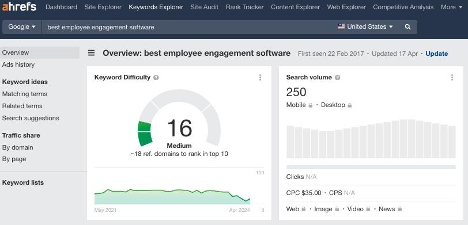
“Justin,” they say.. “I’ve checked my keyword research tool.. The difficulty score is just 16/100 and there’s search volume. Not to mention this buyer is surely in-market. So, it’s a PERFECT keyword.. Right??”
WRONG, Jack! Why?
Because, that’s an ❌ INTENT MISMATCH.
People who are searching for the best employee engagement software really don’t want to see a page that’s all about your product.
They want to see all their options and need help deciding which one’s the best.
So, these misguided marketers will spend lots of money trying to rank this page and sadly.. it never works.
Example 2: Other misguided marketers will try to rank the SAME sales pages for “What is Employee Engagement” by sticking a definition onto the page.. ??
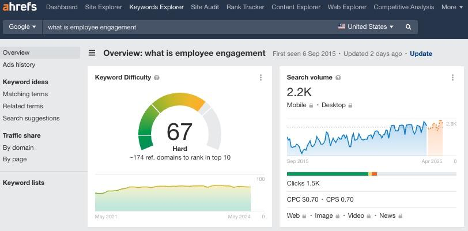
“But Justin” the search volume is GREAT! I’d be a fool not to try and rank my sales page for it.. No brainer, right?
Wrong again!
Yet another ❌ INTENT MISMATCH.
This person is looking for a DEFINITION. They’re just LEARNING.
They want a resource dedicated to that.. your sales page is IRRELEVANT and Google knows it.
A lot of promising HR Tech companies we talk to have gotten burned by marketers and agencies who make those mistakes, and they’re about ready to give up.
Until we show them the right FRAMEWORK.

Want to see how your HR Tech Website Stacks up Against the Competition?
Check out our (Free) HR Tech SEO Benchmarks Report
The Perfect HR Tech Content Framework
Presto!
THIS is the optimal structure for your buyer journey. The PROPER type of content for every point.
GOOD HR Tech Content Examples
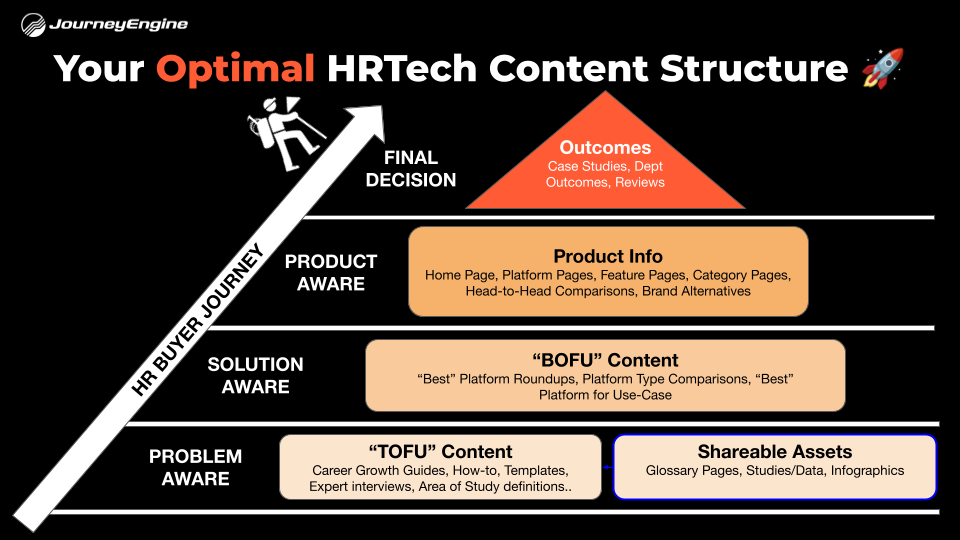
But instead of just telling you what this is.. I’m going to SHOW you how the best companies are crushing each type of content.
Sometimes generating tens and hundreds of thousands in $ value every month for each page they create.
It’s best to think of this as a PROCESS.
And you start that process at the END of the buyer journey. With your product’s OUTCOMES.
Our 5-Step HR Tech Content Strategy
Step 1: Showcase Your Product’s Outcomes

“Outcomes” content often has the BIGGEST ROI of any other content type.
Why? Because the people who’ll see it are those who are closest to converting.
But there’s also a BIG secondary benefit..
By doing this part justice, you’re going to learn exactly how to talk about your product in a way that converts buyers.
How to Create HR Tech Case Studies
Take a look at WorkVivo’s case studies..

These are an AWESOME example of content that’s targeted to people making their final decision.
They’ve expressed the sentiments of their best customers – in their OWN words. They give real data points on the outcomes each client saw.
KPI’s like:
-
% lift in employee retention
-
employee engagement rate
-
adoption rate
All outcomes that get their target prospects EXCITED.
This type of content converts potential buyers who are “on the fence”.
Using HR Tech Product Reviews
Now take a look at how BetterUp’s case studies are organically ranking for the keyword “BetterUp reviews”..

800 people search for that keyword every month.
Think about it.. That’s an opportunity to appear FIRST in 10,000 searches a year who are actively considering BetterUp.
That’s a CLEAR revenue opportunity.. in the multi-millions.
You can tell the BetterUp content team knows this.. Because their case study content is phenomenal. They clearly put a lot of love into it.
Again, clear data points on how their solution helps:
-
reduction in burnout
-
lifts and team performance
-
Self-reported scores
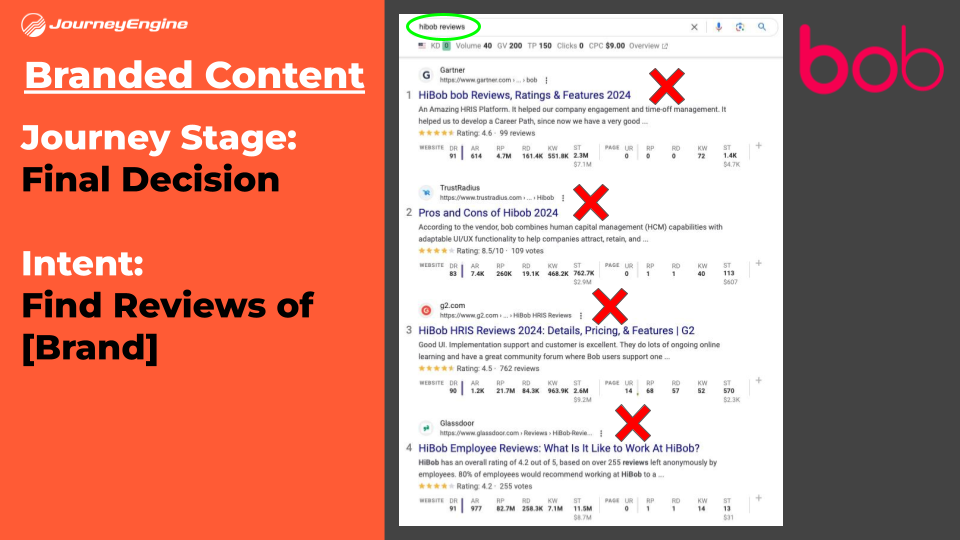
On the other hand.. HiBob is missing this opportunity.
You can see third-party review sites dominate the search engine results page with no website content of their own.
Rippling is ranking first for “Rippling reviews”..
But I also want to point out that a competitor is ranking their own review of Rippling on their website.
Note that this keyword is an important opportunity for the brand AND the brand’s competitors.

I also want to stress how important user generated social content is for this.
For example, there’s also a good number of people searching YouTube for “Rippling reviews”. They’re being met with third-party reviews from respected authorities in HR tech.
You absolutely want to be part of this conversation, and it’s your job to influence this content however you can.
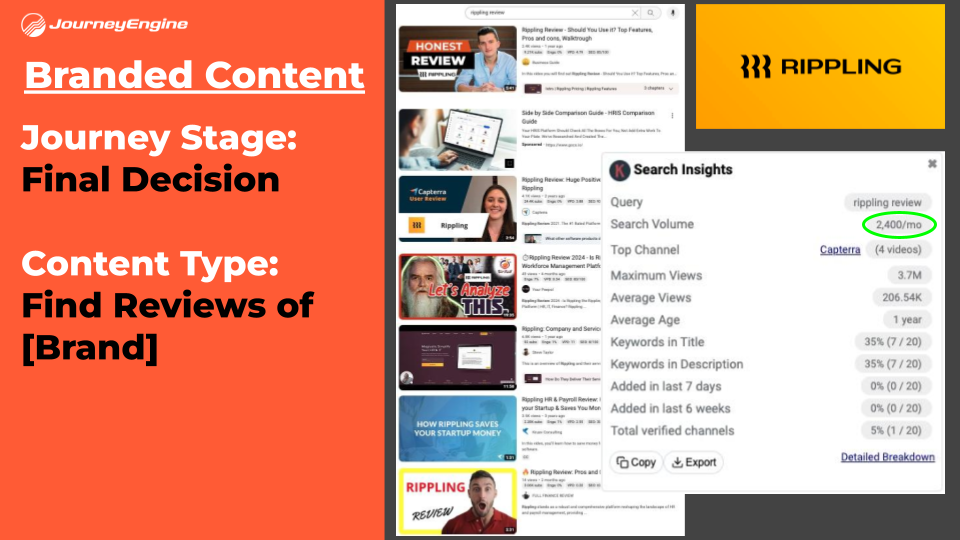
So make sure to build relationships with those influencers and your own custom review content to YouTube as well.
Step 2: Position Your HR Tech Product Against Competitors

There’s no way around it.. when an HRTech buyer is considering you they are going to compare you against your competition..
Meaning they will directly compare how your platform and features stack up against the other brands and alternatives they are considering.
This is where pages like the home page, the product and features pages should come into play.
Sales content that’s designed to convince HR Tech prospects why your product is the best solution to their problem.
Marketers obsess over these pages.. because they know that they’re very close to sales.
They need to be written masterfully in a way that expresses the product’s unique value in solving your customer’s biggest problems, like Rippling’s Recruiting Platform Page.

The customer stories and case studies you wrote for the last step are going to help you do that. But you need to consider that these pages are right for people who are already aware of your product.
The people who are searching for a particular platform or feature. And it’s a mistake to try and rank these four, for example, best XYZ software.
That’s a different type of content and we’re going to cover that later. These folks may be looking to compare you head to head against a particular competitor.
HR Tech Landing Page Examples
Notice how Deel and Rippling both have pages ranking for “Deel versus Ripling”.
Both brands are on top of it.. Check out Deel’s Feature Comparison Page and Rippling’s Comparison Page content.
It’s incredibly robust, giving the bottom-of-funnel prospect every bit of information they need and more. It includes features comparison charts, a benefit matrix, use cases, feature comparisons… the WORKS.

Head-to-head brand comparisons are another great opportunity for user generated video content from influential accounts, like Rippling has done in the screenshot below.
“Parasite SEO” is another good opportunity here. Take a look at this review that’s written on a third party website.
It can be pretty easy to get authors from relevant publishers to post and rank this type of content..

You’ll also, of course, want to consider customer searching for alternatives to a competitor, like our Workvivo has done here.
And that doesn’t always just go for competitors, either. Maybe your product isn’t an adjacent alternative to something like Slack or Google Sheets.. you’ll want to consider that too.

Step 3: Show HR Tech Customers Their Best Options

Now we’re going to cover the content that targets some of the MOST valuable keywords in the game. Those used by “Solution Aware” HR Tech prospects.
These are the people who are searching for your TYPE of product but not necessarily aware of your exact brand.
BOOM.. “best employee engagement platform”.
This is the keyword all the competitors are obsessing about in the employee engagement space. It’s why they’re paying upwards of $30 per client to rank for it! ?
But when the prospects search for this, they’re not looking for your sales page. They’re looking to compare the options. Our client Workvivo addressed that need with a round-up article, including the 11 best platforms.
Like it or not, you’re clients want this type of content. And you want to be part of that conversation.
Of course if you’re posting this on your own website you’ll position your brand as the number one option for a certain type of prospect’s problems.
Workvivo has created 36 of these type of pages. And you can see here that they are getting, for free, what their competitors are paying tens of thousands of dollars every month for.

And of course, once again, an important opportunity to influence third-party unbiased content from other publishers and video content for influencers on YouTube.
On top of that, you should be targeting people searching for the best HR tech platforms for more specific use cases.. for example; “best payroll software for small business”. Take ADP’s Small Business Landing Page:

You can see how valuable these searches are.. Competitors are literally willing to pay in the hundreds of thousands of dollars per month for it!
Again, a good place to use “roundup” content.. (lists of the top best products your prospects might consider).
But SEO isn’t the only goal here. These pages are intended to position your brand as the best solution for very specific subsets of your audience.
The opportunities are endless; “best payroll software for contractors”.. “Employee engagement platform for frontline workers”, “ intranet for small business”, HRIS for midsize companies..

A solution aware prospect may also be looking to compare the type of product, likeLike Workable did in this page on HRIS versus HCM or Namely’s page on HRIS versus PEO software.

The content goal would be to help them decide which platform is right for them and position your product as the appropriate fit for its ideal case.
Step 4: Establish Your Brand as an HR Tech Thought Leader

Finally, we do want to cover your “top of funnel” content.
This is the content that positions your brand as the thought leader.. You’ll do that by giving. By teaching your prospects how to solve their biggest problems.. showing them how to do something better.
Start with all the other types of content first.. But once they’re done, there are literally endless opportunities here.
Your content team will almost certainly spend most of their time on this type of content.
But even still.. You want to make sure you’re not putting out any “fluff”.
Every content piece needs to hit HARD! And by that i mean your content;
-
Provides ORIGINAL perspective.
-
Provides value to YOUR prospects
-
Solves a problem that your product is related to
I first want to cover why podcasts are incredibly powerful content for HR tech marketers..
The truth is.. you may NOT be the best at solving all your customer’s departmental problems. The good news? When that’s the case, you can find and interview the folks who are!
The MOST respected people in HR and workforce management.
The ones who have been through and crushed your prospect’s problems.
Take Bamboo HR’s branded podcast HR Unplugged.. or Workvivo’s branded podcast episodes.
Tons of episodes featuring top-age art people and how they solve problems like fixing a broken performance review process, using data to influence change, communicating to HR leadership, using PTO to retain employees and more.

And your podcast can (should) be easily transcribed, tied into written word, and optimized for phenomenal written HR Tech content pieces and blog articles.
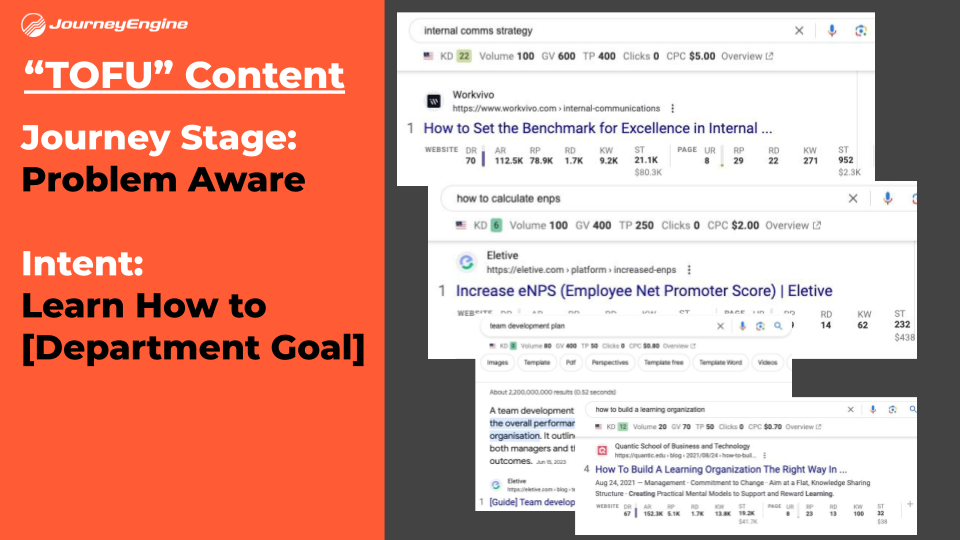
Again, the opportunities here are endless, and that’s why this type of content will likely make up about 80% plus of your site’s content and organic traffic.
Step 5: Promote Your HR Tech Content with Shareable Assets (Link Magnets)

The next and final type of content are your shareable assets or “Link Magnets”.
These are the juice, the fuel for your buyer journey engine. ⛽
They are intended to be shared, not only by your prospects, but also shared by the media. Publishers who are looking to cite great assets for their own content.
When you build this type of content, you’ll notice that people will share it naturally.
You’ll get backlinks without having to pay for them, which is of course, still one of the most critical factors for scaling your SEO.
Templates and tools are great for this. Trailiant, a sexual harassment training platform, uses an interactive sexual harassment training requirements tool.
HiBob uses shareable HR dashboards.

Good data, statistics, reports, and infographics are absolute gold for publishers. Take this page we did for our client Quantic, a research report on female, Fortune 500 CEOs.
It was shared by 58 high-profile websites, including Berkeley EDU. The results, skyrocketing authority for the brand, with zero spent on acquiring those backlinks.

Conclusion
And there you have it!
You now have all the information you need to go and build an HR buyer “Journey Engine” ?.
A content machine that attracts, convicnes and converts HR Tech decision makers like clockwork. ?️
Create this content, and I guarantee you are going to see big, organic, bottom line business results.
And if you have the time and resources to do that all yourself, you absolutely should. But if you want some help.. that’s what the Journeyengine team is here for!
Right now, we are offering a free organic growth projection. We are going to show you exactly how this system fits into your business.
You’ll get a one-to-one strategy call with me, along with the following;
-
Thorough analysis of your competitive market
-
Custom HR tech buyer journey engine strategy tailored to YOUR business
-
A forecast of the exact results that you can expect from the campaign
-
A SWEET data visualization designed to share with your team.. instantly making you the coolest person in your org.
Just click the link below and answer a few questions to prep for our discovery call.
I can’t wait to meet you!
Want Your Own Custom HR Tech Content Strategy?
-
1/1 meeting with Justin (Journeyengine founder)
-
Thorough analysis of your competitive market
-
Custom journey engine strategy tailored to YOUR business
-
A forecast of the exact results that you can expect from the campaign
-
SWEET data visualization to share with your team.. instantly making you the coolest person in your org
Building your marketing team is a pivotal part of your startup’s journey.
In this comprehensive guide, we delve into the nuances of structuring a marketing department that not only aligns with your startup’s vision but also drives growth and innovation.
Drawing from the wisdom of industry veterans, this article is going to equip you with knowledge and tools to build a dynamic and lean marketing team — tailored for the unique challenges and opportunities of the startup world.
The Journey of Building a Startup Marketing Department Structure
The way you decide to structure your marketing operations is absolutely critical for a startup.
This section explores the journey of creating an effective marketing department, emphasizing the right “order of operations” in developing a blend of marketing skills and talents.
POV — Veteran EdTech Marketing Team Leader
In our insightful interview with Rachel Jordan, a veteran EdTech marketing team leader, we gain some pretty profound insights into the intricacies of building and leading a successful marketing team in the startup world.
The Ideal Startup Marketing Team Hierarchy
Let’s explore the lean startup marketing team hierarchy — how to balance skill sets and roles for maximum impact and efficiency.
Early Steps in Structuring Your Startup Marketing Team
The cornerstone of any successful marketing department is its leadership.
This section delves into the essential attributes of a head of marketing and how their role shapes the entire team.
We’ll discuss strategies on structuring a startup marketing team that’s poised for success.
Your Marketing Team’s First Hire
The first marketing hire for your startup is a critical decision that will impact the future of your business. So it’s mission critical that you do this properly..
So, who should be the first marketing person you hire?
-
Copywriter? No
-
Content strategist? Wrong again
-
PPC specialist? Heavens, no.
The answer is simple. First, you need a leader.
Check out my Linkedin slide carousel on the topic ?
In a resource-limited startup environment, it’s essential for the first hire to not only develop high-level marketing strategies but also be able to execute.
The marketing leader can both guide and actively participate in marketing activities, setting a robust foundation for the department’s growth. With a on a balance between visionary leadership and practical marketing skills.
Next Steps: Building Your Startup Marketing Team
After establishing a strong head of marketing, expanding the marketing team becomes the next critical step for a startup.
The question of who to hire next is a common one among startup founders.
Hiring for Specialist-Skillsets
When considering further expansion, the focus should be on building a team that complements the existing strengths and fills in the gaps.
This could mean hiring specialists in areas like content marketing, digital advertising, or analytics, depending on the startup’s specific needs.
Expanding a startup’s marketing team involves carefully selecting individuals who not only have the necessary expertise but also the adaptability and drive to thrive in a dynamic startup environment.
The key lies in finding the right mix of strategic insight and hands-on ability, ensuring that each team member contributes effectively to the startup’s overall marketing goals..
That’s why it’s critical to have a head of marketing in place first – they’re instrumental in determining what skills are needed from your marketing team and what they should be accountable for.
Overcoming Startup Marketing Challenges
The path to building a stellar startup marketing team can be fraught with complexities and uncertainty.
Startups often find themselves navigating a fast-paced maze of strategic decisions, from defining their brand identity to crafting a message that resonates with their target audience.
Balancing budget constraints, limited resources, and the need for rapid growth adds another layer of challenge. It’s a journey that requires not only creativity and innovation but also a keen understanding of the market and the ability to adapt quickly to its changing dynamics.
Difficulties in Hiring Great Startup Marketers
Unlike larger enterprises, startups require marketers who can thrive in a fast-paced, resource-limited environment. These professionals need a broad skill set, adaptable to various roles and capable of crafting innovative strategies on a limited budget.
Structuring Your Marketer Interview Process
One of the most challenging aspects for startups is structuring the interview process to identify the right marketing talent. The key lies in creating a hiring process that not only evaluates a candidate’s marketing expertise but also their fit with your startup’s culture and vision.
You need a structured approach that delves into how candidates have tackled previous marketing challenges, their ability to adapt to the dynamic startup environment, and their potential to contribute creatively to the startup’s growth.
Important Marketing Team Interview Questions
In the interview process, it’s crucial to ask the right questions that reveal a candidate’s problem-solving skills, adaptability, and creativity. Make sure to explore;
-
How they have navigated marketing challenges in the past
-
Their approach to developing strategies in resource-limited scenarios
-
Their capacity for innovation
-
Alignment with the startup’s core values and long-term vision
If you’re a founder or exec, you should keep these areas in mind when you consider your head of marketing. And if you’re a head of marketing, it’s your job to consider these for the rest of the team!
The difficulties in hiring for startups are not just about finding someone with the right skills, but also about identifying individuals who can thrive in a fast-paced, ever-evolving environment and who are in sync with the startup’s ethos and objectives.
What should the Head of Marketing be Accountable for?
1. Early Responsibilities of the Startup Head of Marketing
Assessing the performance of a head of marketing in a startup involves a comprehensive look at their strategic impact and operational execution. The primary responsibility of this role is to develop a cohesive marketing strategy that reflects the startup’s core mission and vision. Their most important early task is clarifying three things;
A. key objectives
B. target audience (ideal customer profile
C. unique selling proposition.
2. Ability to Incorporate the Brand Vision
It’s the head of marketing’s job to integrate the startup’s vision into the marketing strategy, and ensure that it resonates across all departments. So, executives should measure their ability to translate the founder’s vision into a well-articulated, actionable plan.
3. Ability to Execute
Don’t get it twisted.. a startup’s head of marketing is expected to lead from the front — actively participating in marketing campaigns and content creation. Their involvement is not just supervisory but hands-on, especially in early-stage startups, where resources are often limited.
Key performance indicators should include the success of marketing campaigns in generating leads, increasing brand awareness, and contributing to the startup’s growth trajectory.
4. Leadership Quality
In a startup environment, the head of marketing should be a driving force in building and mentoring the marketing team. Their ability to foster a culture of innovation, adaptability, and continuous learning is integral to the startup’s success. In order to measure there performance in this area, you’ll need to talk to their direct reports for a 360 degree view.
In summary, the performance of a head of marketing in a startup should measured through a blend of strategic development, hands-on implementation, and team leadership, all anchored to the startup’s overarching goals and vision.
Digital Marketing Agencies for Startups
The decision to engage with a digital agency is a strategic one, often made when the startup recognizes the need to build a more structured marketing practice.
As startups grow and the demands increase, the need for specialized skills becomes critical. Digital agencies provide the expertise, process and bandwidth required to truly run an effective marketing operation.
Digital Agency vs In-House Marketer
When it comes to executing specialty marketing tasks like; SEO, Content and PPC, startups are often have to choose from two options:
-
Hiring junior, in-house talent
-
Outsourcing to an agency service
Agencies have the clear advantage, when factoring experience and process.
You’ll often pay the exact same price for a junior marketer with no experience and an agency with decades of combined experience in the exact task you’re looking for..
And while that choice may seem obvious, you’ll only see the benefit when a few conditions are met.
When Startups Should Use a Digital Marketing Agency
1. There is Already Head of Marketing in Place
Founders are often tempted to work directly with agencies, before they hire a head of marketing.
In our experience, this is almost never successful.
Choosing the agency, managing them and holding them accountable for the right things is a big job.
Founders and other execs need to focus their efforts on other operations, and almost never have time to do that job justice.
That’s why it’s best to leave the job of managing marketing agencies and outsourced team in the hands of your head of marketing.
2. You Hire a Specialist (vs a Generalist) Agency
Especially when it comes to startups, you’ll be hiring an agency for their experience and process.
And in our experience, full service agencies that operate across all industries just can’t cut it. If you’re going to hire one of those you might as well just go in-house..
You should look for an agency who specializes in the exact task your looking for, your industry specifically, or both. With sufficient case studies to prove their value.
3. The Agency has a “Sprint” Based Offer
Large enterprises may be suited to long-term contracts.. but as a startup, you need to think differently.
Strong startup agency offers are based on “sprints”: short work cycles (often 3-6 months) with a clear, pre-determined scope and deliverables.
Engagements that are structured this way are flexible and dynamic – perfectly suited to the needs of the startup world.
Digital agencies can be valuable allies for startups, especially at a stage where scaling marketing efforts becomes necessary. They offer specialized skills and resources that complement the internal team’s capabilities, playing a crucial role in the startup’s growth journey.
But you need to keep the above qualities in mind before choosing an agency..
Your head of marketing will be critical in the decision!
Best Practices in Building a Startup Marketing Department
1. Hire a Balanced Marketing Leader
In building a marketing department for a startup, the initial focus should be on hiring a leader with both strategic vision and hands-on capabilities. This first hire is crucial in translating the founder’s vision into a practical marketing strategy.
2. Build for Marketing Impact
As the startup grows, the next step is to bring in specialists like a creative educator for multimedia storytelling and social media. These roles, filled with specific expertise like design and video editing, enhance the marketing department’s reach and impact.
However, it’s important to first establish a solid marketing foundation before adding specialized roles. Hiring specialists too soon, especially if the founder lacks marketing expertise, can lead to challenges in management and direction.
3. Follow the Order of Operations
The expansion of the marketing team should be a thoughtful, strategic process. Each new hire should complement the existing team and align with the startup’s evolving goals, ensuring a cohesive and effective marketing unit.
In summary, start with a versatile marketing leader, then carefully expand with specialists. This approach ensures a balanced, dynamic marketing team that can grow with the startup.
Building Your Startup Marketing Ops Properly — The First Time Around..
For startup founders and executives, the task of building a marketing strategy and assembling a team from the ground up can be daunting. You now know that your first step is to find a competent head of marketing to drive growth and establishing your marketing ops.
But startups often find themselves at a crossroads.. You may be balancing your limited resources with high cost and significant commitment required to onboard a full-time (untested) head of marketing.
This predicament leaves startups in need of experienced marketing guidance without the financial strain of a hefty executive salary.
Enter the Fractional CMO — an ideal solution to this pressing challenge.
Benefits of a Startup Fractional CMO
Incorporating a fractional Chief Marketing Officer (CMO) into a startup’s operations is a strategic and cost-effective solution, especially for early-stage companies grappling with the complexities of building a robust marketing department. This approach addresses a crucial challenge many startups face: the need for experienced marketing leadership balanced against budget constraints.
A fractional CMO offers the expertise of a seasoned marketing executive at a fraction of the cost of a full-time head of marketing.. and without the stigma of a longer commitment. It’s the ideal choice for startups operating on limited resources.
There are a few distinct advantages of the fractional CMO approach:
1. Lower Cost (The Obvious)
The most immediate benefit of a fractional CMO is cost-effectiveness.
Simply put, a fractional CMO can provide the same or higher level of expertise and strategic guidance but at a substantially lower cost.
You’re going to be saving a lot.. Think one half to one quarter of what you’d spend, per year, on a full time head of marketing.
2. Lower Commitment (Think “Sprints”)
You may be (understandably) anxious about committing to a full-time head of marketing, especially without demonstrated proof of their value.
With a fractional CMO, founders and exec startup teams can test a CMO for a short period, assess there value and scale the role up or down based on current needs and future goals.
Many fractional CMOs (at least the good ones) offer a “sprint” framework catered this benefits.
3. Process and Accountability (Most Important)
In our view, similar to a marketing agency or contractor, you should hire a fractional CMO for their process.
A great fractional CMO brings with them a clearly defined process, playbook or blueprint for installing your marketing strategy and operations.
From our experience, the expectations with a fractional CMO are typically much clearer compared to a full-time hire. It’s important to look for a fractional CMO who offers a well-articulated plan with specific milestones and deliverables from day one.
The value of their deliverables or sprints should stand on their own merit. With a fractional CMO, you’ll never have to worry about the “clock-in, clock-out” mentality.
Your Next Steps
Whoever you decide to hire, learn their process in advance to see how they work (and to ensure they have structure).
For example, I provide the same four-step framework for all of my clients, before we ever work together:
-
Analyze your past marketing efforts
-
Review the market and competition
-
Create a high-level plan of attack to boost your acquisition
-
Provide pricing and expected ROI if you decide to work with me
If the fractional CMO you’re considering doesn’t give you these basics, then continue looking.
On the other hand, if you’re ready to start scaling, improving, or building your marketing strategy, then book a strategy call with me today.

Never worry about marketing ops again
What to expect:
1. Analysis of your past marketing efforts
2. A review of the marketing and competition
3. High level plan of attack to boost your acquisition
4. Pricing + expected ROI from working with me
Ever wondered how some schools have a line of highly qualified students waiting to enroll, while others struggle for attention? That’s not by chance. It’s the result of strategic maneuvers that outshine traditional tactics.
Quality enrollment growth isn’t just about numbers… but rather it’s akin to tending a garden – each student is a seed needing the right care and conditions to flourish.
We’ve seen this in action at Fusion Academy – once an underdog, now boasting 80 campuses nationwide. They dared to reimagine education and won big time!
Intrigued? I bet you are! This tale is more than just success; it promises insights into game-changing strategies like one-to-one education, savvy digital marketing moves, power partnerships, all designed for boosting enrollment.
Hang tight if your school could use such breakthroughs. You’re about to experience something amazing!
In this blog, we’re going to delve deep into the world of enrollment marketing for colleges and universities. We’ll explore how strategies in higher education mirror and diverge from those in K-12 private schools, offering you a comprehensive understanding of how to attract and retain students effectively.
Let’s dive in!
How to Increase College Enrollment
In higher education, successful content marketing is all about understanding the student’s journey. It involves more than just creating detailed content about your degree programs and courses; it requires addressing every stage of a prospective student’s decision-making process.
Understanding the Higher Ed “Student Journey”
If you’re in charge of enrollment marketing for a college, the most critical concept to understand is the path your students follow on their way to making a final decision about your program.
-
Becoming aware of a problem your program can solve (Problem Aware)
-
Recognizing the available solutions (Solution Aware)
-
Understanding your specific program and offer (Program Aware)
-
Making the decision (Final Decision)
Generally all college programs understand that they need content and messaging that describes the unique benefits their program provides.
But many higher education program marketers fall short when it comes to the bigger picture strategic thinking that’s required to address the student’s entire journey.
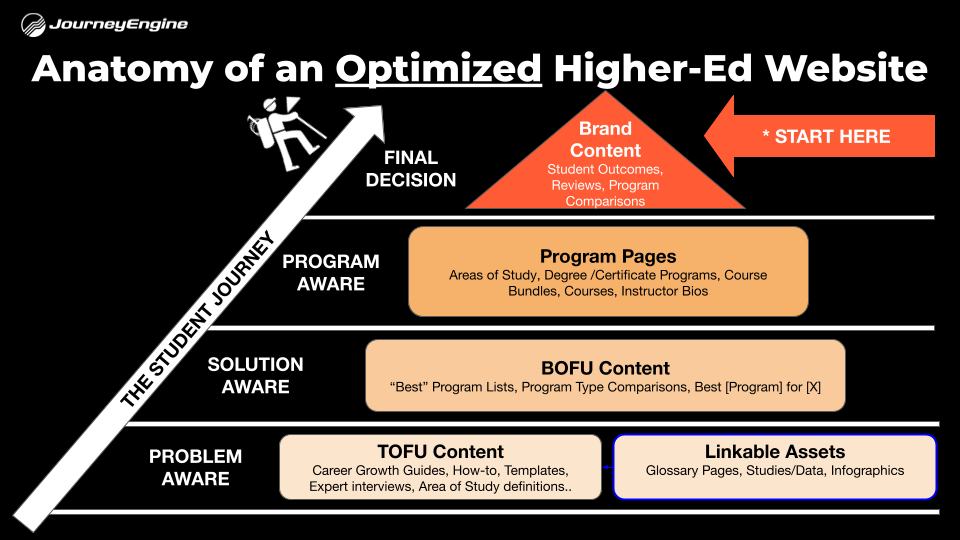
Higher Education marketers need to understand the entire student journey..
And create content to help their student prospects throughout that journey.
College and University Marketer’s Biggest Mistake in Enrollment Strategy
Many institutions make the mistake of focusing solely on end-stage content—details about their degree programs, instructors, etc.
It makes sense. Institutions spend their days in the weeds, improving programs of instruction from the inside-out.. but it’s a problem when that’s all they want to talk about.
While this type of information is crucially important, it only represents one part of a much larger picture.
The most critical first step of improving you program’s enrollments is to understand what makes your students “tick” – their “pain points”.
Understanding Prospective College Student Pain Points
The cornerstone of successful marketing strategies for increasing student enrollment lies in comprehending the unique pain points of prospective students. By delving into these challenges, higher education marketers can craft messages that resonate with potential enrollees and highlight the key benefits of their programs.
1. Interviewing Students
Firstly, it is vital to conduct interviews with current students. These discussions will provide insights into what attracted them to your institution and any difficulties they faced during the admission process. Understanding this perspective allows you to tailor your approach based on real experiences rather than assumptions.
2. Interviewing Alumni
In addition, reaching out to alumni offers a valuable viewpoint on how well your program prepared them for their careers post-graduation – an important factor when considering how to increase college enrollment rates effectively. Their testimonials could serve as powerful marketing tools if used correctly.
3. Interviewing the Admissions Team
Your admissions team interacts directly with prospective students; thus, they have firsthand knowledge about common concerns or questions raised by applicants during the admission process. Eric Olsen suggests “gaining insight from those who are in direct contact with potential enrollees helps shape a more informed strategy.
The best source for understanding student needs is often right under your noses – your own staff.
4. Interviewing Student Success Teams (e.g. Career Services)
Last but not least, interviewing members of student success teams like career services can offer additional layers of understanding. These teams work closely with students throughout their academic journey and beyond, making them a valuable resource for insights into student expectations, experiences, and outcomes.
By adopting these strategies for increasing student enrollment in your marketing plan, you can create compelling narratives that address the real concerns of prospective students while showcasing the unique value proposition of your institution.
Content, Messaging and Promotion for Your Full Student Journey
Your prospects start researching well before they decide what program or school suits them best. They might be curious about financial aid options or looking for tips on balancing work with studies effectively. Perhaps they’re interested in different career paths post-graduation or seeking testimonials from alumni who’ve walked similar paths before them.
To truly stand out amidst competition and increase enrollments via higher education content marketing strategies, you’ll need to address these early-to-mid stages as well by providing relevant answers through the proper forms of content.
There are 10 pieces of content we’ve found particularly effective for generating awareness, interest, applications and college enrollments.
You can click on any of the higher education content tactics below to learn more. Nail these and you may find that your enrollment problem has already disappeared.
By neglecting any stage stages, you’re missing out on opportunities to engage potential students early in their journey and guide them towards choosing your institution. The student journey is an essential concept to grasp when it comes to content marketing for higher education.
It’s like a roadmap that shows you where students are, what they’re thinking, and how you can meet their needs at each stage.
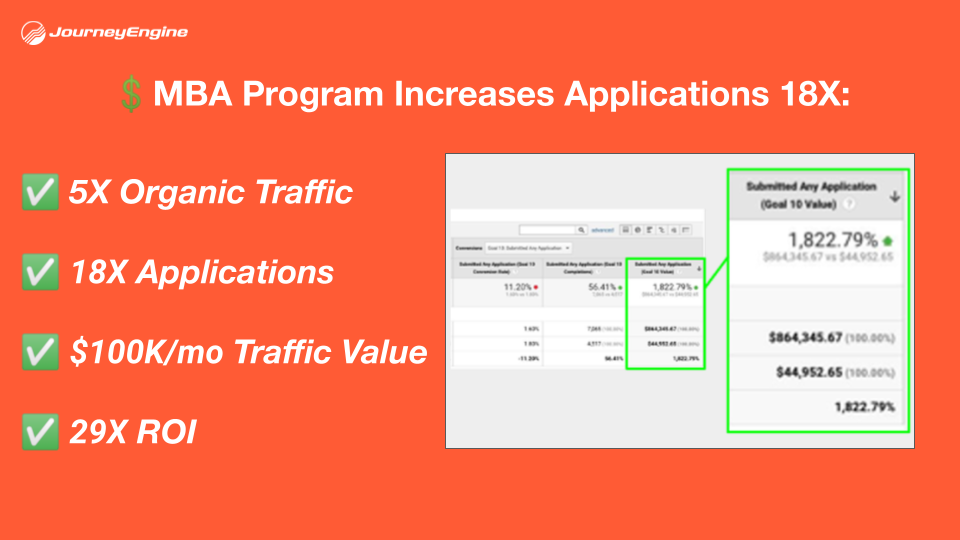
Discover how we helped this online MBA program increase applications and enrollments..
Through 100% organic traffic.. using the “student journey” framework.
How to Increase Enrollments for a K12 Private School
Increasing college enrollments is certainly a different beast compared to increasing enrollment for a K12 private school..
But there’s a LOT marketers of each program level can learn from each-other. We learned that by talking to an expert in both.. The man behind the meteoric rise of Fusion Academy..
The Rise of Fusion Academy: A Case Study
Witness the remarkable growth journey of Fusion Academy, an educational institution that expanded from a single school to 80 schools nationwide, including Fusion Global Academy.
This expansion wasn’t just luck or chance; it was built on strategic planning and unique positioning in the education market.
Unique Selling Proposition: One-to-One Education
Fusion Academy’s growth isn’t about a marketing “hack” or small incremental improvements in the brand.. it’s the result of “creating a category” with a truly disruptive product.
Their personalized one-to-one education model – a unique selling proposition that sets them apart from traditional schools. What does this really signify? Each student at Fusion receives tailored instruction designed specifically for them. Every class has just one teacher and one student, enabling individualized learning like never before.
This revolutionary approach not only benefits students who may struggle in traditional classrooms but also those who are advanced learners and can move at a faster pace than their peers. In fact, Fusion’s focus on personalization propelled them to be leaders in this space with few competitors even coming close.
To put things into perspective, consider this – while there might be other players dabbling in the game of personalized learning, their largest competitor manages only 10 schools compared to Fusion’s whopping 80. The numbers clearly show how far ahead they are when it comes to offering truly individualized education solutions.
“Why Fusion has gone from one school to 80 in the past decade is because there is an inherent constraint in the traditional classroom.. Our one-to-one model really solves for that. It allows every student to go at their own pace, matched to their learning preference and style.”
The Constraints of Traditional Schools
Traditional schooling systems have long been plagued by constraints such as large class sizes where teachers often find themselves teaching towards the middle ground — too fast for some students yet too slow for others — which hinders overall engagement and effectiveness.
Few can deny these limitations inherent within mainstream educational settings that offer limited individual attention thereby leading many bright minds to feel overlooked and underserved. But here’s where Fusion Academy shines brightly.
By focusing on a one-to-one teaching model, they’re able to offer undivided attention and personalized learning experiences that are hard to match in conventional classrooms. This not only encourages students who need extra help but also lets advanced learners thrive without being held back by the pace of their peers.
So, Fusion Academy has managed to pull off a success. That’s what we’re seeing.
Leveraging Digital Marketing for K12 Student Enrollment
When it comes to spreading the word about Fusion Academy and its unique one-to-one education model, digital marketing plays a key role. Through performance marketing and paid media tactics, Fusion Academy has been able to reach out and educate their audience effectively.
Overcoming Marketing Challenges with Storytelling
The introduction of individualized instruction is still somewhat novel, which presents a predicament in terms of informing possible guardians and pupils. But where challenges arise, opportunities also surface. This is where storytelling steps into the spotlight.
Storytelling can be an extremely powerful tool when used correctly within your content strategy. By crafting narratives that resonate with our target audiences on an emotional level, we create “aha” moments that make them see the value of what’s being offered.
Fusion Academy successfully leverages this approach by telling compelling stories about real-life successes from past students who benefited from personalized learning programs – driving home both understanding and appeal for prospective enrollees.
The Importance of Targeting Intent
Digital marketing isn’t just about broadcasting information far and wide; it’s more nuanced than that. It’s crucial to ensure you’re reaching people at the right time – when they’re most receptive or actively seeking related solutions like personalized educational options. This is known as targeting “intent”.
Aiming ads or content towards those showing specific signs – such as search queries around ‘alternative schooling methods’ or ‘personalized education benefits’ – significantly increases chances of engagement because you’re providing exactly what they are looking for. HubSpot’s Topic Cluster Model provides a comprehensive guide on this approach.
Fusion Academy’s strategic use of targeting intent in their digital marketing efforts has helped them connect with parents and students who are already exploring or private education options, but also have the affluence and geographic parameters in line with Fusion’s market. This focus not only increases the probability of enrollment but also fosters trust and credibility among prospective families, thereby building strong relationships right from the start.
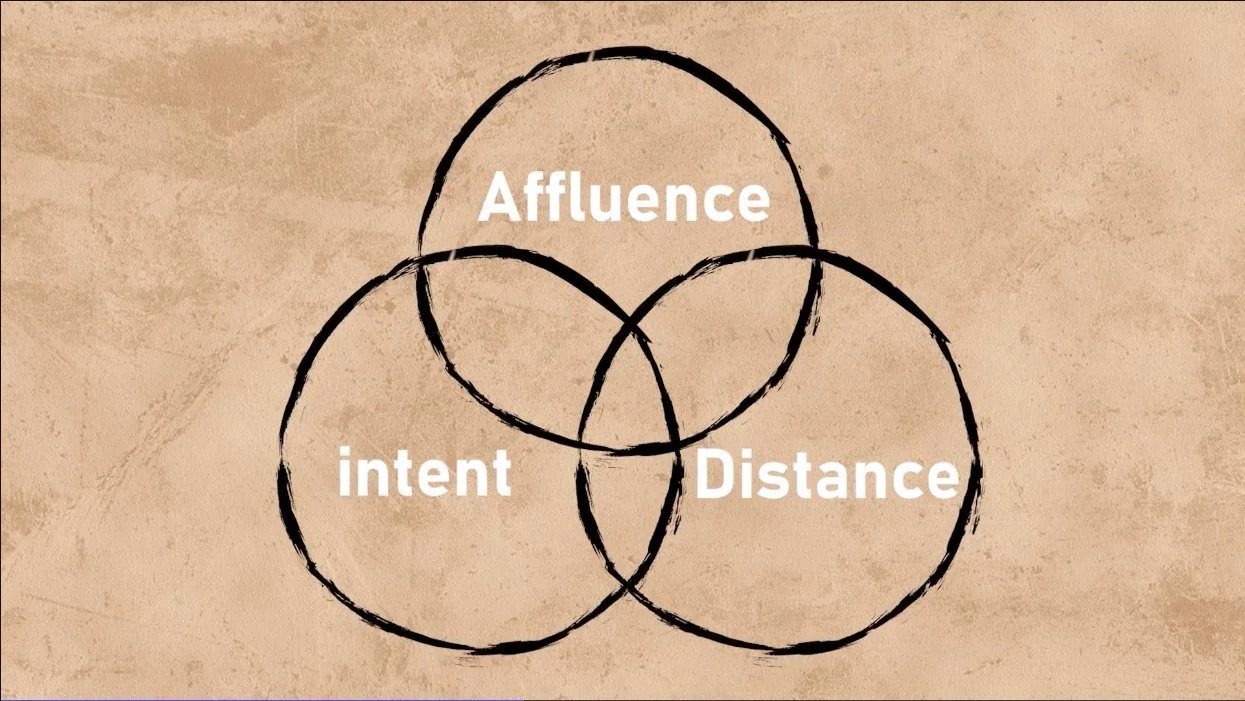
Fusion Academy boosts student enrollment by harnessing digital marketing and storytelling. They use performance marketing to spread awareness about their unique one-to-one education model, crafting narratives that hit home with potential enrollees.
Plus, they’re smart about the “targeting vendiagram” — reaching folks who are actively seeking private learning solutions, are within the geographic parameters and are affluent enough to afford the program.
Building Partnerships for Lead Generation
Fusion Academy’s success story isn’t just about pioneering a one-to-one education model. It’s also a tale of how smart alliances can amplify awareness and spark student enrollment.
In the world of edtech, creating strong partnerships is like crafting an unforgettable melody; it resonates with your audience and lingers long after the final note. For Fusion Academy, these strategic relationships are established primarily with district administrators and school counselors who have their fingers on the pulse of educational needs in their communities.
The Power of School-District Relationships
To grasp this power dynamic, picture school districts as bustling cities filled with eager learners waiting to be guided towards beneficial opportunities. District administrators act as mayors in these cities, responsible for making sure that all children receive quality education.
This role makes them key allies when spreading awareness about innovative learning models such as Fusion Academy’s personalized approach. By forming connections at this level, you’re essentially tapping into a network dedicated to finding optimal solutions for students’ diverse needs. This notion gains weight considering recent findings emphasizing increased authority given to district leaders regarding school improvement initiatives.
School Counselors: The Trusted Advisors
If we continue our city analogy further, consider school counselors akin to trusty tour guides who help students navigate through the maze-like paths toward academic success. These professionals understand each learner’s unique challenges better than anyone else within schools.
Bearing witness firsthand to struggles traditional schooling methods impose on some individuals gives them appreciation for alternative approaches like Fusion Academy offers. As stated by the American School Counselor Association, one of their roles is to actively engage in planning students’ future directions. By aligning with school counselors, Fusion Academy gets a chance to showcase its unique model directly to those who need it most.
Partnerships Fuel Lead Generation
The significance of these partnerships cannot be understated. Imagine trying to introduce a revolutionary car design into an already crowded market; you’d want your message heard by those familiar with industry trends and challenges – essentially the gatekeepers. That’s exactly what district administrators and school counselors represent for Fusion Academy within the education sector.
Partnerships with district administrators and school counselors are essential to our business. They’re crucial for growth and innovation, shaping the way we work every day.
The Future of Education Markteing
Looking ahead, the world of education is set to evolve even more. We’re not just talking about tweaks and minor adjustments here. We mean full-on transformations that’ll redefine how we approach student enrollment.
We’ve seen firsthand at Fusion Academy that one-to-one education isn’t just a passing fad—it’s the future of learning. What does this mean for edu institutions in the US?
Fusion as a Model: The Next Step in Education Evolution
To answer this question, let’s look back at our case study: Fusion Academy. This institution grew from one school to 80 nationwide with their unique selling proposition—personalized, one-to-one education.
They took traditional schooling constraints like teaching to the middle and limited individual attention, and flipped them on their heads by offering personalized instruction tailored specifically for each student.
A Shift Towards Personalization: More than Just Customizable Learning Plans
Incorporating personalization into your strategies can increase student enrollment significantly because it shows potential students you care about them as individuals—not statistics in an admission report.
This shift towards customization doesn’t stop at curriculum design either; it extends right through every aspect of your school’s operations—from communication methods down to extracurricular activities offered.
Digital Marketing Revolutionizing Student Enrollment Strategies
Moving forward digital marketing will play an increasingly vital role in reaching out to prospective students and parents alike—a fact already evident through Fusion Academy’s success story. They used performance marketing tactics along with paid media effectively targeting audiences unfamiliar with one-to-one educational concept turning skepticism into belief using storytelling techniques brilliantly woven within their promotional campaigns.
The trick is to create an “aha” moment for your audience—let them see, feel and understand the value of what you’re offering. And with digital marketing’s reach and precision targeting capabilities, reaching the right people at the right time has never been easier.
Conclusion
So, we’ve journeyed through the tale of Fusion Academy. From one campus to 80, their growth is no accident.
They tapped into the power of personalized education. They didn’t just teach; they transformed lives!
Digital marketing was another key player – crafting compelling stories and targeting intent made them visible and attractive to potential students.
Never underestimate partnerships! School districts and counselors became invaluable allies in generating leads.
The strategies for increasing student enrollment aren’t rocket science but require innovation, commitment, and a bit of courage.
Your school too can rewrite its story. Take that bold step today!
FAQs in Relation to Strategies for Increasing Student Enrollment
What is the trend in enrollment in higher education?
The general trend sees a decline, with economic factors, online learning, trade schools and other options shaking up traditional college paths.
That’s why it’s absolutely critical for Traditional universities and colleges to understsand the changing needs of student prospect in order to survive in today’s changing competitive market.
Why is enrollment decreasing?
Falling enrollments often stem from rising tuition costs, alternative education routes like trade schools or online programs becoming popular.
Universities need to think outside the box of traditional enrollment strategy. By developing disruptive educational products and leaning into them with using marketing and storytelling.
What is enrollment marketing?
This refers to strategies aimed at boosting student numbers. Tactics include digital campaigns targeting potential students and partnerships for lead generation.
Content is an untapped well of potential that can draw students to your doorstep—when done properly.
In higher education, content marketing isn’t just throwing paint on a wall and hoping something sticks. It’s about understanding each student’s journey.
So, how can we apply this knowledge in practice?
Let’s dive deep into the four stages your students go through:
-
Becoming aware of a problem your program can solve
-
Recognizing the available solutions
-
Understanding your program’s offer
-
Making the decision.
Each stage has its own unique needs. We’ll explore various types of content that truly resonate with your student prospects at every phase.
The #1 Mistake in Content Marketing for Universities, Colleges and Higher Ed Programs
Content marketing and SEO are powerful tools for attracting potential students to your higher education institution. The ultimate goal is to provide prospective students with the information they need at every stage of their journey, from initial interest to final enrollment decision. But there’s a common pitfall that many institutions fall into – focusing solely on the end-stage content.
Bottom Funnel Content — Necessary but Not Sufficient
All too often, we see universities and colleges pouring all their efforts into creating detailed content about their degree programs, courses, instructors and so forth. Of course this type of content marketing strategy is critical; after all, it wouldn’t be much of an educational website without such these details. But focusing exclusively on this aspect leaves out crucial stages in the student’s decision-making process.
Addressing the Entire Student Journey
Your prospects start researching well before they decide what program or school suits them best. They may have questions about financial aid options or want tips on how to balance work with studies effectively; perhaps they’re looking for insights into different career paths post-graduation or testimonials from alumni who’ve walked similar paths before them.
These topics represent just a few examples among countless others which make up a significant part of your prospect’s research phase – essentially forming most parts below surface level if you consider ‘student journey’ as an iceberg model.
To truly stand out amidst competition and increase enrollments significantly for your university or college via effective content marketing strategies, you’ll need to address these early-to-mid stages as well by providing relevant answers through various forms of content.
By neglecting these stages, you’re missing out on opportunities to engage potential students early in their journey and guide them towards choosing your institution.
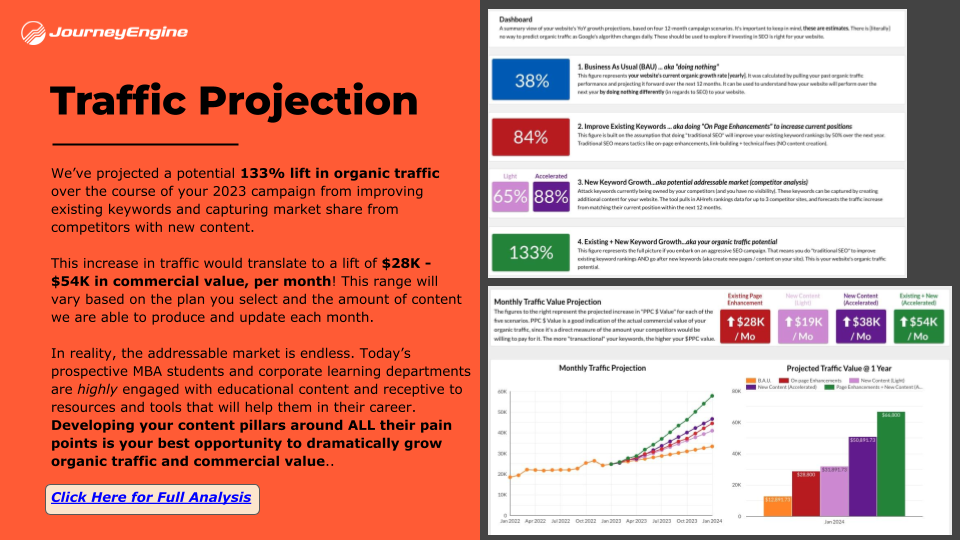
Want a FREE Higher Ed Content Plan?
Here’s what you’ll get:
✅ Opportunity analysis prepared by our team
✅ Custom 3 Month “Student Journey” Content Strategy
✅ Forecast of Traffic, Applications and Enrollments
✅ A sweet “program-led” content dataviz to share with your team
Understanding the Higher Education “Student Journey”
The student journey is an essential concept to grasp when it comes to marketing for higher education. It’s like a roadmap that shows you where students are, what they’re thinking, and how you can meet their needs at each stage.
Problem Aware (Stage 1)
The student journey commences with a prospect who is problem aware. This signifies that your potential students are conscious of their aspirations, such as becoming a software engineer or getting into college, but they may not be familiar with the specifics of your program or even realize that it’s what they need.
Keys to Success:
1. Guide Student Prospects
To guide these prospects effectively, you’ll want to provide them with useful resources tailored to their interests and goals. For instance, if someone wants to pursue data science, offer guides on career growth for software engineers, tips on how to become one, or interviews featuring successful individuals in the field. These types of content help clarify different areas within data science and can steer them towards considering your program.
2. Attract Media Mentions for Your Education Program
Beyond providing targeted content for prospective students, another crucial aspect involves creating linkable assets like studies about software engineering or infographics detailing a typical salary in this profession. While these pieces might not directly target your prospects, they’re designed more for media outlets and authorities within the sector.
Solution Aware (Stage 2)
At the solution aware stage, your potential students have identified their need for a specific program, such as data science. They’re actively seeking out the best programs and comparing them to determine which one fits their needs perfectly. Your institution’s role at this juncture is pivotal in shaping their decision.
Your website should be equipped with comprehensive content that addresses these searches directly. For instance, if you offer a top-notch data science program, create dedicated pages or blog posts highlighting its unique selling points compared to other institutions’ offerings.
Keys to Success:
1. Promote Your Education Institution
Beyond just having this information on your site, it’s also crucial to promote it externally through collaborations with influencers and authorities within higher education space. This not only increases visibility but adds an element of third-party validation that can significantly sway prospective students towards choosing your institution.
2. Create Program Comparisons
A highly effective approach during the solution aware stage involves creating comparison content—blog posts or articles that compare different types of programs side-by-side based on various parameters like curriculum depth, faculty expertise, placement statistics etc. Such comparison content marketing strategy can effectively showcase how your programs stack up against others in the market.
3. Leverage Education Program Influencers
Influencer marketing is another powerful tool at this stage where respected voices in academia or industry review and recommend your program over others. Reach out to influencers who share a similar audience base and propose collaboration opportunities such as guest blogging or podcast interviews discussing aspects of your academic programs. Here’s more about leveraging influencer marketing in higher education.
Remember, the solution aware stage is all about showcasing your institution’s offerings as the best fit for potential students. By providing comprehensive comparison content and leveraging influencer marketing, you can effectively sell your program to prospects at this crucial decision-making stage.
Program Aware (Stage 3)
The next stage in the student journey is “program aware”. At this point, your prospective students have become familiar with your educational institution and are now evaluating your programs and courses to determine if they align with their academic goals and aspirations.
Keys to Success:
1. Emphasize Your Program’s Unique Value Proposition
Your content at this stage should not only provide detailed information about each program or course but also emphasize what sets you apart from other institutions. This could be a unique teaching method, highly qualified faculty members, successful alumni stories or state-of-the-art facilities. Here’s how you can effectively communicate your unique value proposition.
2. Differentiate From The Competition
In today’s competitive higher education market, it’s essential that you differentiate yourself from others offering similar programs. Highlight specific features of your programs that competitors may lack such as smaller class sizes for personalized attention or internship opportunities with top companies. Learn more about differentiating from competition here.
3. Focus on Your Ideal Student Profile
Your content should resonate specifically with the type of students who would benefit most from enrolling in your institution. Identify these ideal profiles based on factors like career goals, learning styles and personal interests then tailor the messaging accordingly. Check out our guide to identifying an ideal student profile here.
Final Decision (Stage 4)
In the final decision stage of the student journey, your branded content takes center stage. This includes compelling information about student outcomes, reviews of your program and direct comparisons to other programs. It’s crucial at this point that you understand just how vital this information is for shaping all other content on your site.
Keys to Success:
1. Create Branded Content
We cannot overstate the importance of starting with this type of content when developing a strategy. If you’re unsure where to begin with your EdTech or SaaS marketing, look no further than here.
This is not only because it’s an integral part in informing potential students about what they can expect from enrolling in your institution but also because it provides invaluable insights into their needs and concerns which will help shape rest of your website design and overall content strategy.
2. Understand Your Students’ Pain Points
Your primary goal should be understanding what challenges or ‘pain points’ prospective students face during their education journey. By focusing on these pain points, we can tailor our offerings to provide solutions that meet their specific needs effectively – making us stand out among competitors as a top choice for higher education institutions.
3. Leverage Program Reviews
Detailed program reviews and comparisons are key components in helping potential enrollees make informed decisions about pursuing higher education at your institution. They offer tangible proof that demonstrates how well-suited our educational services are towards meeting individual learning goals compared to others available in market today. Remember, knowledge gained from these resources informs every aspect – from designing engaging web pages through creating effective promotional materials – so never underestimate its value!
10 Types of Content You Can Use to Increase Student Enrollment — Today
In the ever-evolving landscape of higher education marketing, it’s crucial to adapt your content strategy to meet prospective students where they are. Here at Journey Engine, we’ve developed a student journey framework that leverages ten types of content guaranteed to increase traffic and enrollments on your institution’s website.
1. Higher Education Student Outcomes
In the world of higher education marketing, focusing on student outcomes is a powerful strategy. It’s not just about telling prospective students what they’ll learn—it’s also showing them where your program can take them.
A shining example of this approach is Quantic, one of our clients at Journeyengine Inc. We worked together to create an impactful series spotlighting their alumni, illustrating how Quantic helped these individuals achieve their career goals and overcome challenges along the way.
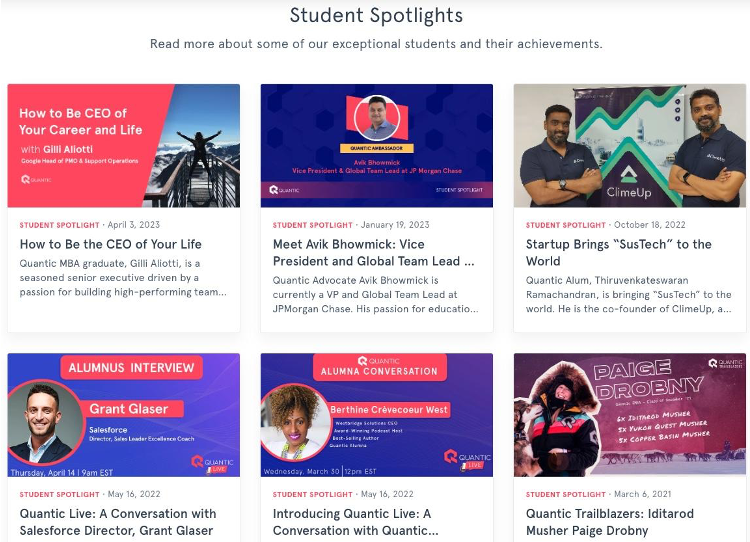
The Power of Student Spotlights
We adopted various content formats for this initiative but found that podcast-style interviews between admissions team members and key alumni resonated particularly well with audiences. These discussions delve into everything from the discovery process to navigating through the program and eventually landing dream careers post-graduation.
This type of content serves dual purposes:
-
It provides invaluable insights for your own team, teaching you how best to discuss your programs by highlighting real-life experiences and success stories.
-
It makes excellent material for repurposing on social media platforms or other channels—helping generate interest among potential enrollees who are embarking on their own educational journeys.

Leveraging Student Stories: General Assembly Example
Another organization making waves in this area is General Assembly (GA). GA has built an extensive library showcasing its diverse array of student stories—all produced with high-quality visuals and compelling narratives. This comprehensive resource paints a vivid picture of GA’s student profiles—their aspirations, struggles, triumphs—and ultimately demonstrates why GA was instrumental in propelling these students toward achieving their personal and professional goals.
Creating student outcomes content is not just about showcasing your institution’s success—it’s also about connecting with prospective students on a personal level, addressing their concerns, aspirations, and motivations. This strategy can transform your website into an effective enrollment generating machine.
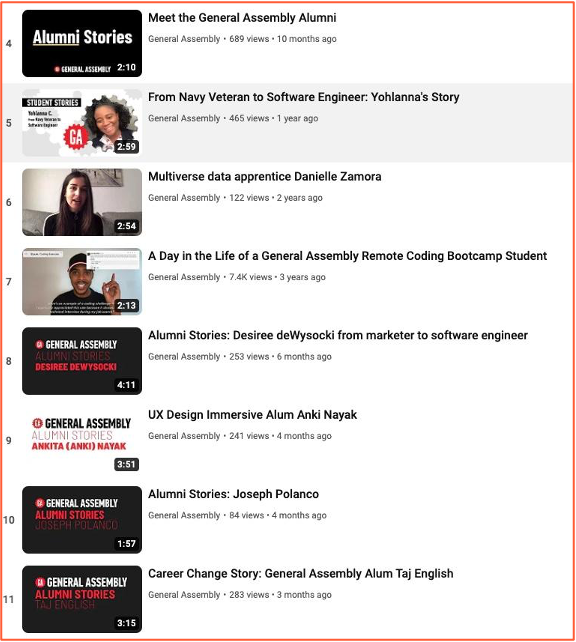
2. Higher Education Program Reviews
In the digital age, prospective students are more informed than ever. They don’t just want to know about your program; they want insights from those who have experienced it first-hand. This is where branded higher education program reviews come into play.
If you’re targeting prospects who are already aware of your program, developing content tailored for them should be a top priority. These individuals will likely search for reviews of your brand or specific programs – like “Harvard online MBA review”.
Control Your Program Reviews.. Or Someone Else Will!
You can see in the screen-cap below that on searching for reviews of Harvard’s MBA program, several negative reviews surface in the top video results.. No bueno for Harvard!
Another common pitfall among institutions is failing to provide relevant content that meets this need. For instance, Harvard’s online MBA page titled “Are Online Business Courses Worth It? 10 Benefits To Consider” might not resonate with someone looking specifically for course reviews.
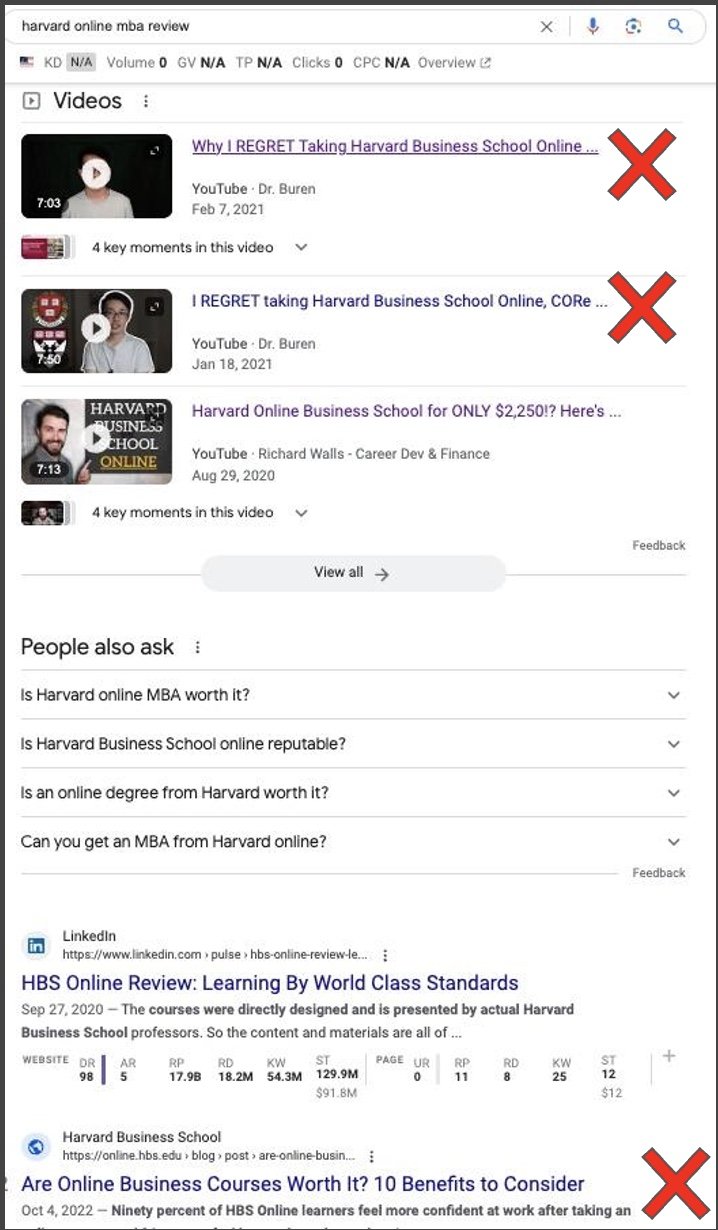
To cater effectively to these potential students, you need to produce dedicated content pages filled with authentic and comprehensive reviews from past and present learners.
Better Practices: Quantic’s Approach
An excellent example in this regard comes from our client – Quantic School of Business and Technology. We helped them create a dedicated reviews page, featuring testimonials by their students and graduates which now ranks highly when people search “Quantic MBA reviews”. The results speak volumes about the effectiveness of such targeted content strategies.

Sponsoring Higher Education Influencer Reviews & Video Testimonials
-
Sponsored influencer endorsements: Another effective tactic involves sponsoring influencers to write genuine product evaluations like E Cornell did with its online courses review. Such endorsements can boost your visibility in search engine results.

-
Video testimonials: General Assembly, for instance, has done an exceptional job with their alumni video reviews, which rank high on Google’s video results. Video content is a powerful tool that can help humanize your brand and make it more relatable to prospective students.
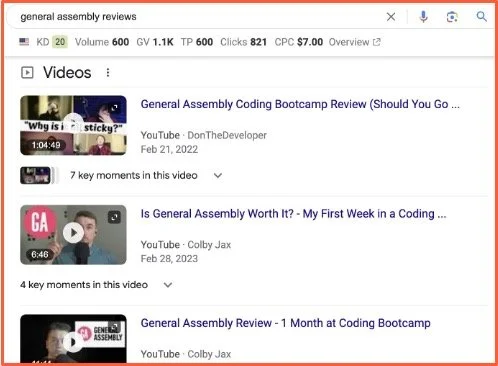
Creating diverse types of content – from written reviews to sponsored posts and videos – will enable you to dominate the search engine result page (SERP) landscape. This not only improves traffic but also boosts enrollments by providing prospects with the insights they’re actively seeking.
3. Higher Education Program Comparisons
In the realm of higher education marketing, one type of content that often goes overlooked is branded program comparisons. This involves comparing your institution’s programs with those offered by other institutions. For instance, a prospective MBA candidate might be searching for “Harvard versus Stanford MBA”. In such cases, having a well-crafted comparison on your site can provide valuable insights and tilt the scales in favor of your institution.
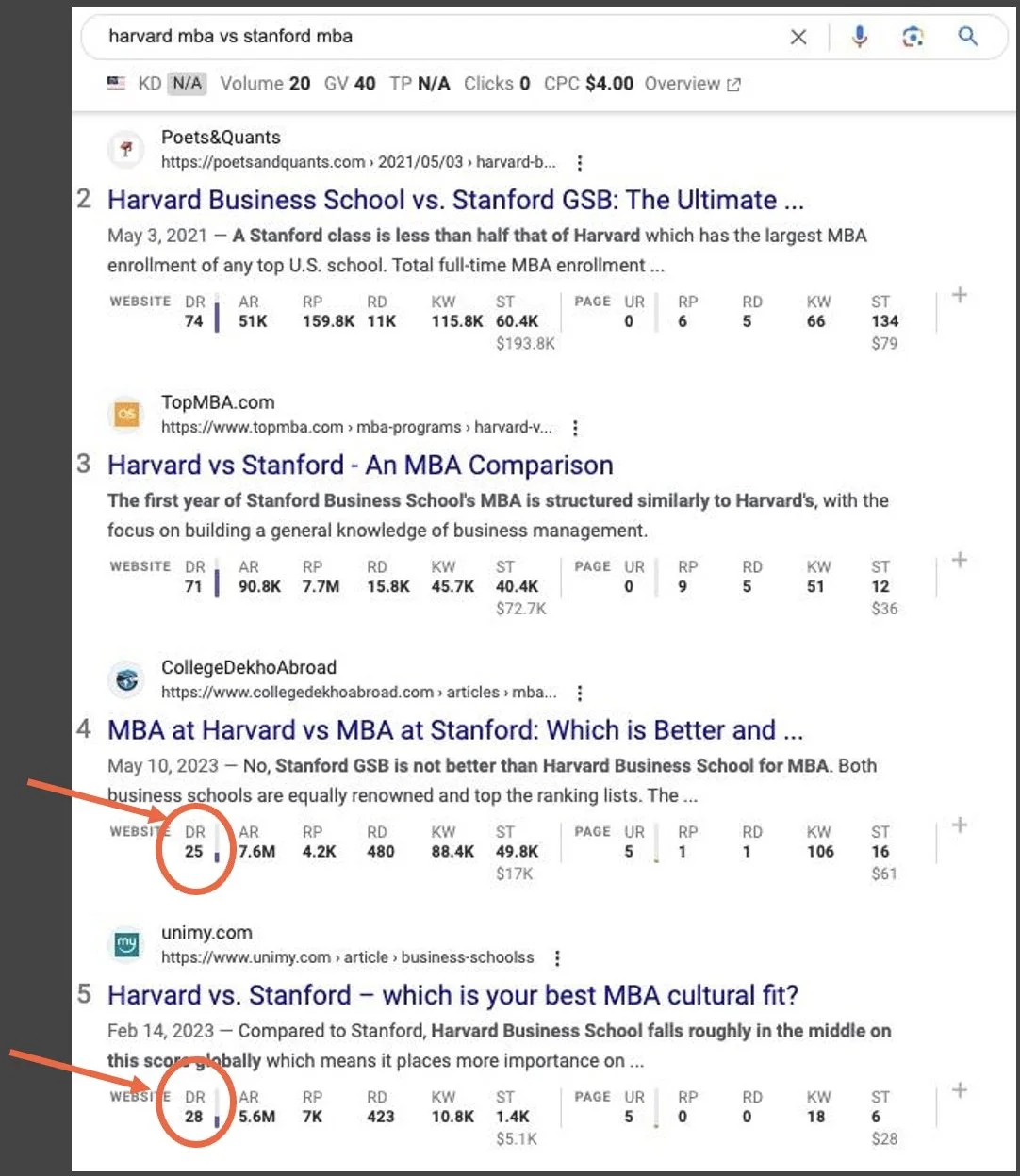
The Power of “Branded” Content
Branded content gives you control over how potential students perceive differences between similar programs at different schools. By presenting factual and positive aspects about your own program while also acknowledging strengths found elsewhere, you build trust with prospects who are researching their options.
Filling The Gap in SERPs
If we take a look at Google’s search engine results page (SERP), it becomes evident that there are numerous reviews for Harvard versus Stanford MBA but surprisingly none from Harvard University itself on this topic. This represents a missed opportunity to influence decision-making right when prospective students are actively seeking information.
Leveraging Your Website’s Domain Authority
Your website’s Domain Rating (DR) plays an essential role here as well. DR is essentially an SEO metric developed by Ahrefs signifying the strength of a website’s backlink profile on a scale from 0-100; higher scores indicating greater likelihood to rank well in search engines. Consider this: if we examine some pages ranking for these terms already, they have DR scores around 25 out of 100 whereas Harvard’s official site boasts score upwards towards 90! Clearly demonstrating how much easier it would be for them to claim these rankings with targeted content creation.
Taking Advantage of Competitor Comparisons
While it’s crucial to create content comparing your programs with those of top competitors, don’t stop there. Consider writing guides on other competitors versus each other and then subtly insert your institution into that discussion. This can help broaden the reach of your content while also establishing a presence in conversations where you might not have been considered before.
Incorporating these strategies into your higher education content marketing plan will ensure you are maximizing opportunities to attract and engage prospective students at every stage of their journey.
Taking Advantage of Forums like Reddit and Quora
Forums like Quora and Reddit are incredibly important to student prospects looking for education program reviews.
For example, note the search engine result page for “UCLA Medical School versus USC” is dominated by these two forums.

You want to become part of that conversation. You might even consider developing your own threads or enter this conversation somehow, have your alumni enter those conversations.
4. Higher Education Program Landing Pages
As we move forward in our student journey framework, we reach the Solution Aware stage. At this point, your prospective students are aware that they need a program like yours but aren’t yet familiar with what you offer specifically.
The majority of higher education institutions have these types of pages on their websites. However, many fail to properly optimize them for search engines which can significantly impact visibility and enrollment numbers.
Optimizing Your Higher Education Landing Pages
To ensure your educational program landing pages rank high in search results, it’s crucial to focus on SEO optimization strategies such as keyword targeting and content quality.
-
Keyword Targeting: Many marketers aim to rank their pages for competitive keywords like “best HR certificate online” or “best nursing program”. But your landing pages are NOT the appropriate type of content for this (more on the right type for that below..). For your landing pages, instead target keywords without the “best” modifier, such as “HR certificate” or “online EMBA”. See the results below:
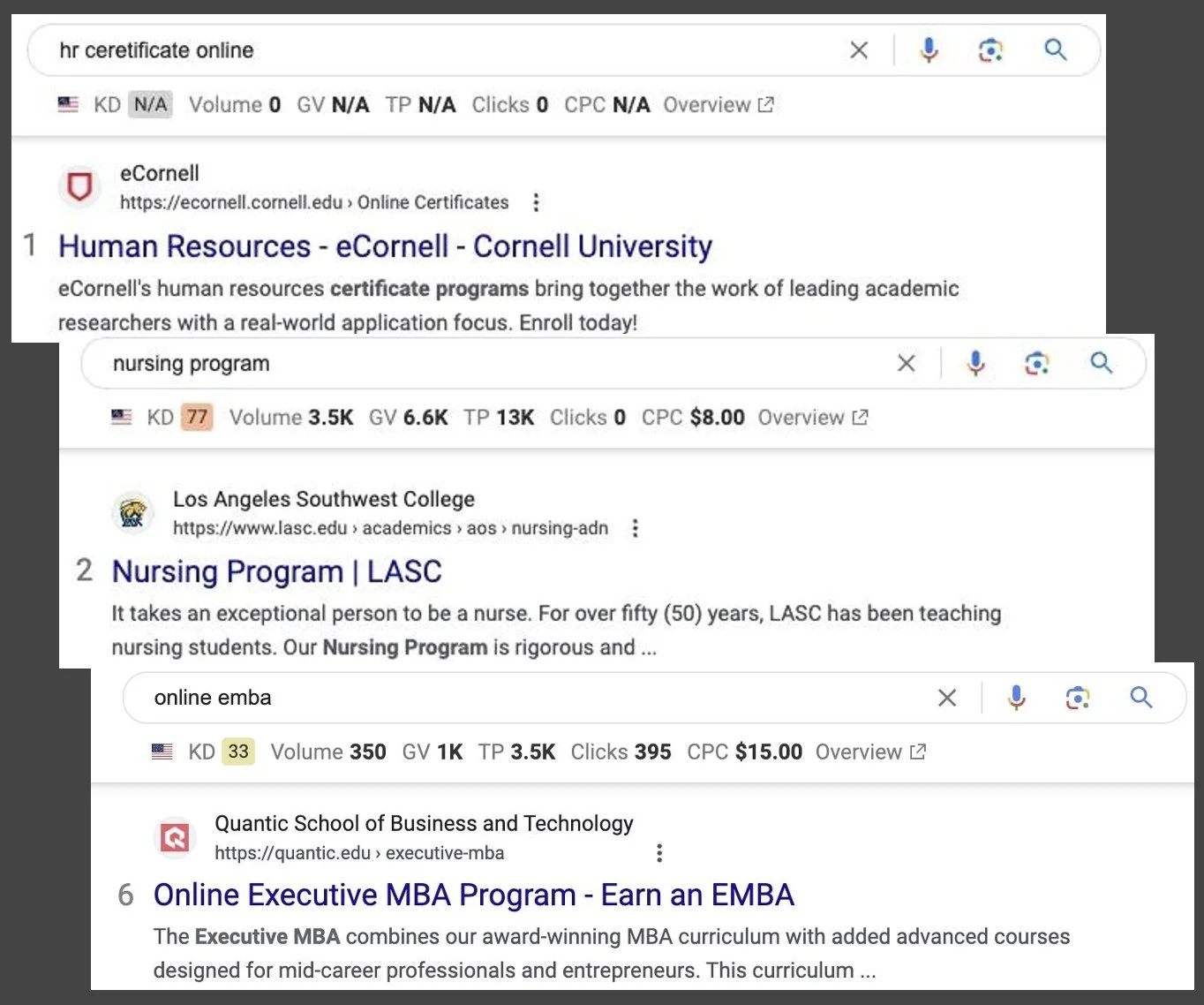
Avoid Common Mistakes When Optimizing Your Landing Page
Beyond keyword targeting and creating high-quality content though there are some common mistakes you should avoid when optimizing your landing page:
-
Poor Navigation: Your landing page should be easily accessible from your homepage. Don’t bury it deep within your site where search engines and users can’t find it.
-
Slow Load Times: Pages that take too long to load can frustrate users and lead them to abandon the site, which in turn negatively impacts SEO rankings.
To wrap up this section, remember – effective optimization of educational program landing pages is not just about ranking for competitive keywords but also providing valuable content that meets user needs while avoiding common pitfalls. By following these strategies, you’ll increase traffic to your institution’s website and boost enrollments significantly.
5. Higher Education Program Roundups
If you’re aiming to rank for the “best <X type of program>”, a roundup post that highlights your prospects’ options is essential. Prospects at this stage are seeking an unbiased list of their best choices, which will aid them in making informed decisions about their future course of action.
Many consultants and agencies may discourage you from attempting to rank for such terms, claiming it’s impossible due to domination by authoritative sites like US News and World Report, Poets and Quants for business schools, among others. However, we challenge this notion. Ranking your website with “best of” content is achievable; our client National Society of Health Coaches stands as proof.
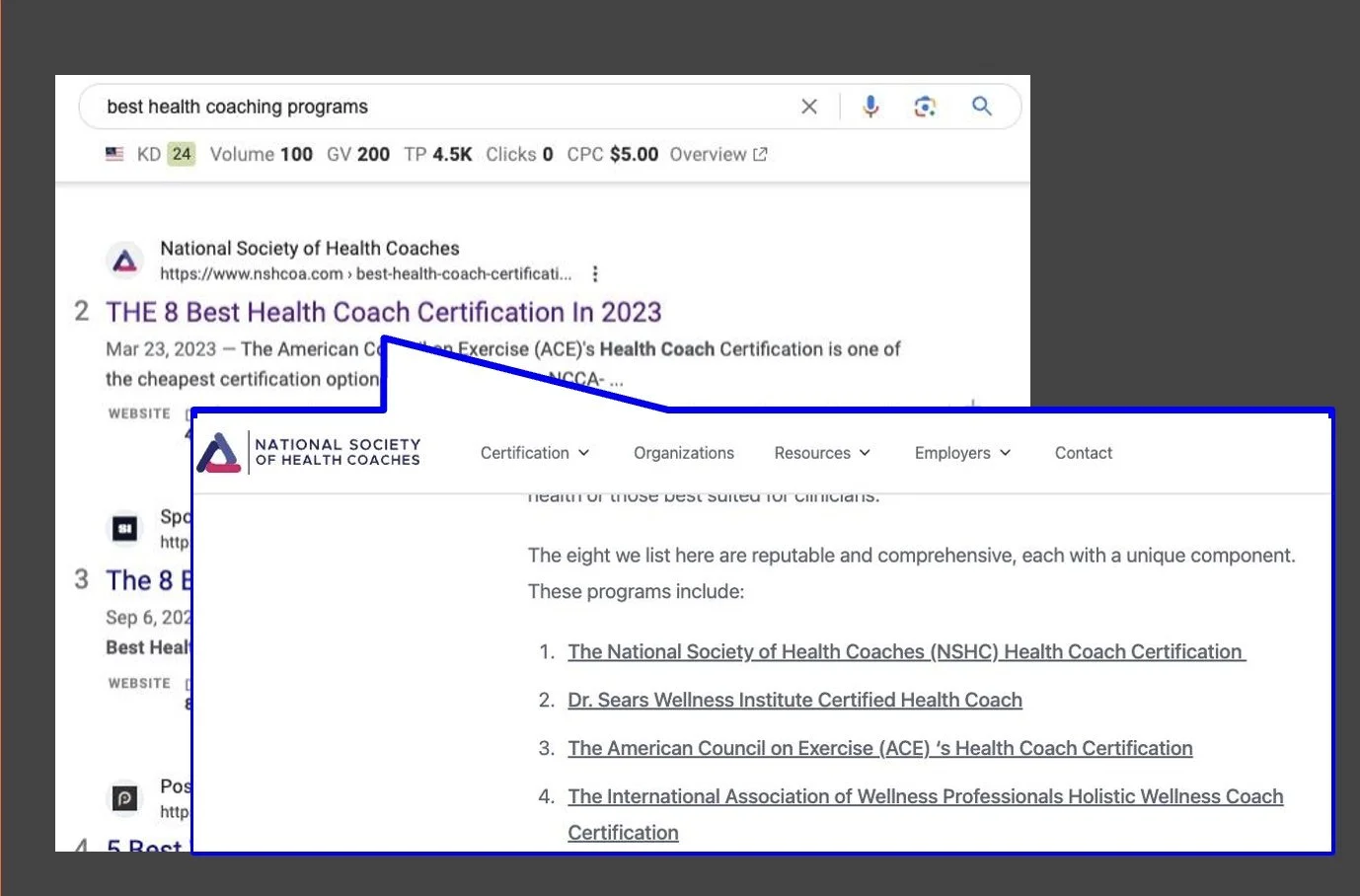
The Right Type Of Content Is Key
To successfully rank, however, requires the right kind of content. Your prospects want an impartial review that includes all top competitors in your field. Therefore, this page must discuss these competitors while simultaneously highlighting why your program differs and how it can better serve prospective students.
Your ideal student profile isn’t just looking for any reviews—they’re searching specifically for unbiased ones. One highly effective tactic involves sponsoring influencers or notable alumni who can record videos similar to what edX has done here.

Emphasize On Uniqueness And Value Proposition
In order to stand out amongst competition highlighted on these round-up pages, emphasize on unique selling points (USPs) – factors that make your institution different from others listed alongside it – be it innovative teaching methods or exclusive internship opportunities etc., Always remember: differentiation is key when competing against well-established institutions.
Create Engaging And Comprehensive Content
Lastly, ensure that your content is engaging and comprehensive. It should not only list the best programs but also provide detailed information about each one of them – course structure, faculty credentials, alumni success stories etc., This will help prospective students make an informed decision while positioning your institution as a trusted source of information.
6. “Best” Program Content for a Student Subset
Creating content that caters specifically to certain subsets of your student population is key. This is particularly crucial when dealing with solution-aware prospects who are actively searching for the best program suited to their needs and career goals.
For instance, consider our client Quantic. They’ve realized that they have an edge when it comes to serving MBA prospects who are engineers or software engineers looking to level up in their careers. Consequently, Quantic has invested time and resources into producing targeted content explaining why its programs offer these specific students the best route towards achieving their objectives.
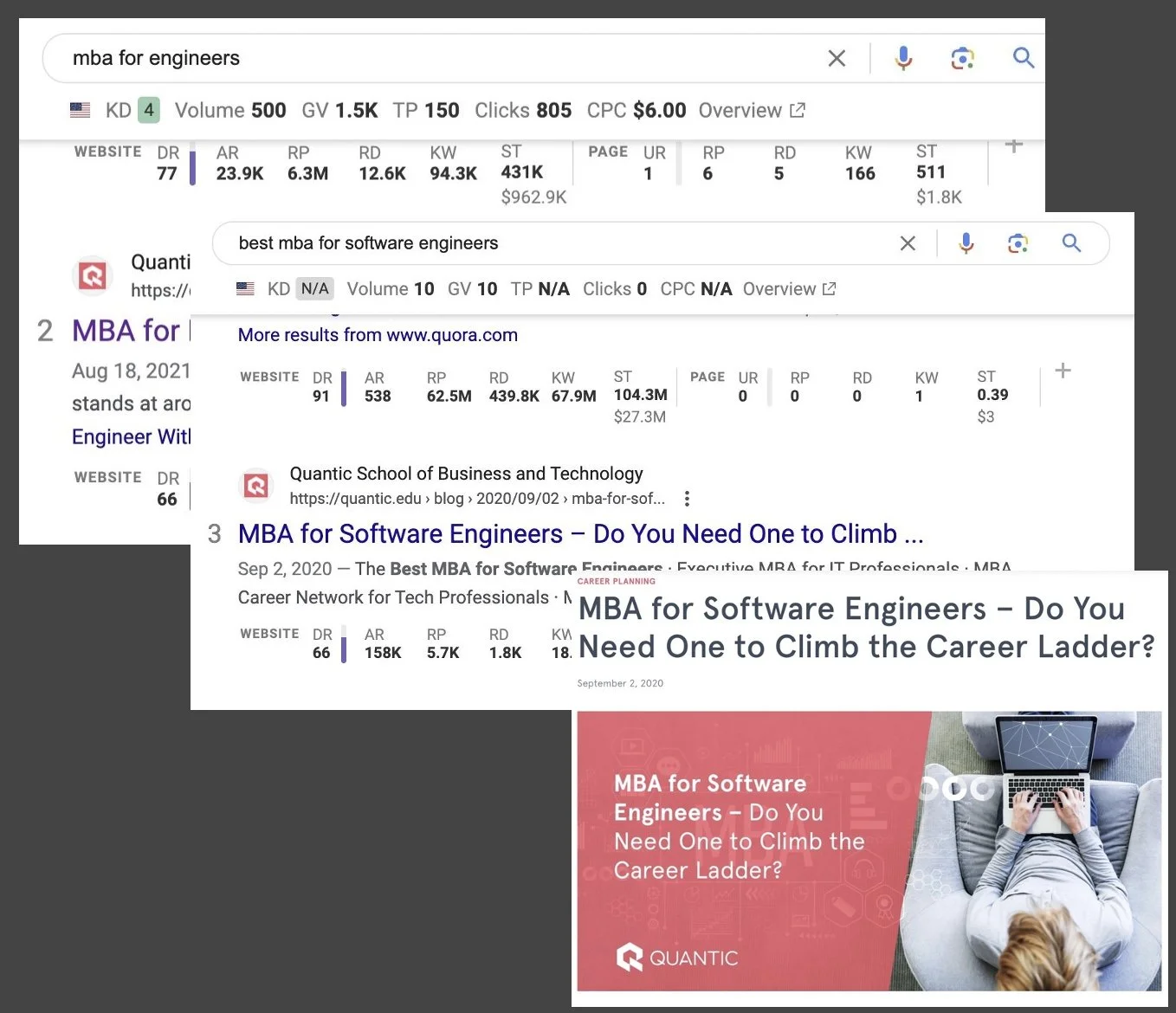
Crafting Content That Resonates With Your Ideal Student Profile
In order to replicate this success, you’ll need first to identify which groups within your student body could benefit most from tailored content. Once you’ve done this, focus on crafting engaging and informative pages detailing how your particular programs can help them reach their career aspirations faster or more effectively than other institutions’ offerings.
-
Demonstrate expertise: Highlight any specializations or unique aspects of your program that make it especially suitable for this subset of students.
-
Showcase testimonials: Use real-life stories from past students who fit into this category as proof points. Their experiences will resonate strongly with similar prospective enrollees.
-
Promote relevant faculty: If members of your teaching staff have notable achievements or industry connections related directly to these fields, make sure future students know about it!
Your ultimate goal should be creating compelling narratives around why these individuals would thrive at—and only at—your institution because you understand better than anyone else what they need to succeed.
Remember: the more targeted your content is towards a specific subset of students, the higher its chances of ranking well in relevant searches—and ultimately driving more traffic (and potential enrollments) to your institution’s website.
7. Higher Education Program Type Comparisons
As prospective students journey up the educational ladder, they become more aware of various solutions available to them. One critical decision point in this process involves choosing between different types of programs. For instance, should one pursue an MBA or opt for an EMBA? Is it better to aim for a Project Management Professional certification or a Certified Associate in Project Management (CAPM)? Should aspiring healthcare professionals go for Registered Nurse credentials or invest their time and resources into earning a Bachelor’s degree in Nursing (BSN)?

To help these solution-aware prospects make informed decisions, higher education institutions must provide content that not only educates about both program options but also guides them towards determining which is best suited to their career goals and personal circumstances.
By producing such comparative content that helps prospective students weigh their options effectively, your institution’s website becomes an invaluable resource on their educational journey. This not only increases web traffic but also builds trust with potential enrollees – turning your site into an enrollment generating machine!
8. How-To Content for Higher Education Student Prospects
In the realm of higher education content marketing, a key stage to target is the problem-aware phase. At this juncture, potential students may not be aware that your institution offers programs they’re interested in. However, they are cognizant of their desire to achieve specific goals or land certain careers.
Your mission? Develop engaging and informative how-to content that guides them on possible paths towards achieving these career objectives – whether it’s becoming a CMO, securing a job at Microsoft, or embarking on medical professions like doctors and nurse practitioners.
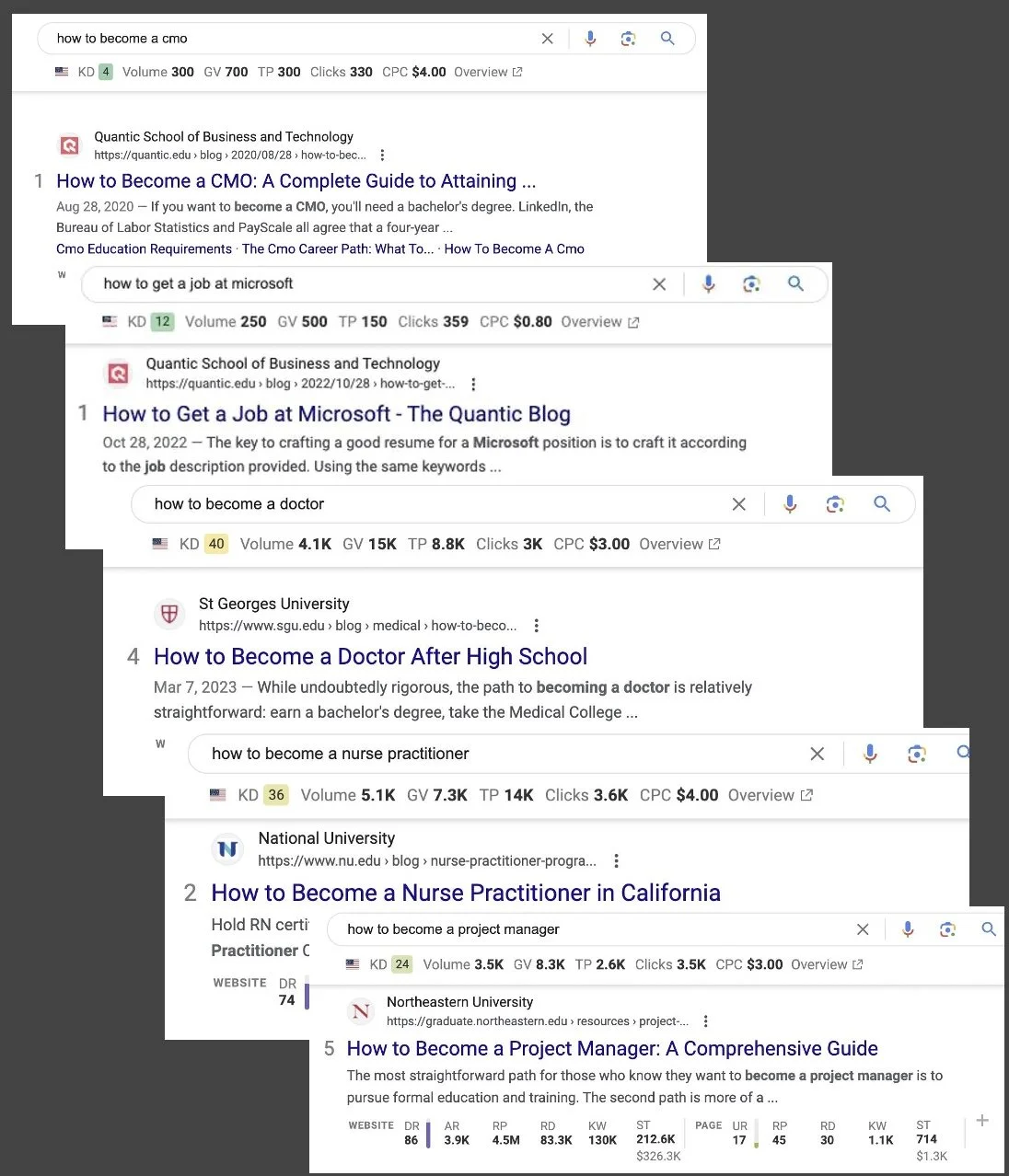
The Power of Problem-Aware Stage Content
By addressing the needs of prospects during their problem-aware stage with relevant how-to content, you stand an excellent chance to boost traffic significantly. Many clients we’ve worked with at Journeyengine have witnessed substantial results from focusing on this aspect.
An exemplary case study here would be General Assembly who has developed comprehensive video series catering specifically to prospective data scientists, UX designers, data analysts and software engineers among others. By doing so, they effectively address this crucial part of the student journey. General Assembly‘s approach illustrates just how effective tackling problem-aware stage can be when done right.
Crafting Effective How-To Content
To emulate such success stories in your own strategy calls for crafting high-quality educational material tailored towards helping prospects realize their dream careers. The aim should always be enlightening them about best practices and various options available for getting there.
-
Detailed Guides: Create comprehensive step-by-step guides detailing what it takes to enter desired professions – prerequisites needed; the kind of courses to consider; potential career paths, and so on.
-
Expert Opinions: Incorporate insights from industry experts. This could be through interviews or guest posts that provide a first-hand account of what it’s like in those professions.
-
Educational Webinars: Host webinars where prospects can directly interact with professionals in their desired fields. Such platforms are great for answering specific questions and dispelling any doubts they may have about these careers.
In conclusion, creating problem-aware stage content is an integral part of higher education marketing strategy that shouldn’t be overlooked. By doing so, you’re not only driving traffic but also positioning your institution as a trusted resource for achieving career aspirations.
9. Higher Education Templates and Tools Content
In the digital age, higher education institutions must leverage innovative content strategies to attract potential students and increase enrollments. One effective method is through offering valuable templates and tools that resonate with your target audience’s needs.
For instance, our client Quantic, a pioneer in online learning for startup founders, has successfully utilized this approach. They provide resources like training request letter templates or startup valuation calculators which are not only useful but also generate substantial backlinks boosting their SEO performance.
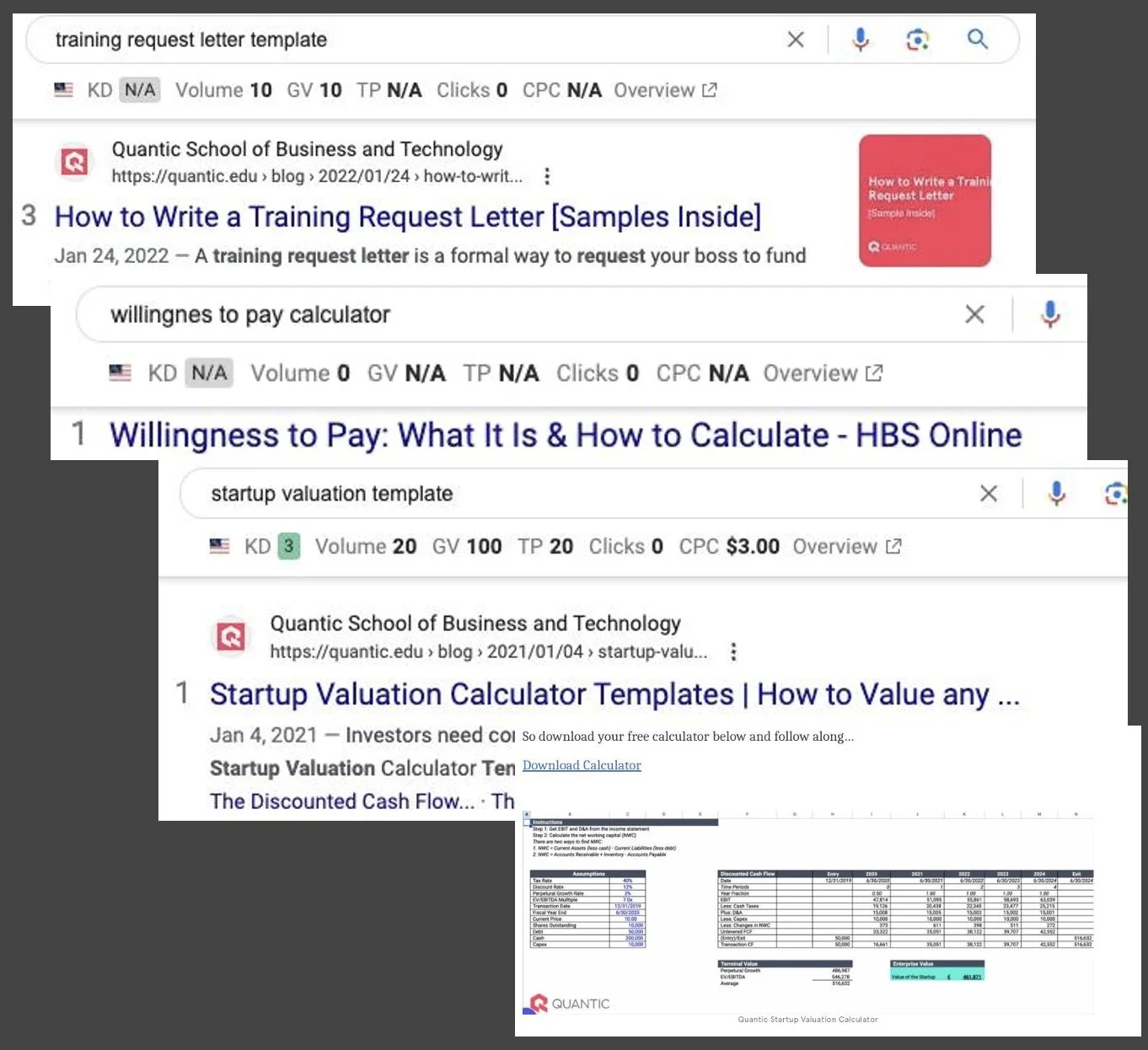
The Power of Practical Resources
Templates and tools offer practical solutions to common challenges faced by prospective students or individuals seeking further education. A willingness-to-pay calculator can help future learners understand how much they should be investing in their education based on various factors such as income level, career goals, etc.
Capturing Backlinks with High-Value Content
Beyond serving the immediate needs of users, these types of content often garner significant attention from other websites leading to an influx of backlinks—a key factor in enhancing search engine rankings. When you create high-value content like a well-crafted template or tool relevant to your niche market (e.g., EdTech), it’s more likely other sites will link back to yours as a credible resource thereby increasing your site’s authority and visibility online.
Achieving Success Through Strategic Implementation
To maximize results from this strategy, ensure that the templates/tools offered align closely with what your prospects need most at their current stage in the “student journey”. For example: If you’re targeting aspiring entrepreneurs looking for MBA programs – providing them with business-related tools/templates could prove highly beneficial.
This strategic alignment between user needs & your content offerings will not only enhance the user experience but also increase their likelihood of converting into enrolled students, thereby boosting enrollment rates for your institution.
10. Statistics, Infographics and Data for Higher Ed Marketing
In the digital age, content is king. But not all content is created equal, especially when it comes to generating organic backlinks to higher education websites. Backlinks are the backbone of search engine optimization (SEO), and acquiring them can often be a costly venture. However, savvy content strategists in the higher education sector are increasingly turning to a particular trio of content types that act as backlink magnets..
When it comes to content that naturally garners attention and backlinks for higher education websites, three formats stand out: infographics, statistics, and data. Not only are these content types visually appealing and informative, but they also offer a wealth of shareable information that can generate organic backlinks without the need for a hefty budget.
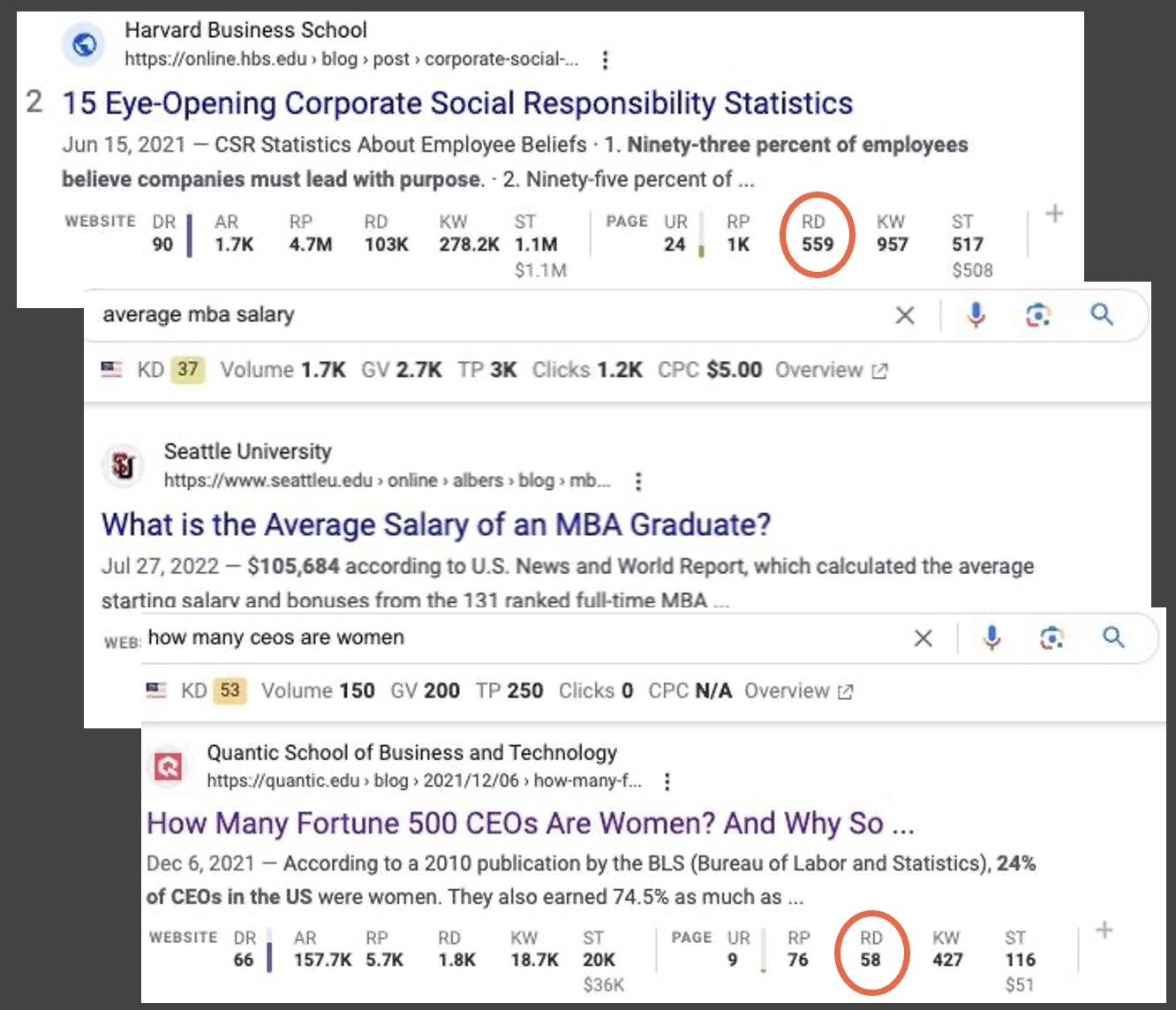
SEO Link Building for Higher Education
Take, for example, the case of Quantic. By publishing a statistic-laden article on the gender demographics of Fortune 500 CEOs, they earned valuable backlinks from 58 unique websites, including an unsolicited link from Berkeley.edu, a site with a domain rating of 91. This backlink, from a direct competitor no less, highlights the immense value and SEO power of high-quality, data-driven content.
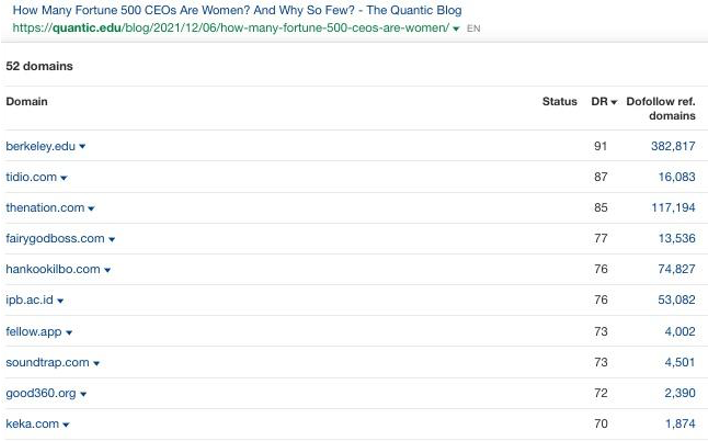
The lesson here is that higher education content marketers can achieve significant SEO gains by creating content rich with infographics, reliable statistics, and compelling data. This strategy not only enhances your site’s authority but also naturally attracts high-value backlinks, cementing your position as an informational nexus in the educational sphere.
Elevate Your Institution with the “Student Journey” Content Marketing Framework
By focusing on these 10 potent content types, your institution can not only rise in search engine results but also in the esteem of prospective students and the academic community. Be the catalyst for this change and become the champion your institution deserves.
Unlock Your Institution’s Potential with a Free “Enrollment Projection” Analysis
And now, for a proposition that promises to align with your institution’s ambition. We’re offering a glimpse into the future of your enrollment strategy without any initial investment. Allow us to present you with a free opportunity analysis, tailored precisely for your education business. Our comprehensive forecast will detail the expected increase in traffic, enrollments, and revenue from a meticulously designed three-month, “program-led” student journey campaign.
Embrace the chance to see the potential uplift before committing resources to the campaign. You’ll receive a detailed report complete with a visually engaging data visualization that you can share with your team. Imagine having a clear forecast of the success that awaits your institution.
Want a FREE Higher Ed Content Plan?
Here’s what you’ll get:
✅ Opportunity analysis prepared by our team
✅ Custom 3 Month “Student Journey” Content Strategy
✅ Forecast of Traffic, Applications and Enrollments
✅ A sweet “program-led” content dataviz to share with your team
Don’t miss this chance to make data-driven decisions that could redefine your student recruitment approach. To claim your free analysis, simply sign up below and schedule a quick call with us. We need just a sliver of your time to gather the necessary information, and within two days, your custom forecast will be ready.
Securing funding for your EdTech Startup is a tricky minefield.
Do it wrong, and you risk embarrassment.
Do it right, and you could be en route to owning a famous company.
In this article we’re going to expose proven, first-hand fundraising secrets straight from a founder who has the process down to a science.
You’ll discover the importance of problem-solving, defining product-market fit, and starting lean to attract investors.
By the end, you’ll have everything you need to scale and win. Even in a tough economy.
Along the way, we’ll be sharing insights from Rune Hauge, founder of Mentorcam. They navigated the world of venture capital to secure over $4m in funding.
Let’s dive in…
4 EdTech Fundraising Mistakes to Avoid
Are You Ready to Start?
Newbie EdTech startup founders have to wear multiple hats. And there’s some common pitfalls that come with that territory.
Here are the bases you need to cover before you even start fundraising…
1. Don’t Obsess about the the Idea. Instead — Focus on the Problem.
In the ideation phase there is usually an excessive focus on the idea itself.
While the idea is essential, its value lies in the problem it solves.
Rather than falling in love with a specific solution, you should prioritize understanding the core problem and its impact on the target audience.
By focusing on the problem, you can remain adaptable and open to evolving your solutions as you gain user feedback and insights.
2. Don’t Wait for Funds Just to Get Started!
Another common misconception is the belief that funding is necessary from the outset; to build a fully featured product.
This mindset is backwards.
Instead, start lean and focus on developing a Minimum Viable Product (MVP) that addresses the core problem.
By launching a simplified version of the product, you can validate your assumptions, gather user feedback, and iterate based on real-world insights.
Funding should be sought to scale rapidly once product-market fit is achieved, rather than as an initial requirement.
3. Don’t Be a Trend Chaser
There’s significant interest in leveraging AI platforms like ChatGPT within EdTech right now.
But don’t be so quick to adopt trends like this.
Controversial, I know.
Instead the focus should be on identifying real problems… first!
Then utilizing technologies like AI to provide effective solutions. But only if it makes sense.
While trends can be alluring, founders should avoid getting caught up in the hype.
Previous years have witnessed various trends, such as cryptocurrency, NFTs, content creation, and AR/VR, each capturing attention for a period of time.
Then fading away into the ether.
Don’t be the company that embarrassingly bandwagon jumps, right before a crash.
Stay grounded.
4. Be Wary of Scaling Without Product-Market Fit
While some companies may raise substantial capital without achieving product-market fit, we advise against falling into this funding trap.
Rapid scaling without solid product-market fit can lead to unsustainable growth and missed opportunities to address critical customer needs.
On top of that, investors look for companies with a genuine proven product-market fit. Because it demonstrates a viable business model and sustainable customer base.
Successful startups should actively work towards understanding their target market, iterating their product to address real needs, and gaining customer acceptance.
It’s a delicate balance between meeting customers’ needs and finding the right market demand for the product.
OK.. Does your product solve a real world problem? Do you have an MVP?
Great!
You’re now ready to raise funds, young padawan…
How Mentorcam Went From $0 to $4M in EdTech Funding [Case Study]
3 years ago, Mentorcam started as a platform that connects startup founders and entrepreneurs with famous mentors and advisors.
Despite having limited traction initially, the founder recognized the potential and created a simple deck to present their vision.
With an initial fundraising goal of $100,000, they leveraged their network of angel investors in the San Francisco community to secure the necessary capital.
This early success enabled them to refine their product and validate key proof points.
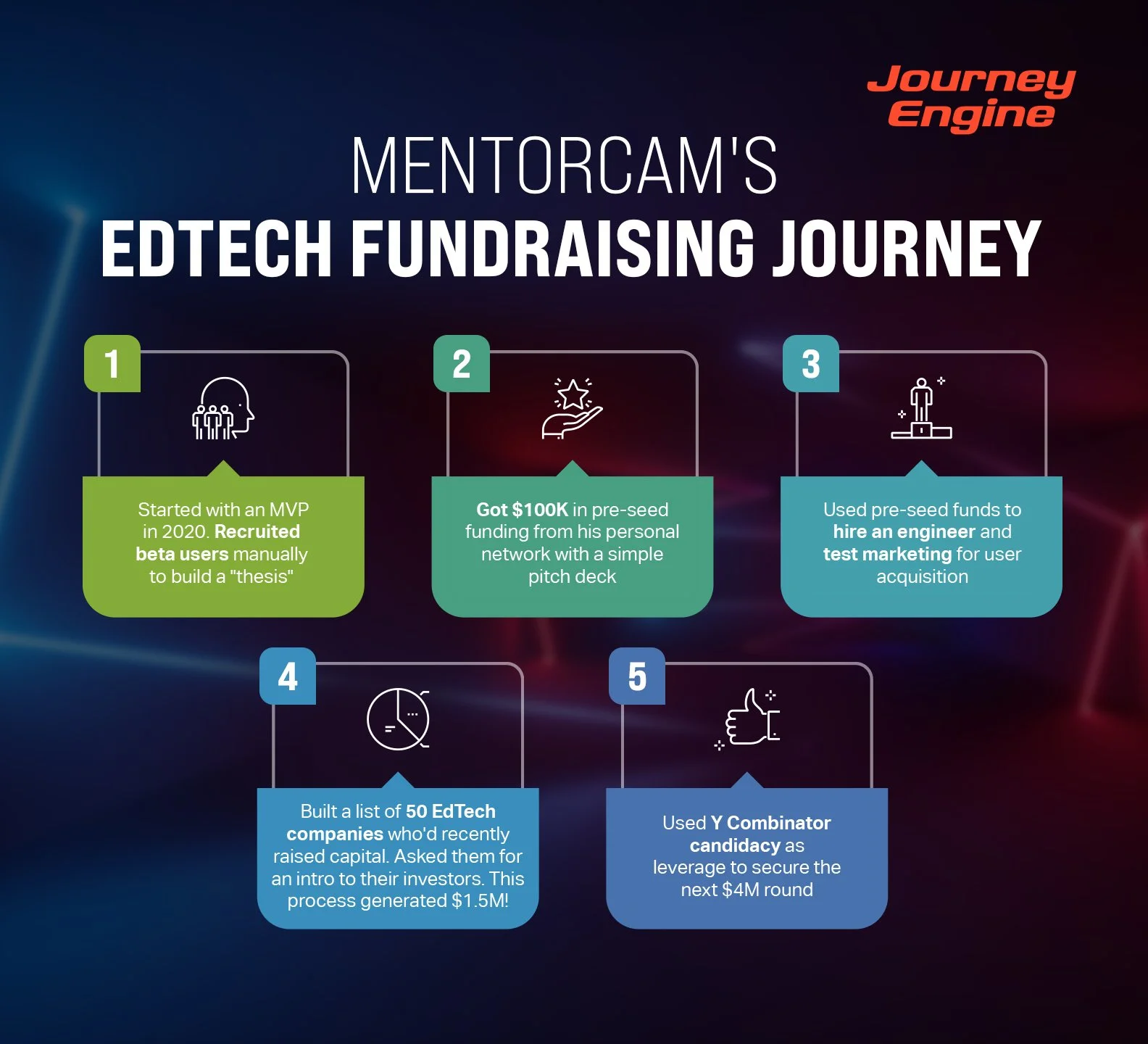
How To Raise Funds For Your EdTech Startup in 5 Steps
Funding is a means to an end, not an end in itself.
This mindset is invaluable throughout your journey.
Sometimes the fundraising process is smooth. Other times you’ll encounter challenges along the way.

Keep your ultimate goal in mind, regardless of the fundraising landscape..
1. Use Your MVP to Build a “Thesis” for Your Pitch
At the minimum viable product (MVP) stage, you probably have little to no funding and product awareness.
During this stage, the most effective approach may be recruiting users “manually,” like Mentorcam did.
This allows you allow you to engage directly with potential users, gaining invaluable insights into their needs and pain points.
Start by identifying your target audience and reaching out to them directly through targeted channels like social media groups, forums, or networking events.
Offer your MVP as a solution to their specific problems and encourage them to provide feedback on their experience with your product.
This hands-on approach not only helps in fine-tuning your product but also creates a sense of exclusivity and ownership among early users, increasing their commitment and loyalty.
Remember, the feedback and support of your early users can be the bedrock for building a solid foundation for your EdTech startup’s growth and success.
Wrap your insights from the MVP up into a pitch deck that tells the story of your MVP and your thesis about why your product will be a success on the open market.
You can learn more about how to create your pitch deck here.
2. Raise Your Pre-Seed Round
In the early stages, it can better to focus on a smaller goal of raising at least $100,000.
Many founders do this raise using their existing network.
If you know 4-6 people who are able to cut you a check for $15K – $25K, you’re in good shape.
By approaching your personal network, you are more likely to find individuals who already believe in your capabilities and are enthusiastic about supporting your venture.
And these initial investors may also act as valuable mentors, advisors, or even evangelists for your EdTech startup, opening doors to further opportunities and connections.
Don’t hesitate to reach out to friends, family, former colleagues, or acquaintances who might be interested in contributing to your venture.
Personal connections can be a powerful resource at this stage, setting the groundwork for future growth and attracting the attention of other potential investors and partners.
Remember, every investment counts, and your pre-seed round is a crucial stepping stone towards building a successful and sustainable EdTech startup.
3. Hire a Lean Team and Test Marketing Channels
Your “mini raise” provides the much needed ammunition to start scaling up and building.
Armed with their initial $100k in funding, the MentorCam team used the resources wisely to take their product to market and explore user acquisition channels.
Hiring an additional engineer alongside the technical co-founder allowed them to accelerate product development and achieve further proof of concept.
Building upon these achievements, the team set their sights on raising $1 million in pre-seed capital from venture capital firms (VCs).
But in the beginning, hire slowly.
Scaling prematurely without a solid foundation can result in wasted resources and unsustainable growth.
Exercise caution, maintaining a strong focus on achieving product-market fit before pursuing any aggressive scaling strategies.
A small team with defined responsibilities and objectives is better than a bloated team with no direction.

Need Help with EdTech User Acquisition?
Apply now for Your free User Acquisition Strategy
4. Get Introduced to Qualified VC’s
The next step is to go where the big money is.
Your goal now is to raise a significant amount of capital.
But approaching VCs can be a daunting task.
Fortunately, you can employ a strategic approach to increase your chances of success…
-
Research EdTech companies and other relevant businesses
-
Identify a list of companies that have previously received funding from VCs
-
Leverage the power of introduction by reaching out to the founders associated with these investors.
This approach will increase your visibility and help you secure initial interest from investors.
If this doesn’t work, then you’ll have to be persistent…
Save the most desirable VC firms for later in the process.
This ensures you gain valuable experience pitching to less preferred investors initially.
5. Raise Your Next (Seed) Round
As interest began to grow from their top-choice investors, MentorCam secured a $250,000 check from a boutique East Coast investor.
Using this as leverage, they closed a significant $500,000 check from renowned VC firm General Catalyst, known for investments in successful companies like Instacart and Snap.
Build momentum…
Secure funding from notable investors…
Become selective.
That’s the path for putting your company in the driver’s seat.
By being persistent, Mentorcam’s eventually oversubscribed their funding round.
Meaning, there was a surplus of interest in their company.
This allowed them to become selective and limit the investment size to avoid excessive dilution.
Ultimately, they raised an impressive $1.5 million, which paved the way for their acceptance into Y Combinator (YC), a prestigious startup accelerator program.
6. Consider Y Combinator
Riding the wave of success, Mentorcam was accepted into the y Combinator program.
Rune used the Y Combinator experience to close a $4 million seed round, solidifying their position in the market.
Funding priorities evolve from team and market potential in early stages to traction, revenue, and unit economics in later rounds.
Regardless of the stage, product-market fit is critical for success.
Never. Forget. That.
You might be wondering what Y combinator is. So let’s explore that in more detail now…
Y Combinator For EdTech Startups
What Is Y Combinator?
YC is widely recognized as the most prestigious startup accelerator globally, with an acceptance rate of merely 2% among all applicants.
While the experience may seem mysterious from the outside, YC operates transparently.
Acceptance into the program can be highly beneficial for startups that are pre-product market fit and have raised less than $2 million in funding.
Benefits of Y Combinator for EdTech Startups
1. Building Credibility
One of the notable advantages of YC lies in the credibility it brings to startups.
Being associated with YC instantly signals to investors, potential employees, and partners that the founder and their venture have undergone a rigorous selection process.
With YC’s endorsement, early-stage startups gain credibility and reduce perceived risk in the eyes of external stakeholders.
This added credibility significantly enhances interactions and opportunities.
2. Fundraising Leverage
YC’s strong brand reputation plays a pivotal role in securing investment.
Investors often rely on founders’ expertise and their ability to navigate competitive markets successfully.
But predicting a startup’s success at an early stage remains a challenge.
The YC badge of approval helps investors evaluate opportunities based on pre-vetting.
This advantage translates into increased fundraising leverage for YC-backed startups, allowing founders to negotiate favorable terms and attract investors who are excited about the YC brand.
3. Access to Networks
Apart from financial support, YC provides access to an invaluable network of founders who are part of the program’s cohort.
This network fosters collaboration, knowledge sharing, and potential partnerships among entrepreneurs.
Establishing connections with like-minded individuals who face similar challenges can be immensely impactful for long-term success.
By harnessing the power of this network, founders can access diverse expertise and leverage collective experiences.
Conclusion
In the fast-paced world of EdTech startups, securing funding can be a game-changer.
However, it’s crucial to avoid common pitfalls and prioritize problem-solving, product-market fit, and lean approaches.
Always remember that funding is not an end in itself, but a means to achieving your vision.
A well-executed funding strategy, backed by a genuine product-market fit WILL become the driving force behind your startup’s success.
Good luck!
Need Help with EdTech User Acquisition?
Apply for Your Free Strategy Today:
FAQ
Why is it hard for EdTech startups to get funding?
Funding can be challenging due to high competition, lack of a proven track record or product market fit, and investors’ risk aversion.
What is the main problem with using a venture capitalist for a startup company?
The primary issue lies in potential loss of control and equity dilution that founders may face when partnering with venture capitalists.
Can startups grow without funding?
Absolutely. Startups can leverage bootstrapping, customer-funded models, or revenue-based financing to fuel growth without external funding.
How many VCs fail?
An estimated 75% of VC-backed firms do not return investors’ capital, indicating a high failure rate in this sector.
As the EdTech and online education industries continues to evolve, so must your EdTech Marketing Strategy.
Avoid wasting your budget chasing vanity metrics.
In this article, we show you how to create a strategy that generates sales, pipeline and revenue.
And the supporting tactics you need to explode growth.
It’s easy to get caught up in the excitement of various tactics and channels.
But before diving into the nitty-gritty of execution, it’s essential to understand what a marketing strategy truly entails.
What is an EdTech marketing strategy?
A marketing strategy goes beyond the specific actions and tactics employed to promote a product or service.
It encompasses the broader picture of a company’s brand-level strategy and its differentiation from competitors.
How a business positions itself, and how that positioning is reflected in its overall messaging.
To illustrate the disparity between marketing strategy and tactics, let’s consider a few examples.
Edtech marketing strategy examples
-
Duolingo
Duolingo is an EdTech company specializing in language learning software.
Their ideal customers are individuals who are eager to find the most effective way to learn and retain a new language.
Duolingo’s marketing strategy revolves around showcasing the gamification features of their program.
By emphasizing the fun, speed, and ease of learning, they position themselves as the premier solution for language learning.
There’s a great article here on EdTech Business models from our friends at FourWeekMBA. Check it out to learn more about EdTech positioning and business models.

2. Masterclass
Masterclass is a platform that attracts users through the authority and celebrity status of its experts.
People are drawn to Masterclass because they want to learn from industry leaders they already trust and admire.
Consequently, Masterclass’s marketing strategy is distinct, leveraging the expertise and reputation of its instructors to appeal to their target audience.
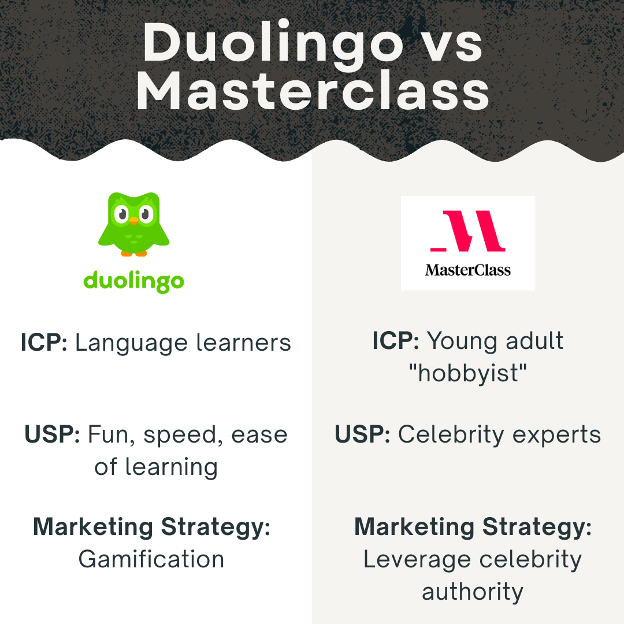
3. Quantic
Quantic caters to professionals looking to advance their careers, secure new roles, and increase their salaries.
While both Duolingo and Quantic are educational programs, their marketing strategies diverge due to different customer pain points.
Quantic’s audience is less concerned with pedagogical features and more focused on achieving tangible business outcomes.
Their higher education content marketing strategy revolves around addressing these specific pain points.

We increased this EdTech product’s revenue by 20X — through organic traffic!
✅ Page 1 Ranking on Target Keywords for all Content Pillars.
? 3X the Organic Site Traffic (Hockey-Stick Growth)
? PPC Value Upwards of $100K per Month (Ahrefs).
? 20X Increase in Conversion Value (per Google Analytics).
? 29X ROI for JourneyEngine’s Content + SEO Service.
Want to see how we did it, step-by-step?
Two Common Mistakes in EdTech Marketing Strategy
Mistake #1: Reversing the order of marketing operations
Here is the simple formula for effective marketing campaigns:
Content + Promotion + Measurement
That’s it.
Great marketing campaign incorporate each of these.. IN THIS ORDER!
Avinash Kaushik wrote a classic post on this framework here.
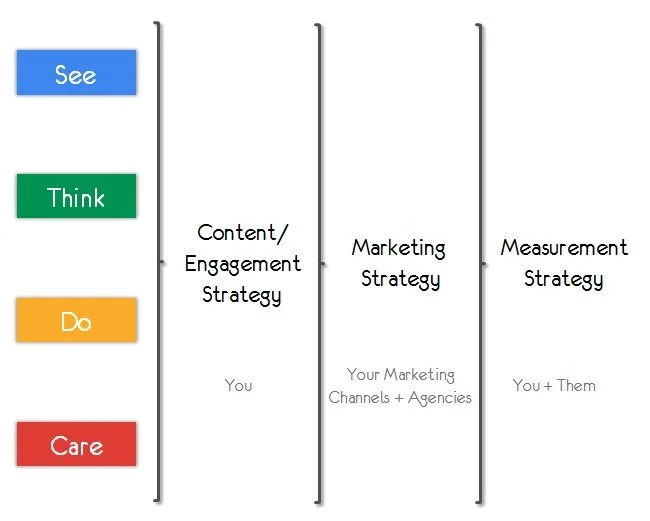
One of the most common mistakes for early stage EdTech and eLearning companies is attempting to engage in social media marketing without a library of content that adds value and addresses your prospects actual pain points using product-led content.
Without a these resources to draw from, you’ll face challenges in creating meaningful and consistent social media campaigns.
To avoid this, you need to prioritize building a library of valuable content that addresses customer pain points.
First and foremost.
Some companies jump straight into promoting sales pages and conversion-focused messaging without first providing value through helpful content. That’s a mistake.
Resources that entertain, engage, and solve problems are the ONLY was to build trust and credibility with an unaware (cold) audience.
Once this foundation is established, you can gradually introduce sales messages and promote their content assets through various marketing channels.
Mistake #2: Selling the Shovel (Instead of the Hole)

Your prospects DON’T care about the inputs (features) of your product.
They could care less how long and hard your product team has spent developing (sorry).
They care about one thing: the output (benefits) to them.
Take, for example, Quantic from the example above. Their prospects aren’t overly interested in platform or the pedagogy.
So focusing only on the platform in marketing messaging would be a classic case of “selling the shovel”.
Instead, their prospects pain points revolve around their difficulty advancing in their career, being promoted into executive positions.
And on the enterprise sales side; companies struggling to train their executives in leadership skills
So they focus on those pain points in their content.
They create resources and guides on how to solve these pain points. And then weave the product back into the content using student and enterprise case studies.
Differentiating Your EdTech Marketing Strategy
Step 1- Identify Pain Points ?
Deeply understand your ideal customer profile and their pain points.
This knowledge can be acquired by engaging with internal team members who regularly interact with customers.
-
Sales teams
-
Support teams
-
Customer success teams
These can provide valuable insights into the challenges customers face.
By effectively communicating your solution and addressing their pain points, you can guide potential customers through your marketing funnel and convert them into loyal advocates.
Here are some strategies to help you identify and address common customer pain points:
-
Conduct surveys to gather feedback from customers
-
Monitor social media channels for comments and feedback
-
Provide excellent customer service and support
-
Regularly update your product or service offerings to meet changing needs
-
Offer training and resources to help customers get the most out of your product or service
-
Regularly revising and providing resources to help customers utilize your product.
Step 2 – Solidify Your UVP (Unique Value Proposition) ?
Crafting a unique value proposition and developing targeted marketing messaging is the next step.
Clearly communicate how your product differentiates itself from competitors and addresses customer pain points more effectively.
The goal is to story-sell your product as the optimal solution to your customers needs.
Step 3 – Design Your “Value Ladder” ?
If you want to get the best possible ROI from your content then you need to strategically guide potential learners through a journey of increasing value — from free to premium.
Enter the “value ladder” — a marketing approach designed to take customers on a journey from low-priced entry-level content to a high-priced premium offer.
For example, let’s take edX.
They have a highly sophisticated, multi-tier value ladder starts with free courses and ends with masters programs valued in the tens of thousands..
It works by generating interest in free courses through Product-Led Content.
And then sequentially upselling free course students into higher tiers over their lifetime with the company, using marketing automation and other channels.
Check out my LinkedIn post for more detail:
Ok we’ve covered a lot in this article so far.
At this point you should know the difference between an overarching marketing strategy and individual tactics.
So, let’s examine the latter now…
EdTech Marketing Tactics
I. SEO For EdTech Companies
Understanding the Real Value of SEO
At the outset, it’s essential to recognize that SEO has evolved beyond merely trying to rank for a single high-volume keyword.
While ranking for specific terms is valuable, it is often challenging to outrank established authority sites for competitive keywords.
Focusing on customer pain points is one of the few remaining “blue oceans”.
So, we’ve adopted a broader approach.
Effective SEO now means understanding the customer journey and identifying the pain points your products address.
Now, we conduct thorough keyword research and align content with customer needs.
That way?
Our clients attract organic traffic that is more likely to convert into leads and customers.
Here’s our new keyword research process…
1. Identify customer pain points by engaging stakeholders from sales, support, and customer success teams.
2. Create a list of topics that resonate with the clients target audience.
3. Validate these topics using keyword research tools to identify primary and secondary keywords relevant to their content.
Hire us for your next campaign here
Optimizing Website Structure and Architecture
EdTech companies should focus on two categories of pages on their websites: content pages and sales pages.
Content pages serve as a library of topics that provide value to their target audience and introduce them to the brand.
Sales pages, on the other hand, showcase the edtech product or service and aim to convert visitors into customers.
The key is to tie these pages together gracefully by transitioning from value-driven content to product and service offerings.
A seamless flow from informative content to sales pages improves user experience and increases the likelihood of conversion.
[Screenshot]
The Importance of EdTech Backlinks
Backlinks remain a critical factor in SEO rankings after optimizing on-page elements.
However, building high-quality backlinks requires having a critical mass of valuable content on your website.
Reaching out to relevant publishers and promoting content that offers free value to audiences can lead to more effective link-building efforts.
Technical SEO Issues
Technical SEO is still essential for ensuring that websites are search engine-friendly and that there are no red flags impacting search visibility.
However, the emphasis on technical audits has decreased.
You should focus more on creating high-quality content and less on frequent technical audits.
Resolving any technical issues that arise promptly is crucial to maintain search traffic and leads.
2. Email Marketing For EdTech
Email campaigns play a crucial role, particularly in the early stages of the buyer journey.
The primary objective is to generate interest, engage the audience, and build a subscriber base through valuable content.
Eventually, email can become an essential tool for lead generation and nurturing.
Email campaigns serve various purposes in EdTech marketing. And there are multiple series’ you can employ…
-
A trial-to-paid sequence to convert trial users into paying subscribers.
-
Relationship-building sequences help convert marketing qualified leads into trial users.
-
Topical newsletters maintain interest and provide ongoing value to customers, educating them on how to address their pain points effectively.
Despite email sometimes being overlooked in favor of other marketing efforts, it is a crucial component.
The majority of website visitors are not immediately ready to take desired actions, such as signing up for a free trial or making a purchase.
Therefore, implementing email capture mechanisms, such as content upgrades or opt-in forms, is essential to capture interest and initiate ongoing correspondence.
Building relationships
The relationship-building aspect of email marketing is also significant.
By leveraging a series of emails, businesses can guide prospects through a journey of understanding why and how their product solves their problem.
This gradual process helps build belief and trust, leading to more engaged and committed users.
Additionally, in the case of demo calls, a pre-sold prospect resulting from email correspondence is more likely to convert compared to a cold lead.
[Insert belief map]
Gated Content [Content Upgrades]
Gating mediocre content like a precious diamond that needs to be protected is silly.
No one wants it anyway ??♂️
You’ll receive no downloads or leads.
Then rattle off blanket statements like “gated content doesn’t work”.
Of course it doesn’t if you can find what you’re gating elsewhere… with generative AI or a simple Google search.
People are going to bounce and do just that!
Here’s a few scenarios where gating content makes perfect sense…
↳ You’ve got a unique template that helps users reach their desired outcome faster
↳ You custom built a tool that cuts users time to result in half
↳ You’ve executed independent research that you can’t find elsewhere
3. Leverage Data
EdTech companies can leverage data and analytics to improve their marketing strategies in several ways:
Cut Down Your KPI Metrics
Choose a few key metrics that are relevant to your role and can be realistically tracked and measured over time.
This could include leads, revenue, click-through rates, conversion rates, or other relevant performance indicators.
Set Targets and Segment by Content and Channels
Define specific goals for each content piece and marketing channel in advance, and evaluate performance against these targets regularly to determine which pieces of content and channels are effective and should be prioritized.
Notice how in the below content calendar we’ve set a target for leads and organic traffic for EACH AND EVERY content piece.
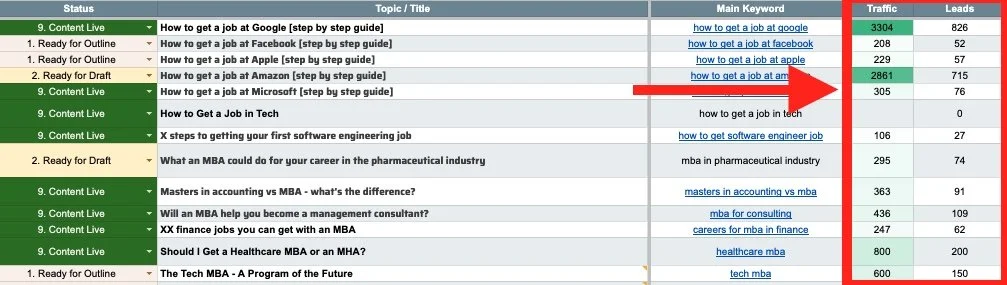
And then check out how we’re segmenting our analysis by content type here in this dashboard.. WOAH our blog content is pulling in an 11X lift in SQL’s!

That’s targeting and segmentation in action, baby!
Make Sexy Dashboards! (Seriously though).
If you give your marketing team an unsightly “data puke” with 50 metrics on it.. that’s the response you should expect. ?
So give your team a pretty marketing dashboard that they actually comprehend. One they’ll even find “fun” to use!
Focus on presenting the most important information in a clean and simple format.
Or just steal ours! ?
Want your own Product-Led ROI Forecast?
-
Learn what Product-Led content can do for your business
-
Discover the Biggest Opportunities for Your Website
-
Forecast Traffic and ROI from your Campaign
-
Sell-through Product-Led Content to your Team
Automate the Flow of Data
Utilize ETL (Extract, Transform, Load) tools such as Supermetrics or Stitch to automate data collection and reporting processes.
This helps save time and allows teams to focus on analyzing data and deriving insights rather than manual data management tasks.
By leveraging data and analytics in these ways, EdTech companies can gain a deeper understanding of their marketing performance, identify areas for improvement, and make data-driven decisions to optimize their strategies.
4. Social Media Marketing For EdTech Companies
When it comes to distribution, social media platforms play a vital role in amplifying your content and engaging with your target audience.
Treat your website as a library of resources that cater to customer needs.
Social media then becomes a platform to repurpose and distribute these resources effectively.
Organic social media engagement is about igniting conversations with intriguing content snippets that spark interest and generate attention.
It’s an opportunity to build trust and authority by offering unique perspectives as a human and as a business.
On the other hand, paid social media strategies can be used to move potential customers further down the marketing funnel, leveraging retargeting and tailored content to specific audience segments.
5. Prioritize User Experience (UX)
As an EdTech marketer, you may have come across the term ‘user experience’ or UX being used often.
But what does it really mean?
And why is it so important in your marketing strategy?
In simple terms, user experience refers to how easy and enjoyable your website or app is to use.
Creating a pleasant connection between the user and your product is essential to ensuring that they return.
Google has made it clear that they prioritize websites offering superior user experience. This means that if you want to rank higher on search engine results pages (SERPs), focusing on UX should be at the forefront of your site’s design layout or when creating new features.
Role of Google Ranking Factors in Prioritizing User Experience
Google emphasizes UX in order to ensure users have the most enjoyable online experience possible.
They achieve this by using certain ranking factors related to UX, like mobile-friendliness, safe browsing and HTTPS-security.
To put it simply: If Google sees that people enjoy using your site – meaning they stay longer and interact with more content – then its algorithms will likely boost its visibility in SERPs over time.
Ways To Improve Site Usability And Overall User Satisfaction
-
Simplicity: Keep it simple, stupid. Make sure everything from navigation menus to contact forms are straightforward and easy-to-use. Don’t overwhelm visitors with too much information all at once; instead break things down into manageable chunks.
-
Faster Load Times: Ain’t nobody got time for slow-loading sites. Use tools like Google PageSpeed Insights to check your page speed and optimize it for faster load times.
-
User-Friendly Design: A clean design not only looks professional but also helps users find what they’re looking for quickly without any confusion. Make sure your design is consistent across all pages and devices.
A positive user experience often translates into higher visitor retention rates as well as improved search engine rankings over time.
So whether you’re just starting out with SEO or are already an expert, remember: don’t neglect UX.
This doesn’t mean making drastic changes overnight – rather continuous small improvements based on feedback from real users will lead towards better usability and satisfaction overall – ultimately boosting both customer loyalty and organic traffic growth alike.
The Future Of EdTech Marketing Strategies
The EdTech industry is evolving in terms of marketing strategies, and several trends are expected to be important in the coming years…
Automation and AI
The advancements in data automation and AI are transforming various aspects of marketing.
By automating repetitive tasks and leveraging AI capabilities, marketers can focus more on creating original perspectives and providing unique value.
Originality and Expertise
Regurgitating information from other sources is becoming less valuable, and search engines like Google prioritize content that demonstrates expertise, experience, authoritativeness, and trust.
Integration of Marketing Channels
The silos between different marketing channels are expected to diminish and dissapear.
Strategies implemented on social media will have more impact on website content, and advancements in technology will facilitate better integration and coherence across channels.
Human Value and Creativity
As automation takes over mundane tasks, marketers can invest more time in activities that require human creativity and provide distinct value.
Coming up with original perspectives, developing opinions, and infusing content with personality and expertise become essential.
Overall, the EdTech industry is moving towards more strategic and impactful marketing approaches that leverage automation, AI, originality, and expertise to deliver value to learners and customers.
At Journey Engine we stay on the cutting edge.
In fact, we never start a campaign before doing a full traffic projection.
We’ll project the amount of traffic and leads you can expect from an organic campaign.
We’re currently offering these projections for free, you can take advantage of this offer here.
Want Your Own Product-Led Content Strategy and ROI Forecast?
-
Learn what Product-Led content can do for your business
-
Discover the Biggest Opportunities for Your Website
-
Forecast Traffic and ROI from your Campaign
-
Sell-through Product-Led Content to your Team
What an exciting time to be in EdTech!
Funding, exposure and unreal growth are in abundance. Feels like we’re entering a new age of education.
Making it the perfect opportunity to take stock.
How are Your Ed Tech company’s SEO and Content marketing performing against sites that share similar size and ranking power?
Fortunately, our engineers built a tool that answers that question directly:
Want to know exactly how much you stand to improve and how to edge out these competitors right now?
The EdTech benchmarking tool is great.. but my team and I want to take a much deeper look at your site (still free)! If you qualify, we’re going to give you an Organic Traffic Projection report and strategy customized for your business.?? Check that out here:
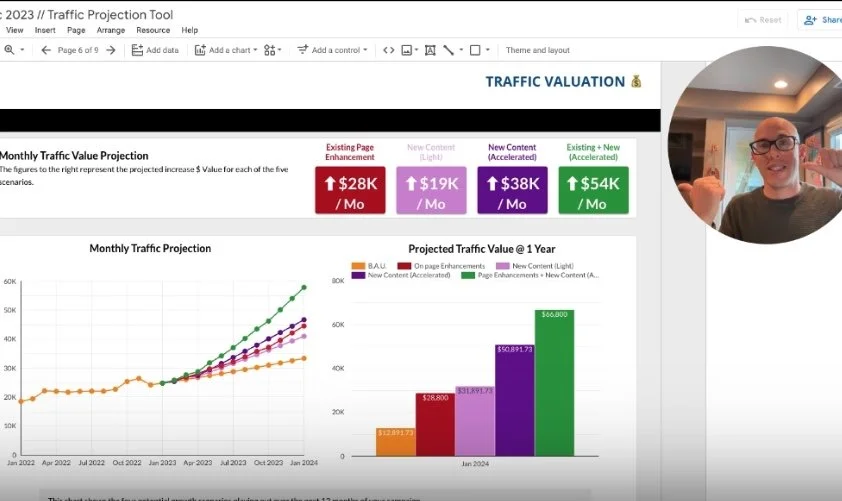
Want a free product-led content strategy for your EdTech business?
We’ll give you the blueprint + forecast the results..
Now back to the benchmarking tool..
If you’re in a marketing function at an EdTech company, then pay close attention.
You’re about to discover exactly how to scale up your organic content efforts. First, let’s look at the metrics we analyzed.
SEO Metrics for Ed Tech Companies
We analyzed 988 EdTech websites. Here’s what we looked at…
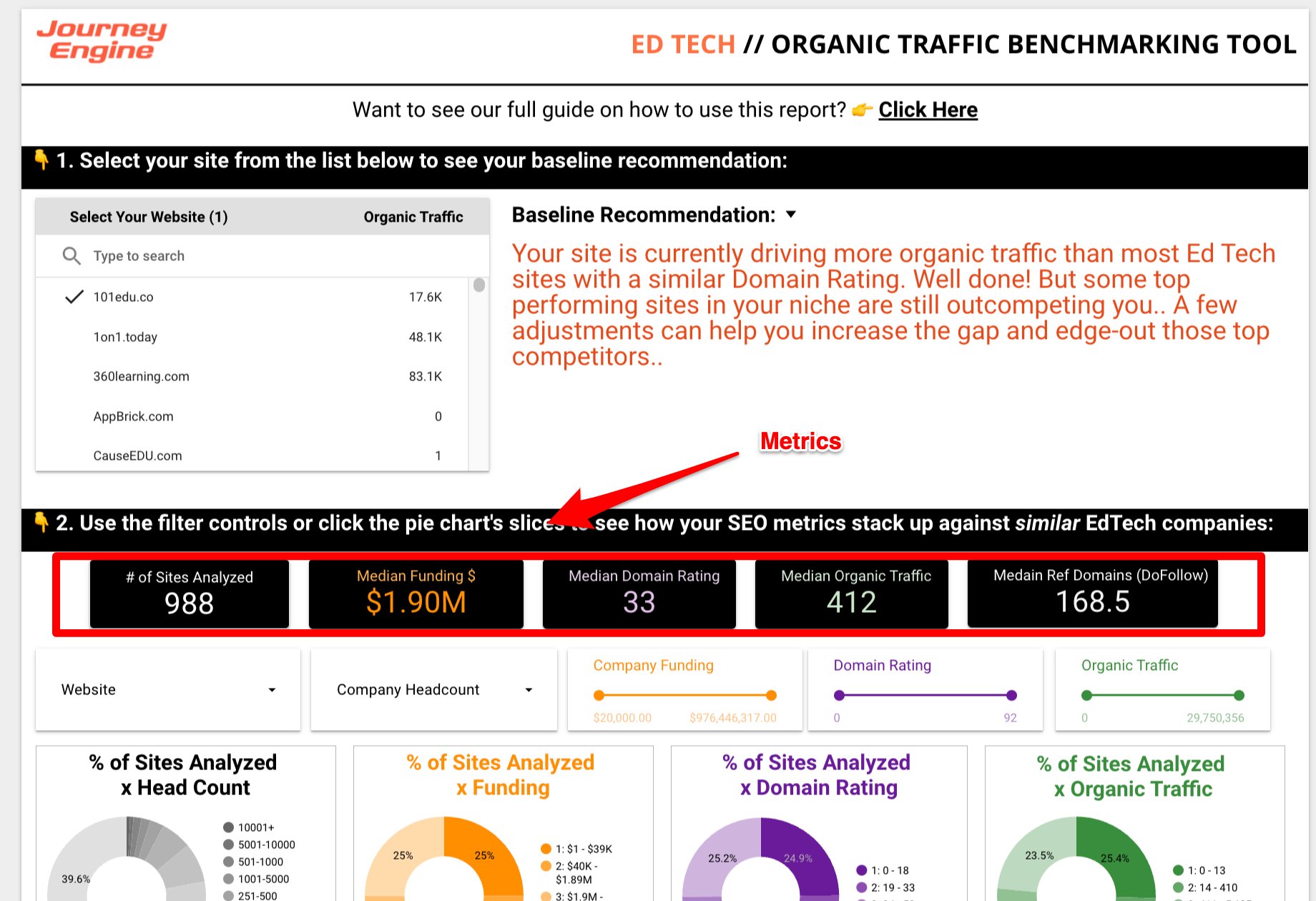
Employee headcount: LinkedIn
Company funding: Crunchbase
Domain rating: Ahrefs
Organic traffic: Ahrefs
Employee headcount and company funding are pretty self explanatory.
The metrics related to your SEO efforts are domain rating and organic traffic.
Here’s what they mean…
Domain rating definition
Measures your website’s ability to rank for competitive keywords on a scale from one to 100.
The higher you are on that scale, the more power you have to rank in search engines.
This is a function of the quality and the number of other websites that are linking back to your website.
A website with 0 DR probably won’t rank for anything significant.
A website with 100 DR should rank page 1 for the most competitive keywords. Every piece of content is a surefire “win” right out the gate.
Organic Traffic definition
Your non-paid traffic from search engines every month.
It’s essentially the “free traffic” Google sends to your site.
How To Use The Tool
Step 1 – Find your website
Use the search function to find your website. Then click on it.
If you don’t see your website here email us at (justin@journeyengine.com) and we’ll add you.
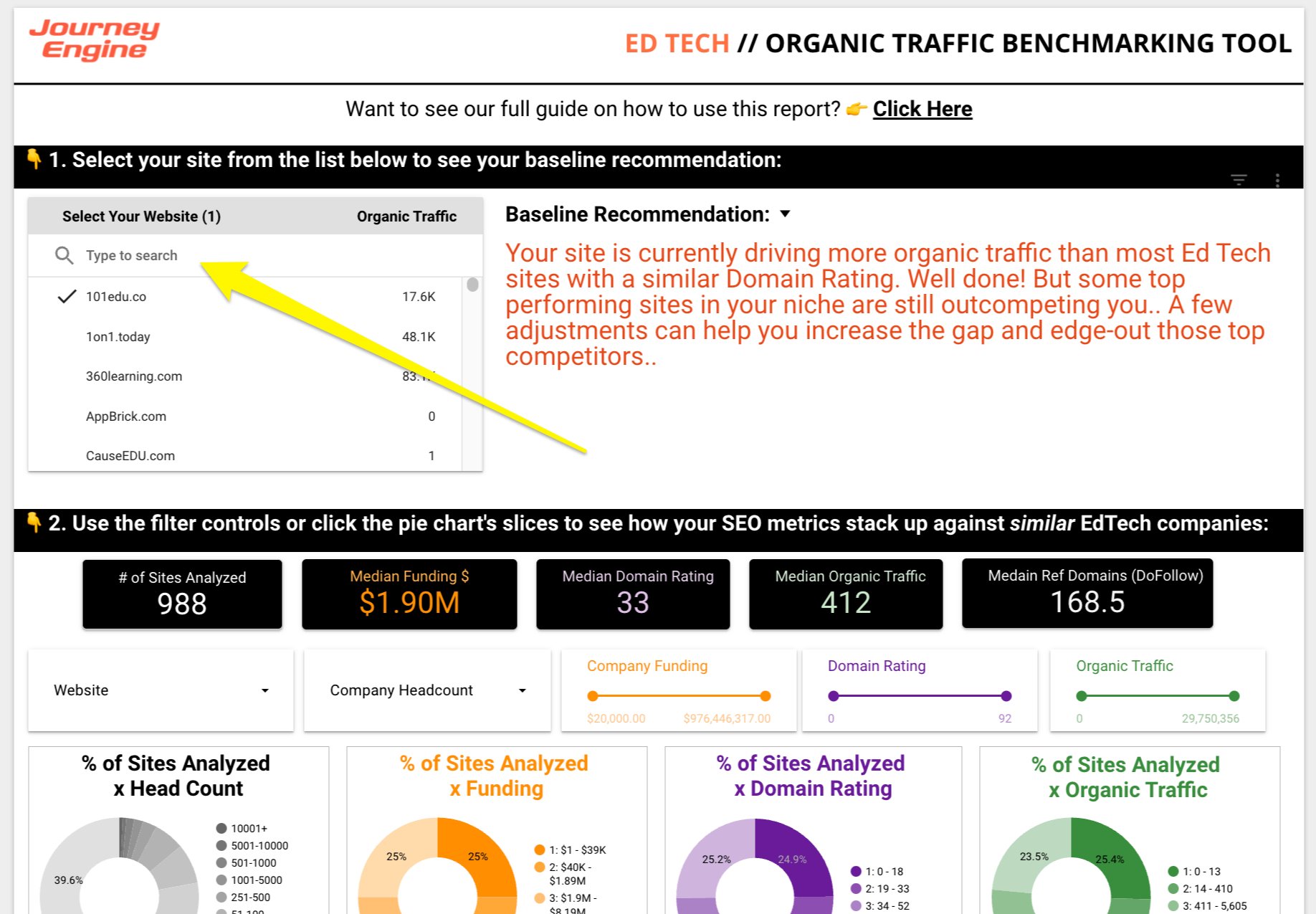
Step 2 – View Your Baseline Insight
Your baseline insight is an overarching recommendation. It shows you…
-
Where you stand against your closest competitors
-
What direct SEO actions you should take to get ahead of them
Example 1 – Content Strategy for EdTech
You can see the website 1on1.today is driving more organic traffic than most EdTech sites with a similar domain rating.
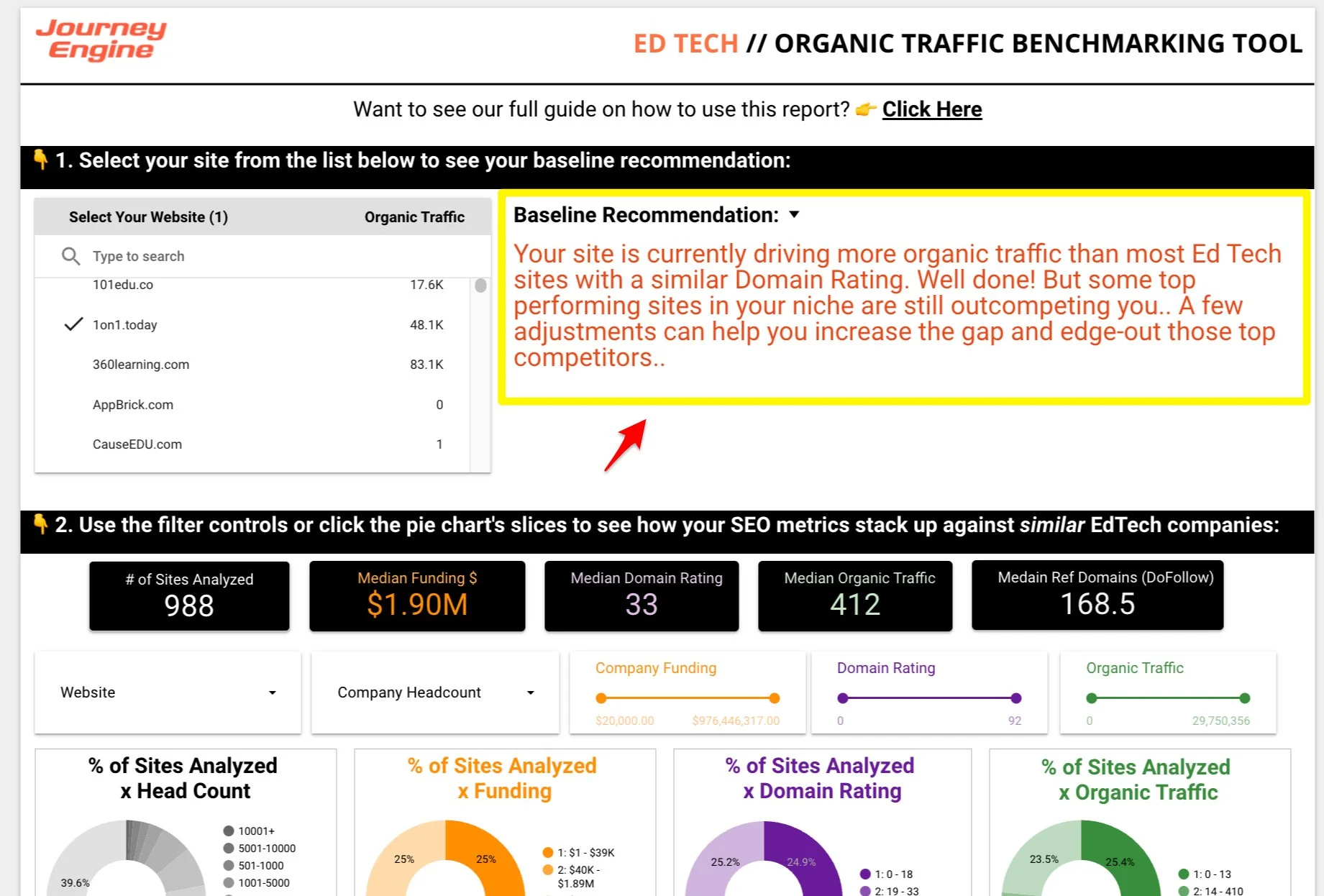
However there are still some sites in the niche that are outcompeting them.
In order to edge-out the remaining competitors, this site should;
-
Note the websites in their DR “Quartile” range that are driving more organic traffic
-
Plug each site into an SEO competitive intelligence tool like Ahrefs or SEMRush
-
Locate the content and keyword gaps that are helping these competitors drive more organic traffic
-
Use these insights to optimize existing content and build new content that will capture remaining market share from your competition
Example 2 – PR for EdTech Websites
On the other hand, Appbrick’s Domain Rating is far below most of the Ed Tech sites we analyzed.
Their best course of action at this stage may be a Digital PR campaign to raise awareness and authority.
With a higher DR score they’ll be able to better compete for organic traffic, leads and revenue in this space.
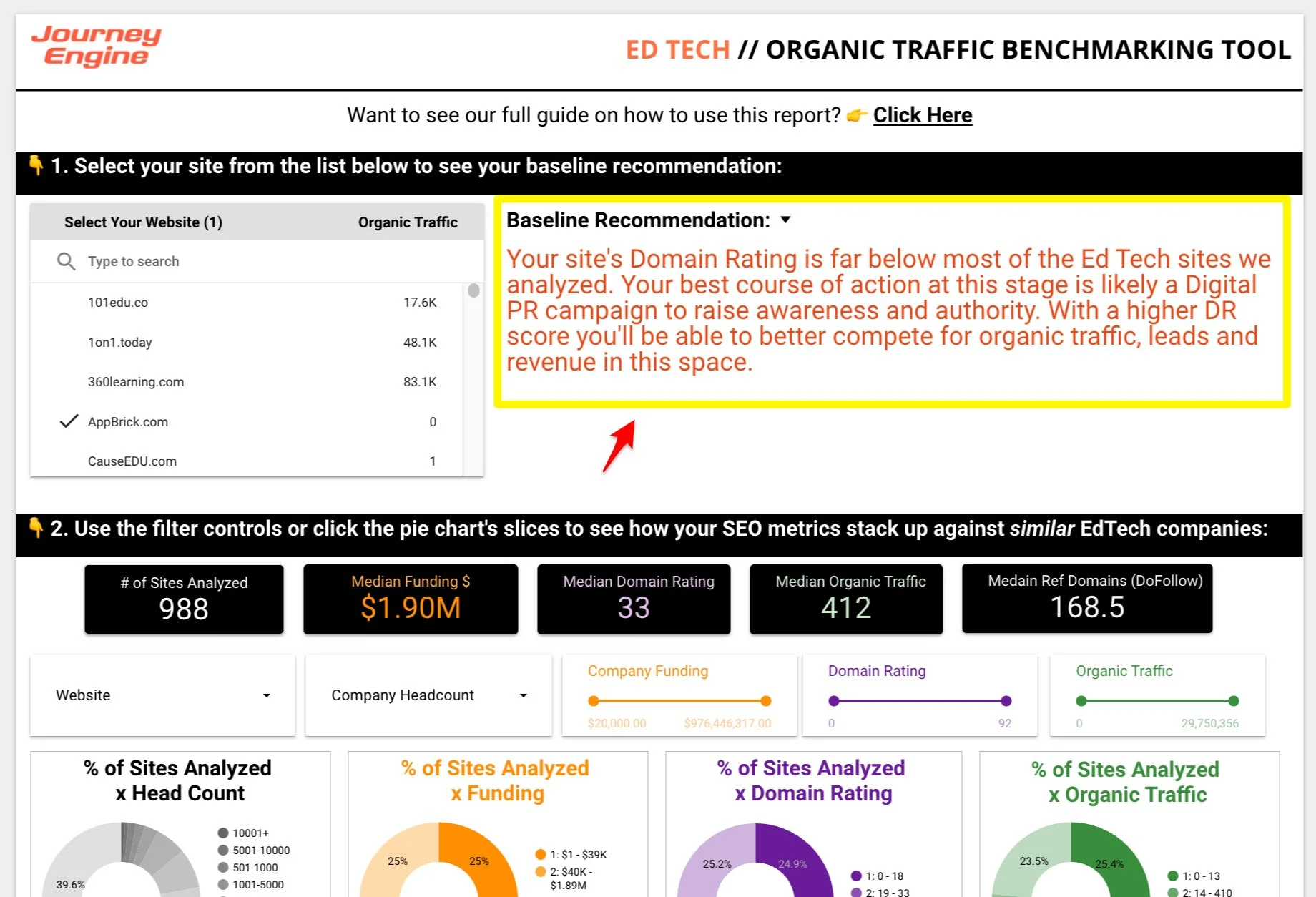
Step 3 – Other EdTech Website Benchmarks
You can filter the data based on any metric.
Here’s how you filter for domain rating.
You can see that the DR for 1on1.today is 27.
The 4 pie charts have been separated into equal quartiles: groups that are similar in profile to ours on each of these metrics.
-
Locate the relevant group (which is anything with a domain rating of 19 to 33).
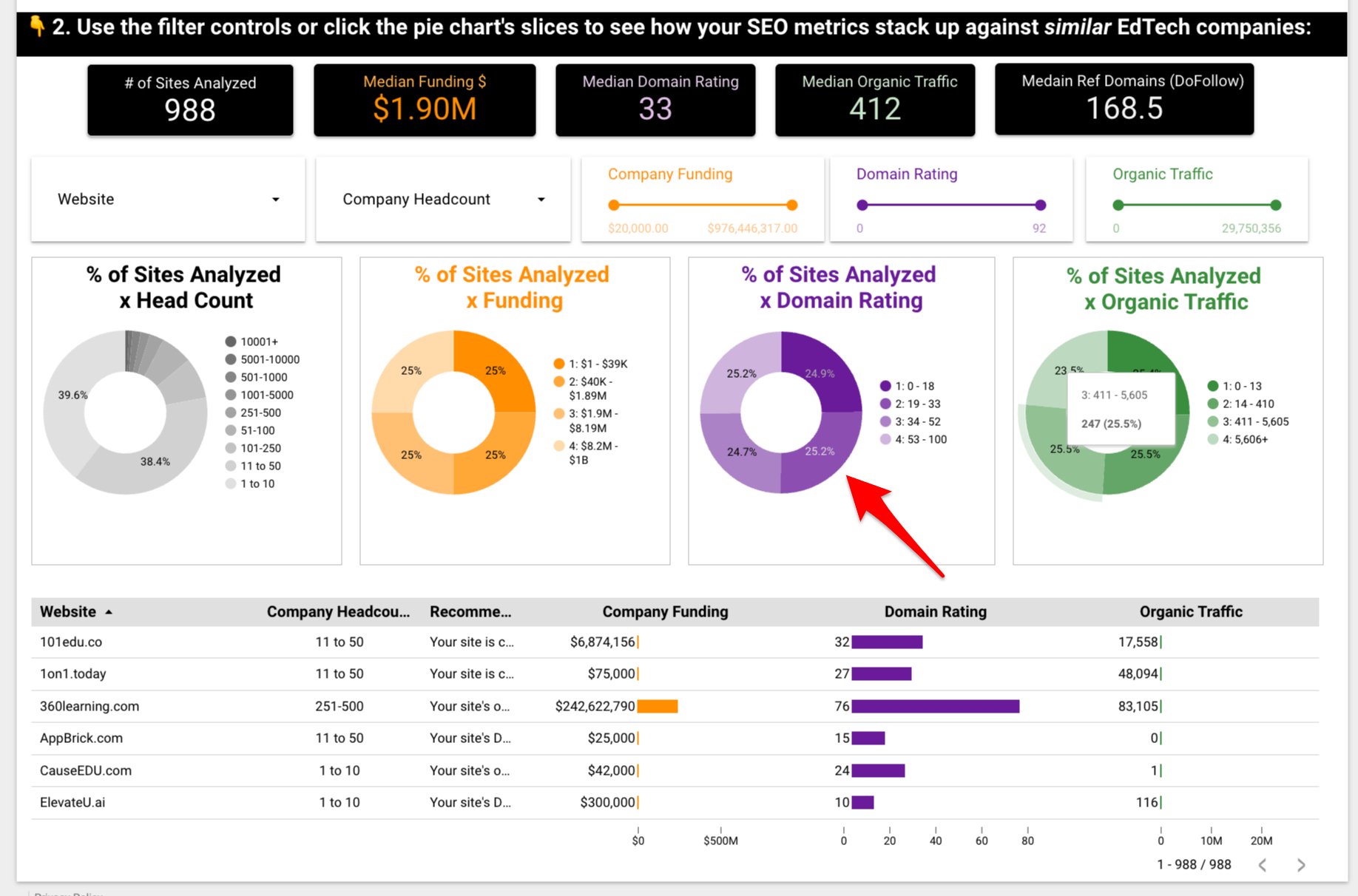
Click that slice of the pie. That filters the entire dashboard for only EdTech sites with a DR of 19 to 32 sessions per month.
You can see that companies with this DR typically have:
-
Funding of $1.45m
-
1-10 people in headcount (46.6%) or 11-50 (42.6%)
-
139 organic sessions
-
101 backlinks
In 1on1’s case if we filter for organic traffic you can see they are close to the top.
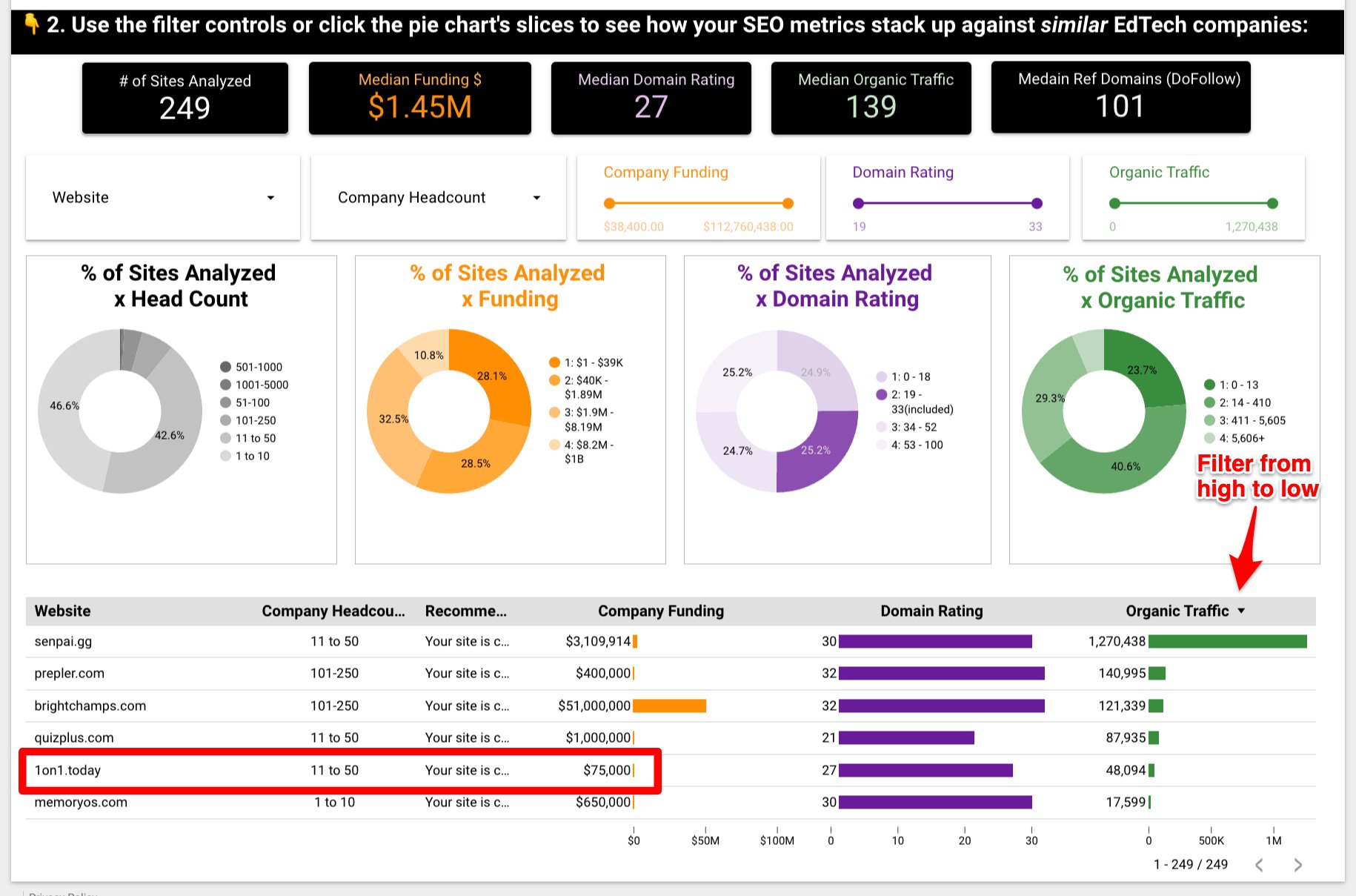
But there are still a few sites that are outcompeting them (Quizplus, Brightchamps, Prepler and Senpai).
So they might want to check out those websites. See what they’re doing content / keywords wise. Then try to replicate or outdo them.
This tool works from any metric.
For example, let’s say you want to look only at companies that [a] have 1-10 in headcount and [b] 1-40 million in funding.
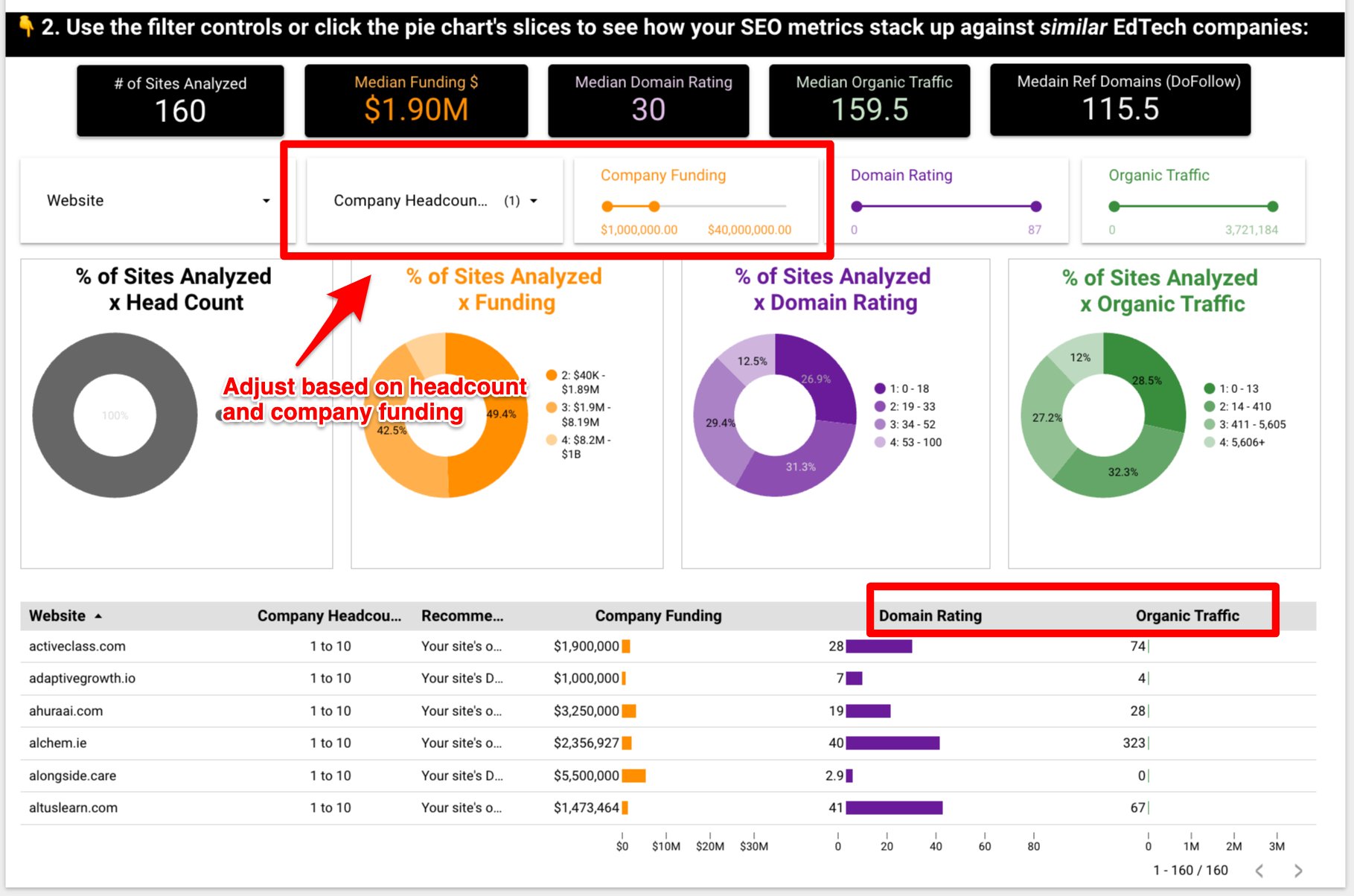
You can see the domain rating and organic traffic for those companies as well.
Special Offer – Free Organic Traffic Projection
My team built a separate tool called the Organic Traffic ROI Forecast.
It’ll show you what your organic traffic will look like in 12 months time. For four different scenarios…
-
Business as usual: i.e. doing nothing differently.
-
Basic SEO campaign: Optimizing pages for keywords you’re already ranking for.
-
Aggressive content creation campaign: What’ll happen when you start publishing “lead optimized” content
-
Combination campaign: This is a combo of scenario’s 2 and 3.
This is a free report. We just have to collect a few data inputs from you.
So if you’re interested email justin@journeyengine.com. Make the subject line “I want a free traffic projection”.
We look forward to hearing from you!
You need a scalable sales funnel.
One that generates organic traffic. On autopilot. And converts it like crazy.
Into trials, demos and paid users.
A predictable level of pipeline and sales. Without a single paid ad.
That’s exactly what we built for this EdTech business…
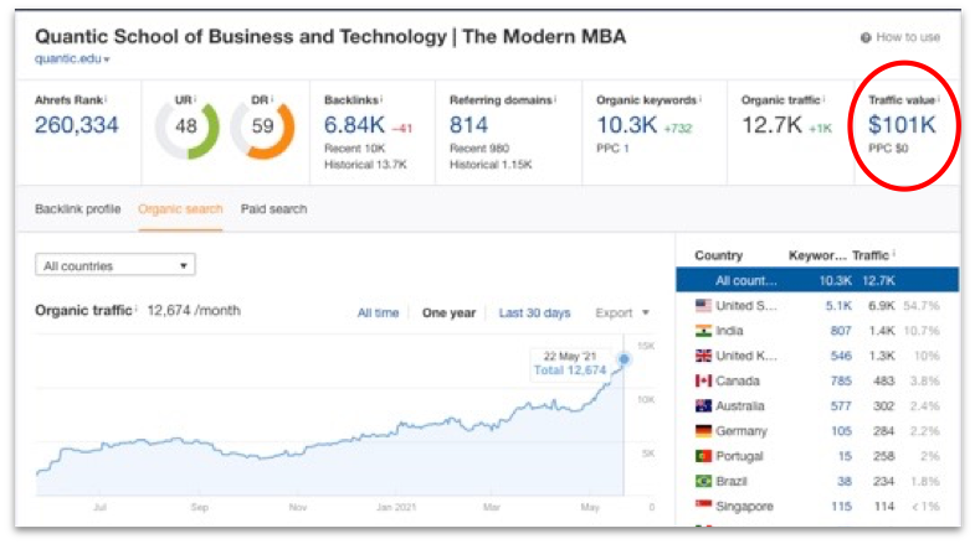
? The content we created pulled in $900k worth of free traffic in one year
? That organic traffic converted to over $1.2M in revenue value
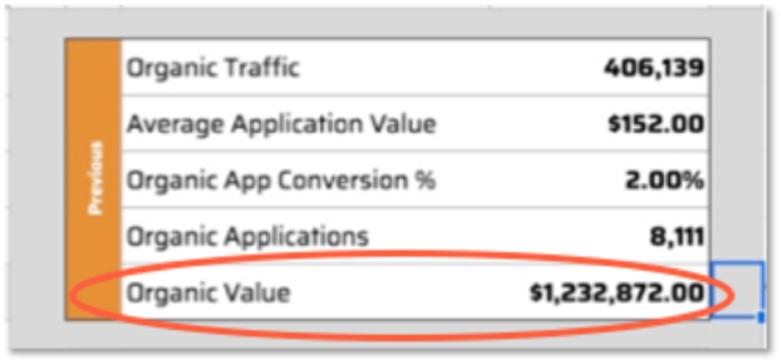
We’re going to break down our exact process in this article.
From start to finish.
Read to the end and you’ll know:
✅ What content to create. To generate targeted traffic for your company.
✅ How to set everything up in a “funnel”. So that traffic actually converts and boosts your monthly recurring revenue.
End to end. Content to conversion.
Why Do You Need An Organic SaaS Funnel?
Problem 1: Competition
The SaaS world is cutthroat.
You’re competing against hundreds, if not thousands, of other SaaS products.
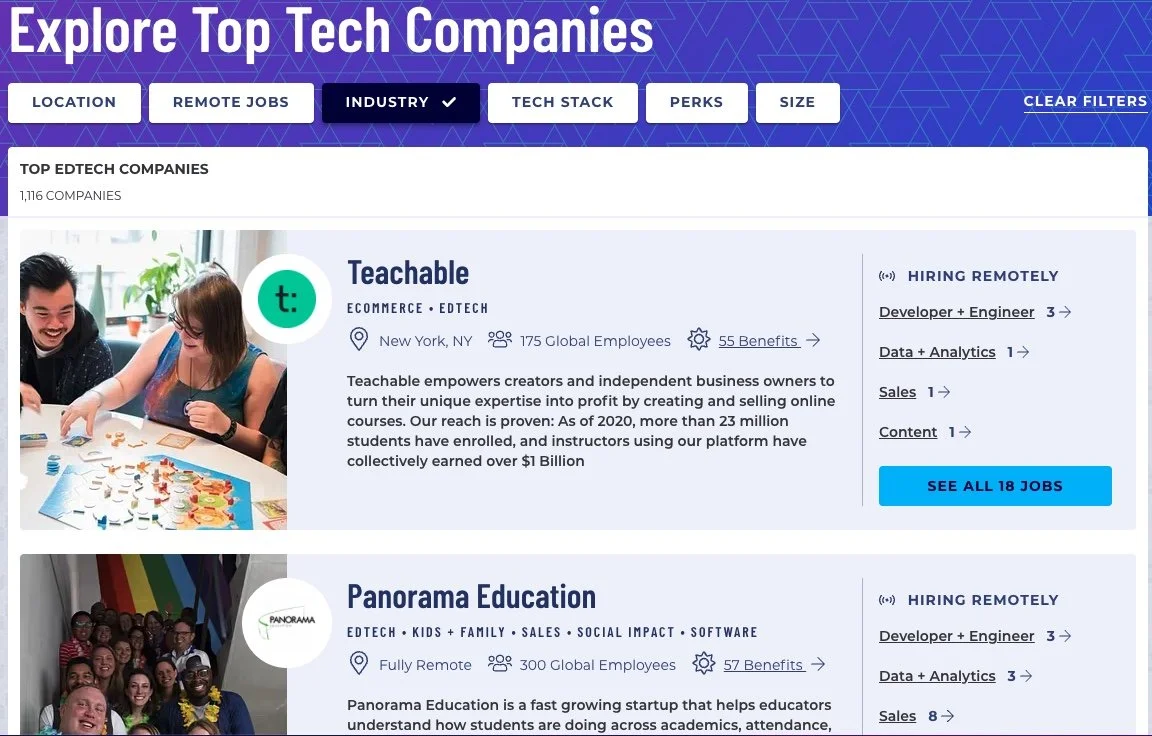
For example, there are 1,116 SaaS products on Capterra for “EdTech” alone.
Some are well known, established brands. With mighty budgets.
How do you become noteworthy?
How do you stand out in such a crowded marketplace?
Easy… give prospects an “aha moment”.
An “aha” moment is when the prospect understands how your solution fixes their problem.
A spark flies off in their brain. The synapses connect the dots.
Making you a solid frontrunner amidst the noise.
You can create multiple “aha moments” through your content. On the front end.
Like the SaaS powerhouses Hubspot, Kissmetrics and Buffer do.
But if your content doesn’t do the job on the front end?
Then your funnel should deliver it, on the backend (We’ll show you how later on ..)
Educate your audience. Think about their wants and needs. And watch the customers roll in.
Problem 2: Over Reliance On Paid Traffic Is Dangerous
With SEO the cost of acquisition decreases over time.
When executed properly, Search Engine Optimization not only gains you a flood of organic traffic..
It drives qualified leads and top-line revenue, more efficiently than any other channel.
CoBloom analyzed the 250 biggest SaaS companies. Here’s what they found on non-brand organic search traffic:

The top 10% of SaaS companies are doing something right. And it’s about time you joined them 😉
Producing content has a one time cost.
And the traffic growth is also exponential. Because we stack content on content.
Results like this are not uncommon well executed SEO…
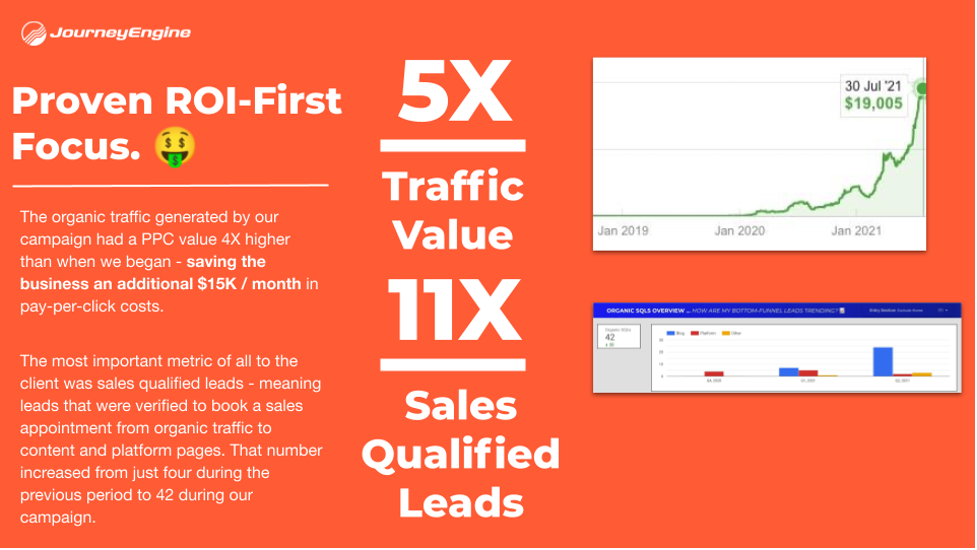
Often, you can’t outspend your competition on paid media. So you’ll need to be smart and play the long game.
29% of new startups fail because they ran out of cash. 19% because they got outcompeted. According to CB insights.
It’s easy to see why.
Paid ads depend on unreliable algorithms and winning ads.
Imagine your cost per lead shoots up from $100 to $200 overnight. Rendering your ads unprofitable.
How do you report that to stakeholders and investors?
How do you let your employees know their jobs are on the line?
The stakes are high.
Building a storehouse of Evergreen content is a safer bet. For the long run sustainability of your company.
So, let’s get building!
We’re going to show you how to create content that leads to conversions. The entire funnel.
How To Build a SaaS Sales Funnel – The JourneyEngine Way
There are three parts to this:
-
Acquisition – how do we pull leads into our sphere?
-
Activation – how do we convert those leads?
-
Analysis – how do we learn from the data? To optimize / repeat.
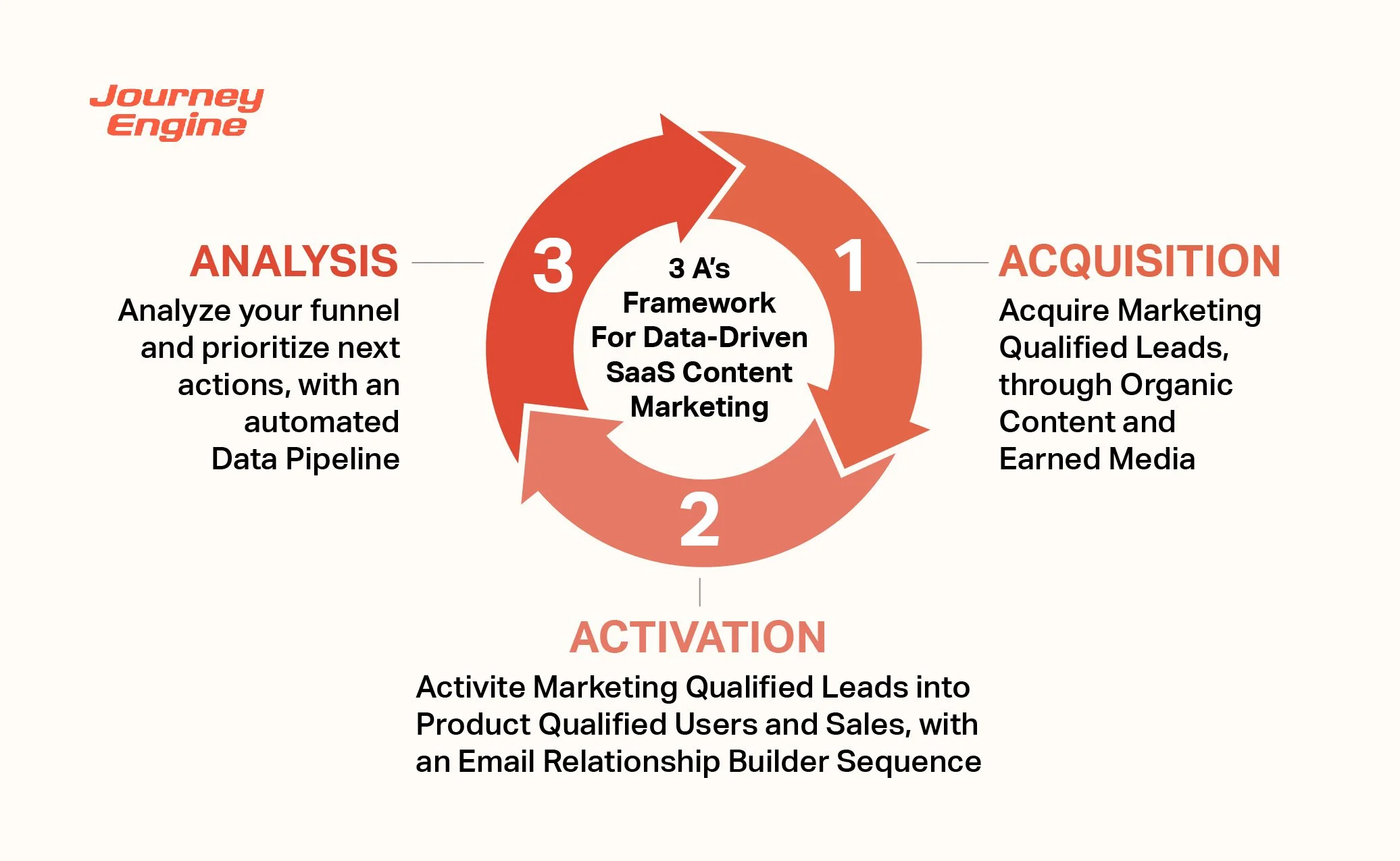
Let’s dive in…
Part I: Acquisition
Our framework focuses on organic acquisition (SEO). That’s worked best for our clients. To generate impressive results, at scale…
““JourneyEngine gave us the turbo boost we needed to hit our aggressive growth goals. Organic SEO has become a channel that delivers a predictable level of pipeline every month.””
We use quality content. As our method to pull cold leads into our world.
Here’s why:
✅ Evergreen content will always attract traffic. People are already searching for solutions. You don’t need to rely on hype or trends.
✅ Gives readers an “aha” moment from the very first touchpoint.
✅ Introduces your brand the right way. You’re offering value and making a great first impression.
✅ Allows us to push interested prospects through a funnel. At scale.
The key to success in SEO is QUALITY content. Period.
Well researched. Well written. Keyword dense. And compelling asf ?
It’s worked for big fish like Hubspot and pipedrive. And it’ll work for you too.
But how will you know where to start? What should this content even be about?
Map the SaaS Sales Funnel Stages to Your Content
Every Google searcher has a different level of awareness. We refer to this as their “Journey Stage”.
There are FIVE stages in the SaaS user journey. Your audience will be looking for a different type of content in each of those stages.
Let’s break this down…
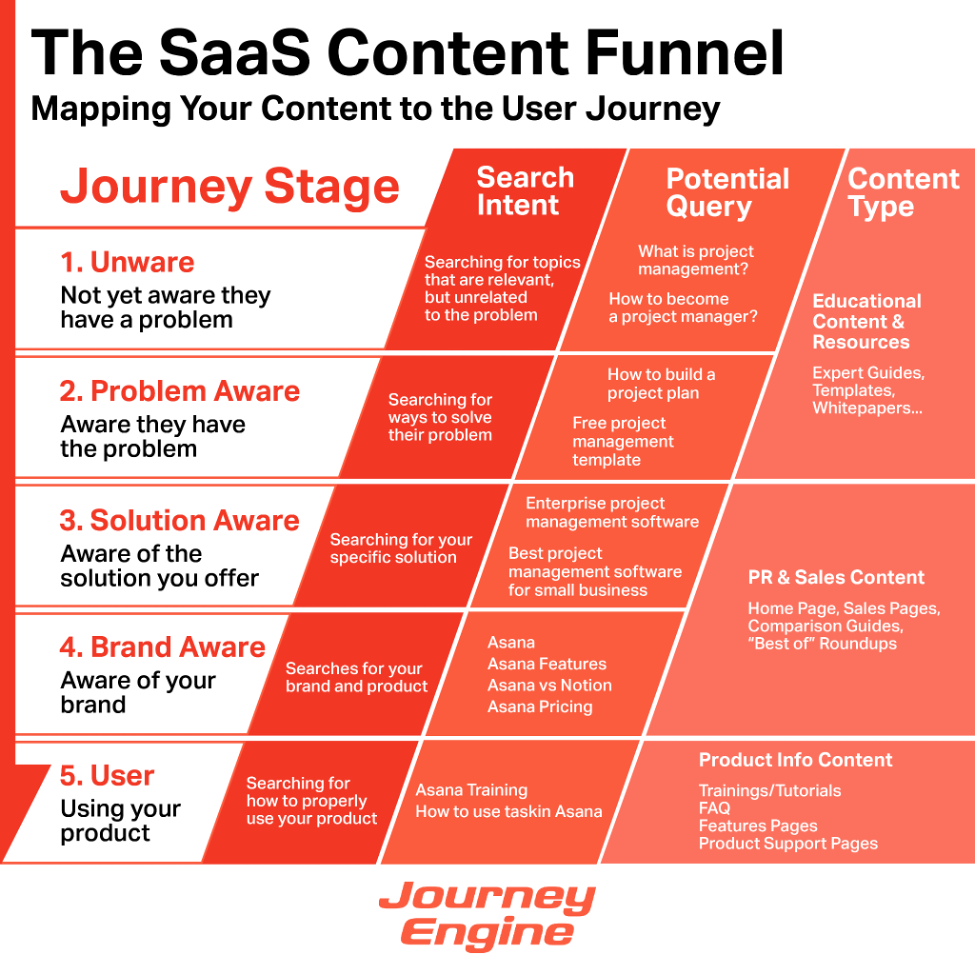
Your SEO goal is to capture your entire market of prospective users.
Get in front of them during every stage of their journey.
Reach those in the market right now (the 2%) ..
.. and those who are likely to buy in the future (the 98%).
The perfect piece of content will help move readers to the next stage.
At JourneyEngine our goal is to help clients strategize and develop content that…
A. Generates organic traffic that acquires leads
B. Converts cold prospects to product users
A Detailed Example…
Project Management Software – Asana
Stage 1. Unaware: Help and educate your prospects on topics they’re interested in, but unrelated to your product or specific solution. Do NOT be salesy, just informative.
? Content Example
-
Expert guide on how to advance your career as a project manager.
Stage 2. Problem Aware: Show them how your product helps them overcome the problem. You can begin to “soft sell” your solution.
? Content Example
-
Project plan template
As you can see in the screenshot below from Ahrefs, this keyword has a volume of 7,300 searches per month and many topically related terms.

Stage 3. Solution Aware: Your content’s goal is to prove why prospects should choose you over competitors. Demonstrate your unique selling proposition.
? Content Examples
-
Enterprise Project Management – Sales Page
-
Top project management software roundup listicle (often on third party review site)
The search volume is lower, but the prospect is much closer to a conversion.
They’ll be looking for roundups and comparison guides to help make their final decision.
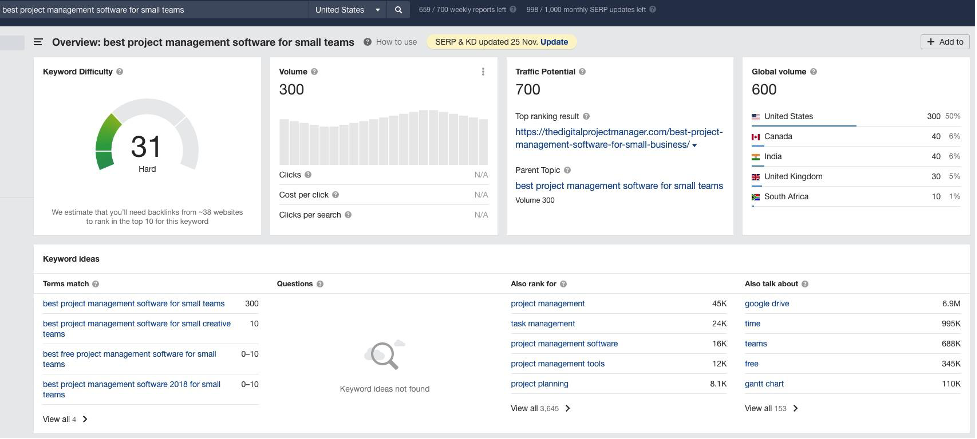
Stage 4. Brand Aware: This content is where you finally push them over the line, into conversion. Give them ALL the information about how YOUR product solves their problem, in a way no other brand can.
? Content Examples
-
Home Page
-
All Product/Features Sales Pages
Stage 5. Current Users: Provide support for using your product. So they get the most possible value out of it.
? Content Examples
-
FAQ Section
-
Support pages
And there you have it.
A plan to map the right content to each stage of your user’s journey.
SaaS Link Building // Promote Content with Earned Media
Off-site promotion is absolutely critical for modern SEO (guest posts, PR placements, review sites, etc).
In the past, ranking content meant landing large quantities of low quality links. Often, from questionable websites. Unfortunately, many uninformed SEO Companies still do this, with disappointing results.
You will do things differently.
View every promotion as a FURTHER opportunity to move readers closer to conversion. While enhancing your brand.
A couple of examples:
-
An expert guide on “how to build a project plan” would work well as a guest post on projectmanagement.com.
-
Placement in a roundup of “The Best Project Management Software” will certainly have more impact from a third party site vs your own.
Prospect for high quality, authoritative websites that your buyers actually visit. And provide those websites quality content to publish.
Part II: Activation
SaaS Lead Generation // Acquire Leads With Content Upgrades
Blog posts will convert a small percentage of readers into demos or paying customers.
So what about the rest?
Incentivise them to join your email list! Where further lead nurturing can take place.
Imagine the article they’re reading is “6 Ways Modern Social Intranets Kill Traditional Intranet Software”.
A perfect compliment to that article would be a checklist. For setting up their own Modern social intranet.
Here’s what that looks like. Inside a blog post…
Readers have to submit their email address to download it.
These are also known as “content upgrades” or gated content.
Bryan Harris: from Videofruit reported 20 – 30% conversion rates on his content upgrades.
Brian Dean: from Backlinko saw a 785% increase in optin’s after he implemented them.
Two different Bri(y)an’s. Same result.
And yes – gated content still works in 2022.
But your incentive has to be worth $’s. I.e. it has to be super valuable.
Which is why content teams are essential. You need a proper strategy.
The goal is to insert relevant content upgrades into every single blog post.
So your email list grows.
Here’s what happens after they join your list…
SaaS Email Marketing // Relationship Builder Sequence
To make it rain you need to convert those email addresses into users.
That’s where a Relationship Builder Sequence comes in (RBS). It’s a welcome series / autoresponder. Designed to convert prospects who are still on the fence.
You take them from what they believe now (starting belief) ..
.. to what they need to believe to buy your product (end belief).
Across 5 – 7 emails.
Squashing every possible objection.
While developing a real relationship.
Creating a belief map is the first step.
The marketing company Wild Audience developed this concept. So credit goes to them.
Here’s what their “belief map” looks like ..
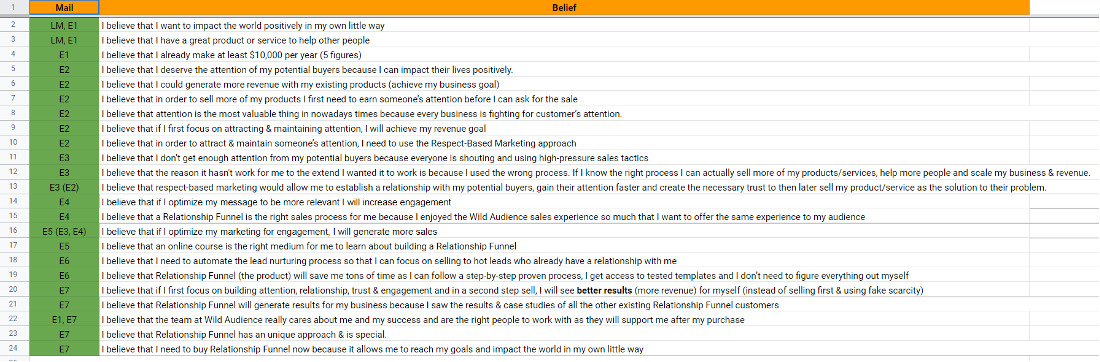
View the Full Google Doc here.
The second step is to turn that map into a series of 7 compelling emails. Utilizing copywriting, storytelling and clever triggers. To ensure maximum engagement. And the highest conversions.
Once it’s written?
We set everything up in your autoresponder. So it goes off on autopilot. Meaning, you’ll book more calls without lifting a finger.
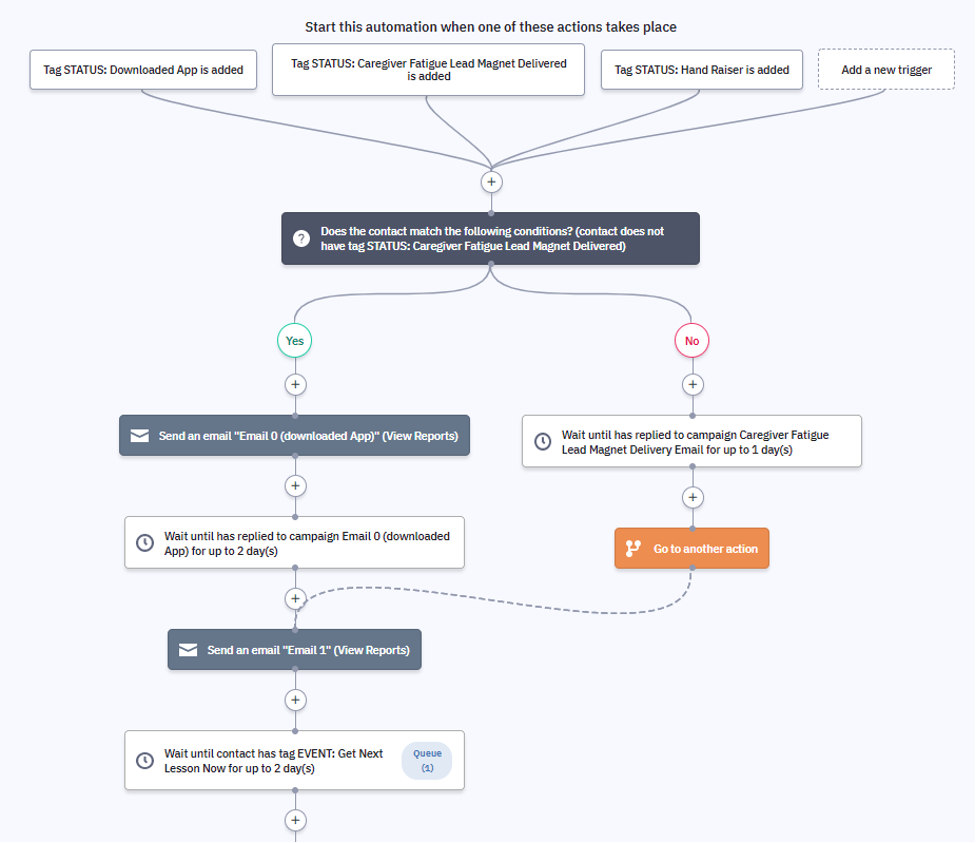
Once people truly believe you’re the best?
They’ll be more than happy to pay for your software. And tell their friends about you.
Your sales reps will have an easier time on sales calls and demos, too. Because prospects arrive pre-sold.
Here’s the flow so far…
-
Users arrive on your blog post, through organic (unpaid) traffic
-
They convert on the blog post itself.
If they don’t convert, then…
-
They sign up to your email list (via a content upgrade) in the blog post.
-
They receive a Relationship Builder Sequence via email. Which leads to a conversion.
TWO opportunities for a conversion.
And everything runs on it’s own.
Can you see the power of this now?
Follow these steps and you can build your own SaaS sales funnel.
Once it’s humming along the next step is to analyse the data. So we can learn from it. And keep improving.
Part III: Analysis
Reality check – your SaaS Sales funnel will probably NOT be profitable after your very first piece of content.
If it is, then you’re a legend. You should be writing this article.
But if not, your SaaS sales funnel WILL be fixed, optimized and scaled to profitability.
You just need to know exactly where to start fixing.
That’s where the third “A” in our framework (Analysis) comes in.
The Analysis phase keeps you accountable for the other two (Acquisition and Activation).
With metrics for each phase..
SaaS Acquisition Analysis
In the first section of this article, we talked at length about how to build content for every stage of your user’s journey.
Now it’s time to hold each piece of content accountable.
Reward the content pieces that get results. Kill the ones that don’t! ?
There are two simple metrics you’ll track:
Non-Brand Organic Traffic
The first goal of your content is to drive awareness, through non-brand organic traffic (searches that don’t include your brand name).
If you mapped your keywords and content properly to the journey, Google will reward you by ranking your target keywords higher. Resulting in organic traffic lift.
What is a Marketing Qualified Lead (MQL)?
These leads come directly from our content and promotion efforts.
If a user books a demo as a result of your blog post?
That’s an MQL.
You’ll need a dashboard to track organic traffic and MQL’s (your key metrics), broken down by site section and content piece (your key dimensions).
There are many ways to tag your content. If you’re not using a database like BigQuery, you should do this with Google Analytics Content Groupings.
The output is clean and simple. A view of how content types and content pieces are performing.

Activation Analysis
OK, so now you know which content types and pieces are driving Marketing Qualified leads.
Earlier in this article we detailed how to build a relationship builder email sequence and nurture MQL’s into “Product Qualified Leads” and sales.
Now it’s time to hold those email funnels accountable for their job.
What is a Product Qualified Lead (PQL)?
An MQL becomes a PQL once they have used your product and reached a pre-defined trigger that signifies a strong likelihood to become a paying customer.
A PQL for your business could be a user who completed a key action during their trial, completed a series of key actions, or spent a certain amount of time within the app.
The rate of MQL to PQL will help you determine whether your product features and content messaging deliver enough value to upgrade your leads to qualified buyers.
Using event data collected from Mixpanel, Segment, or another method can help you define and track the moment an MQL becomes a PQL.
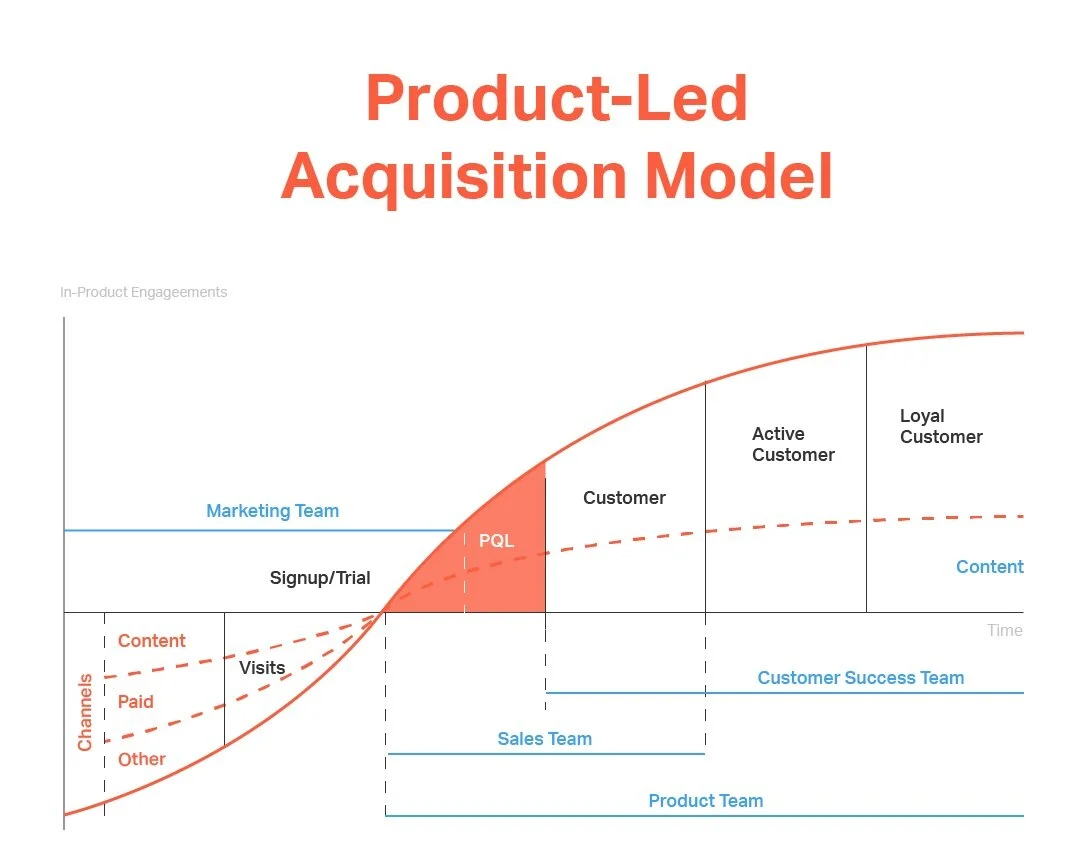
SaaS Email Marketing Analysis
Your email relationship building goal is to convert MQL’s into PQL’s.
So you need to know how well each sequence and campaign converts.
Your dashboard should give you a simple view of this.
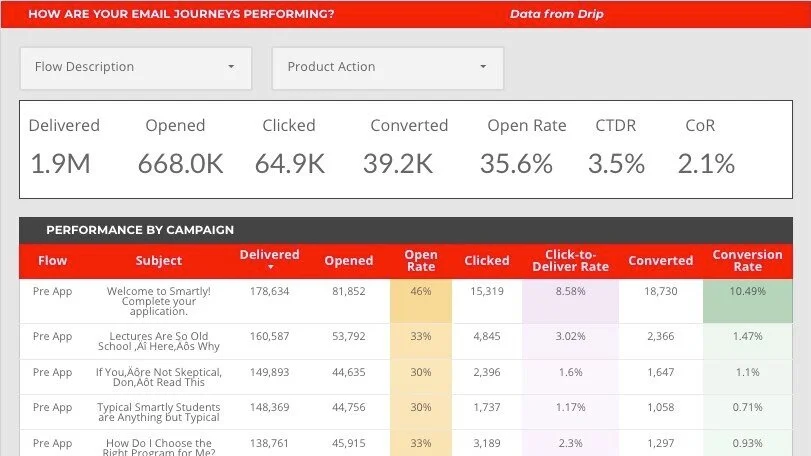
Customer Acquisition Cost (CAC)
Yes, this article is on how to build a funnel with free traffic.. So there’s not actually a “spend” number associated with it.
But it’s always helpful for us to do a side-by-side analysis and compare organic traffic vs the results of your paid campaigns.
Your campaigns should inform each other. We find that holistic insight into your business makes for the best analysis in the long run.
Total acquisition cost / number of customers = CAC
How much does each new customer cost?
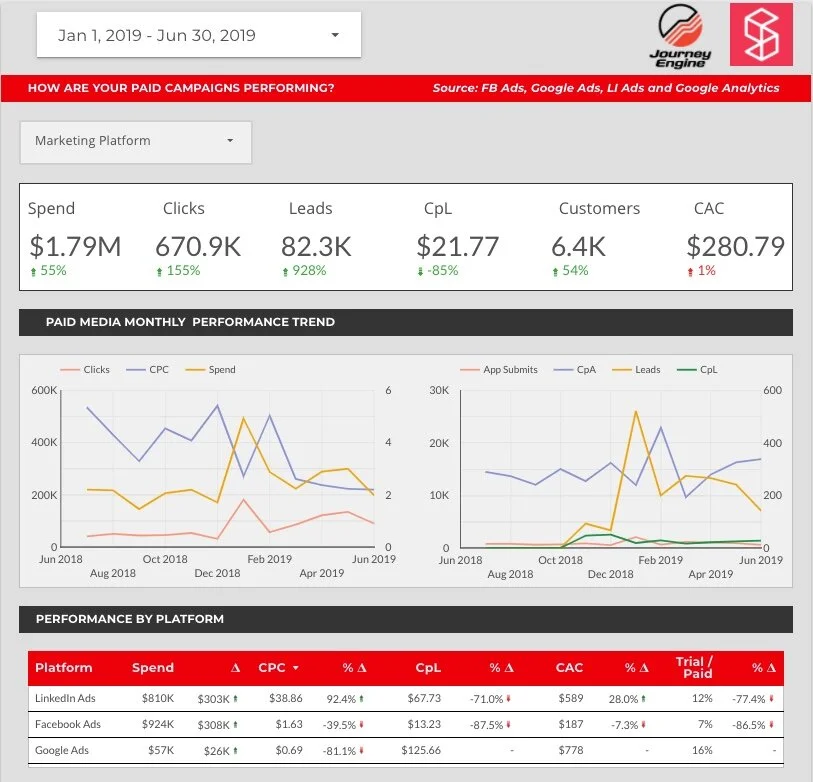
The Automated Data Pipeline Approach
Let’s be honest..
Marketers tend to look at data analysis as a necessary evil. At best.
It’s obvious why.
Because it is a massive time suck and a nuisance to collect all of this information. Often for questionable return.
But it doesn’t have to be that way!
Data-Driven marketing in 2022 means eliminating the tedium associated with data analysis. By building an automated SaaS “data pipeline”.
Here’s what this entails:
-
Automated data feeds (e.g. Stitch, Fivetran or Supermetrics)
-
A single Data Warehouse (e.g. Google BigQuery or Amazon Redshift)
-
Automated Data Visualization Dashboards (e.g. Google Data Studio or Looker)
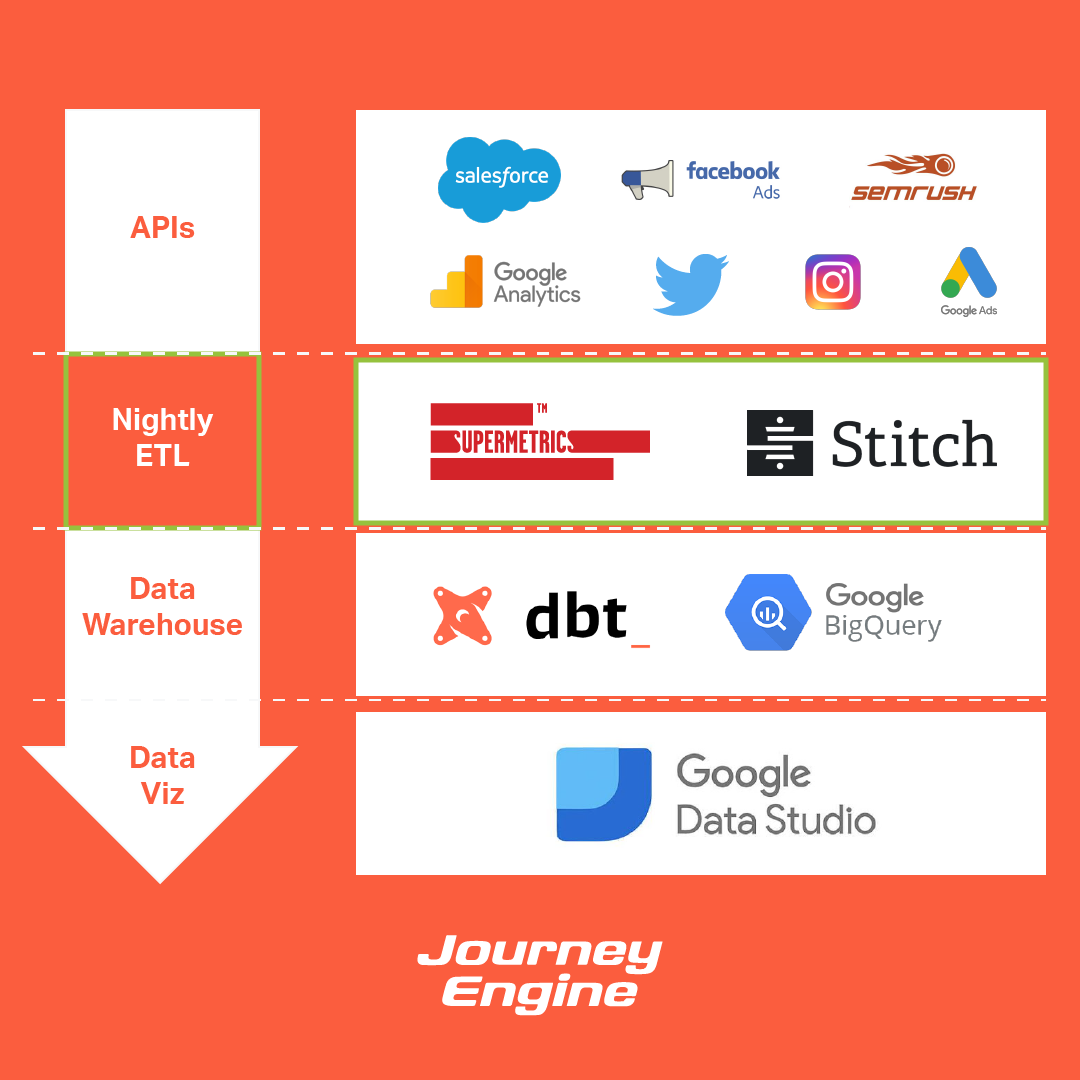
This approach means a single source of truth for all of your data analysis needs.
You set it up once.. And all of your business questions are answered.
No more pulling data, writing/fixing formulas or formatting slides.
Find out more on how we build custom SaaS data pipelines here.
Example SaaS Sales Funnel
At JourneyEngine, we “eat our own cooking”. So to speak.
You can see one of our “live” funnels in action. By downloading the case study below.
It’s everything we discussed, in living color.
We show you every stage of the process. From Keyword Research to link building…

To Recap..
OK. So we’ve gone through the entire process we use to drive qualified leads for SaaS businesses, at scale.
In summary:
-
Map content types to your user journey stages
-
Start small, with 10 new content topics to execute
-
Convert organic traffic to MQL’s with content upgrades
-
Convert MQL’s to PQL’s with an email “relationship building” sequence
-
Create an automated data pipeline to analyze your content engine
There you have it!
Everything you need to build your own Organic SaaS Sales Funnel. From scratch.
Let us know how you get on 🙂
Or.. we can handle the whole process for you
Want Your Own JourneyEngine Funnel?
Take advantage of our done for you service today.
We have a hard cap of 2 new clients per month.
So, let’s see if we’re a fit. Book your free, no obligation discovery call now. While it’s still fresh on your mind…
Content marketing and SEO for B2B companies is a unique challenge.
Most B2B marketers already know the three three things they need to be successful with organic growth;
-
Keywords that are properly mapped to bottom-line revenue
-
Content that positions the business as the authority in their niche
-
Smart promotion, in the form of digital PR
The problem is getting these three things done at the scale required for results. It takes constant, dedicated effort and can be nearly impossible for a team who does not specialize in this process and niche alone.
Thankfully, JourneyEngine is here to help take the burden off their shoulders. We’re 100% dedicated to this stuff. So in house B2B marketing teams can focus on the bigger picture.
As a matter of fact, as we help more and more businesses, the more our company grows. Today, we are very proud to announce that our love for providing the best strategies and solutions in this industry has landed us a spot on Clutch’s top B2B SEO agencies in Los Angeles.

We understand that the SEO industry is cutthroat, and knowing that we are among the leading agencies in a market as competitive as Los Angeles is really special for us.
The hard work and dedication, everything, means a lot more when we have someone as Clutch recognize us on their platform.
We’re thrilled to add this distinction to our growing list of awards this year, including Best SEO Consultants by Design Rush.
Our company is grateful for Clutch and their team for this amazing award. Furthermore, we would like to give a huge thank you for everything that they do for vendors like us.
Their contribution in the B2B industry is expansive and we hope that you continue to connect vendors to buyers as efficiently as possible.
If you have no idea about Clutch, they cut through disorganized market research by collecting client feedback and analyzing industry data, arming businesses with the insights and analysis they need to connect and tackle challenges with confidence. Check out our Clutch profile to read unbiased reviews conducted by Clutch analysts.
Ready to expand online? Hire our team to help you with your SEO journey. Give us a call and let’s talk about our future collaboration.
To keep your edge in the SaaS world, you need to be able to quickly and accurately answer a number of key business questions;
⚙️ Am I spending too much to acquire subscribers? If so – why?
⚙️ How much profit am I making on each plan type?
⚙️ What type of users are churning? Why are they churning?
⚙️ How will different growth, marketing spend and hiring scenarios affect our business?
As an SaaS marketer, you don’t have time to wait days or weeks for your analyst to return with the answers to these questions.
But that’s the case far too often.
It’s because there’s no individual data source that can provide the answer to these questions.
And the bits of necessary context are always missing;
? Your subscription data can’t tell you how much profit you are making on each plan type, user or marketing channel
? Your churn reports don’t tell you what types of users that are churning
? There’s no forecasting tool that will let you to play out different scenarios to see their impact on your business
The typical analyst’s remedy is to dig into multiple data sources, stitch those sources together with their own logic and formulas, then make an effort to form a story about your buyers.
This process is time consuming, prone to error and filled with potential headaches.
Not fun!
That’s why it’s critical for your team to develop one clear framework around how you approach data analysis.
Intro to the SaaS Data Pipeline
A data pipeline is more than a tool or software.
It is the path to analysis freedom for SaaS marketers and stakeholders.
The pipeline is a framework for joining your raw data sources together, doing predefined math and then visualizing your data in a way that your team can easily use it.
It’s an ecosystem that connects ALL of your business’s technology together into a single source of truth that surfaces only what’s valuable to you.
You set it up ONCE. The end result?
? Your data refreshes automatically, on a timeline of your choosing (hourly, daily, weekly).
? Your data is visualization-ready – it can be used in your dashboarding tool of choice (Data Studio, Sheets, Tableau, Looker, etc.).
? Everyone on the team uses a single, cleaned data source. At all times. No more discussion about why one dataset doesn’t match another.
? Data Users (marketers, product managers, etc.) are free to explore + analyze data. With no worries about breaking anything.
Below, we’ll dive into the nuts and bolts of how to build this awesome framework into your SaaS business.
Here’s what you’ll learn;
✅ The KPI’s and Segments you should be analyzing for different areas of the business; Sales, Marketing, Operations, Product.
✅ The basics of how Data Pipelines work.
✅ The technology stack you’ll use to automate your analysis workflow. Permanently!
Sound good? Alright, Let’s begin!
The Best SAAS KPIs and Segments for Your Dashboards
The most important lesson we’ve learned as marketers and analysts is that when it comes to data.
Less is more!
Providing your team a dashboard with too many metrics is a quick way to get ignored.
“Cutting the fat” is the first step to building an effective analysis workflow.
If a metric doesn’t answer an important business question it’s not a “KPI” and it shouldn’t be included in your dashboard.
The next section covers the key KPI metrics and types of analysis you can leverage to skyrocket your value as a SaaS marketer.
Then in the following section, we’ll show you how to work those into your automated KPI Engine.
SaaS Acquisition Metrics
Your acquisition analysis provides insight into the effectiveness of your marketing campaigns. You’ll quickly be able to see whether your content is compelling and how users discover your product.
Customer Acquisition Cost (CAC) + Lifetime Value (LTV)
With accurate CAC + LTV analysis, you’ll be able to answer perhaps the most critical question in SaaS acquisition;

Analyzing your customer acquisition cost will tell you;
-
How much it costs to acquire new customers
-
How much it costs to keep existing customers
For this analysis, you’ll need to synch up datasets from different ad platforms (like FB Ads, Google Ads, etc.).
It’s fairly easy to get your CAC number from standard tools. But there’s much more important context you need that you can’t get so easily;
1. You need to know how much each customer has spent over their lifetime (not just during their last transaction).
2. You need to know whether your ads were truly driving new users or merely helping convince new users to upgrade.
For that “Lifetime Value” data, you’ll need to join in your conversion attribution (Google Analytics) and downstream payment processing (e.g., Stripe).
Combining LTV to come up with a target CAC will give you the baseline to judge all of marketing efforts and will fuel the rest of your analysis engine.
Want a template to build your own CAC profitability? Grab this CAC profitability and cohort analysis template from Dan Martell at Blackwell and Christoph Janz @ point Nine Capital:
ACCESS TEMPLATE
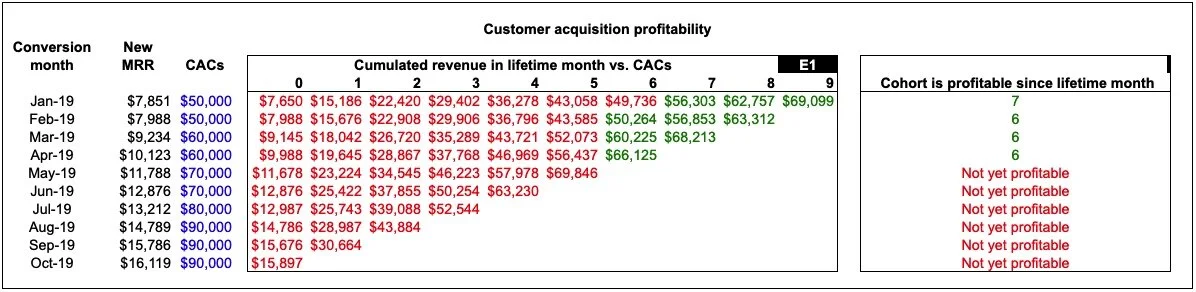
SaaS Conversion and Sales Metrics
Your Sales metrics are they key to understanding how effectively your business is converting leads into buyers.
Trial versus Paid Rate
Are demos and free trials converting into paid subscriptions? Or do your campaigns drive users who never actually convert?
Trial users can be your best friends or they can destroy your margins, depending on whether they convert. Remember that even trial users can deplete your support staff and other resources.
If your trial users aren’t converting to paid customers at an acceptable rate, you need to understand why. It could be a red flag of a weak product to market fit, or another bottleneck in your funnel.
You should segment this metric by your marketing channels, campaigns and content to make decisions about where to pour fuel and where to pump the breaks.
User Cohort Analysis
Study your monthly performance from trial subscribers to paid users compared to your overall retention rates.
Instead of tracking your user base as a whole, viewing a grid of cohorts can show you how changes in your product positioning and messaging over time influences your revenues.
You should segment your cohort analysis by acquisition channels (Facebook ads, Organic Search.. etc) and by your SaaS product usage metrics for greater insight into your marketing success.
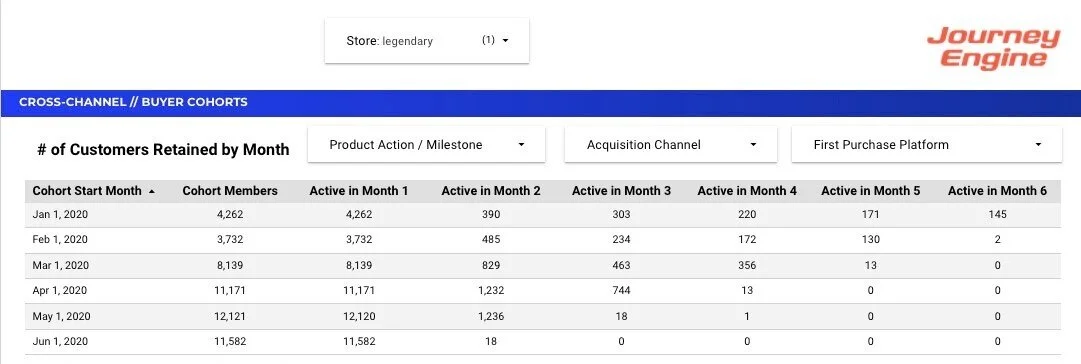
SaaS Marketing Automation Analysis
Relationship-building through email is absolutely critical, perhaps more so for SaaS marketers than any other niche.
Your analysis should allow you to easily drill-down the performance of your customer journeys and tell you which campaigns prompted lifts in conversion and product usage.
Segment your SaaS product usage metrics against email messages to determine which campaigns are driving users to interact with your product’s most important features.
SaaS Product Usage Metrics
Are your product’s features moving users to convert? Or are they just a waste of space?
Using event data collected from Mixpanel, Segment, or another method will highlight which areas of your product are activating users.
You can use feature-level data to tweak your product roadmaps and measure the response from users whenever you launch a new feature.
Trial vs Product Qualified Leads (PQLs)
Our friends at Chameleon define PQL as “a free or trial account that has gotten to a point of initial value with your product”. Make sure to check out their comprehensive guide on how to measure Product Qualified leads.
A lead becomes “product qualified” when they have reached pre-defined triggers that signify a strong likelihood to become a paying customer, such as;
-
Account created
-
Invited 2+ team members
-
Created project
-
Uploaded 2+ files
-
Created 3+ calendar events
-
Created 1+ tasks
-
Completed 1+ tasks
These users already received meaningful value from your product and, as such, are more likely to convert to paying customers.
Every customer journey is different, so finding the data points that identify PQLs will be different for every business.
A PQL for your business could be a user who completed a key action during their trial, completed a series of key actions, or spent a certain amount of time within the app.
The rate of sign ups to PQL’s will help you determine whether your product features and content messaging deliver enough value to upgrade your leads to qualified buyers.
SaaS Operating Metrics
Your SaaS operating metrics can help you find an optimal economic model for current operations and future expansion.
Finding the relationship between growth (revenues) and the marketing spend to acquire one dollar of additional revenue gives you a clear and concise view of your team’s performance.
Churn / Retention Analysis
Are my users staying loyal? Or do they quickly bounce from the product?
It’s a known fact that keeping existing users is cheaper than earning new ones.
That’s why analyzing churn is one of the most important things you can do.
Churn rate is the proportion of customers who leave during a given time period. It is often an indicator for customer dissatisfaction, cheaper and/or better offers, or reasons outside of your control like business failure or strategy shifts.
Looking at your “top-level” churn number is helpful, but insufficient. Alone, it won’t give you the context you need to understand why users are churning.
You need to understand the difference between users who churn and those who remain loyal. What features they use, what marketing channels and campaigns they have touched, etc.
Once you understand the difference between these segments, you’ll know what you can do to move the churn needle in the right direction.
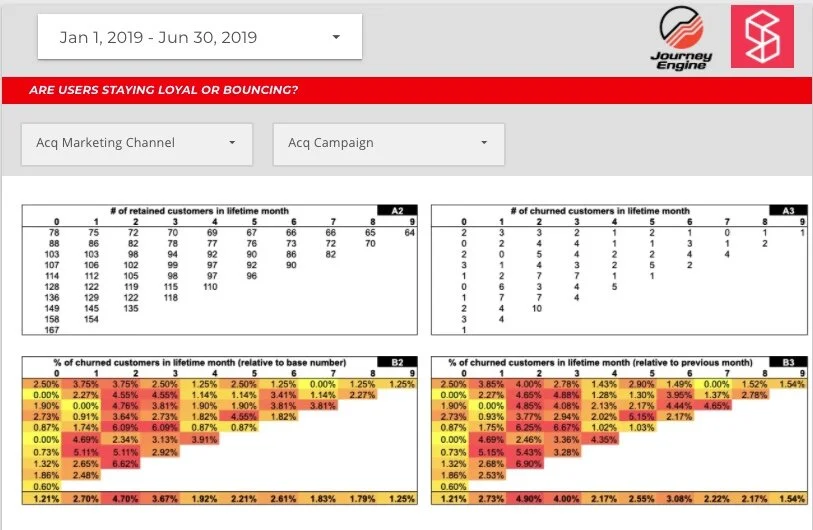
Forecasting + Burn Rate Analysis
How can distributing your media mix differently impact your overall revenue? How will different hiring scenarios affect your margins?
If you’ve raised money, knowing this information will be especially critical. Your investors will thank you for giving them accurate burn rates and a variety of scenarios to make your operations more efficient.
It will give you a clear understanding of how your cash position changes using different strategies and help you determine when you should target the next round of fundraising.
Click below to get an awesome template to help you with financial modeling & Valuation (from Dan Martell @ Blackwell):
ACCESS TEMPLATE

SaaS Metrics Definitions and Benchmarks
For every KPI, you’ll want to set a manageable benchmark.
Without targets, you’re flying blind – you will never know whether to throw a party or go back to the drawing board.
The cheat sheet below is a classic from Joel York @ Chaotic Flow. It runs through the types of analysis we’ve covered thus far and provides an awesome baseline for benchmarking.
SaaS Metrics Cheat Sheet
If you’re just getting started, you can download this cheat sheet with benchmarks to help set your own baselines –
ACCESS TEMPLATE

Your Automated SaaS KPI Engine
Alright, if you didn’t already, you should now know exactly what to measure.
Now for the fun part.. automating your analysis!
Before you start building an automated data pipeline, you’ll need to understand what it is and how it flows.
How a Data Pipeline Flows
A data pipeline is more than a tool or piece of technology.
It is a system that frees you from the tedium of collecting and analyzing ALL of the different datasets you need to answer the business questions we’ve covered and more.
Your “pipeline” grabs data from its original sources and delivers it into a data warehouse, where it can be processed, analyzed and visualized to your heart’s desire.
Automating the flow of your data sources into a single database will help you:
-
Establish a single source for all the raw data your team uses.
-
Apply standardized logic to join datasets to calculate KPI’s that answer your business questions.
-
Format the data into intelligent reports that all of your stakeholders can easily use and apply.
The SaaS Analytics Software Stack to Set you Free
There are four components you’ll need to setup your data pipeline;
-
Your Data Feeds
-
An ETL software
-
A Data Warehouse
-
A Dashboard / Data Viz Tool
How to Build Your Data Pipeline
Here are the steps you’ll follow to build your engine:
1. Select Your Data Feeds
The first thing you need to do is select the data sources that will be part of your pipeline.
You’ll need to have access to all the important tools your team regularly uses to analyze data.
The possibilities are endless as every team’s software stack will be different. Here are the categories we come across most often;
Common SaaS data sources include:
-
Payment processing solutions like Stripe.
-
Subscription management software like Recurly.
-
Email Service Provider (ESP) and campaign management solutions like Drip.
-
Different ad platforms, including Facebook Ads, Google Ads or others.
-
The site user statistics from Google Analytics or Adobe.
-
Product and event analytics, including Intercom, Mixpanel, or Segment.
Your goal is to grab only the data you need from each of these platforms automatically, on a schedule, so that it can be transferred to your data warehouse.
Each of these sources has an “API” (Application Programming Interface) that you can access to pull your data from.
ETL (Extract, Transform, Load) software helps you do this automatically, on a predetermined schedule.
2. Setup Your ETL Software
Four solutions provide similar functionality while having slightly different pricing models. You can opt for Supermetrics, Fivetran, or Stitch as your ETL solution.
Internally, we use Stitch and Supermetrics for Google Sheets, which has been tremendously effective at the lowest possible cost for our clients.
Your ETL software will help you to turn those raw data sources into curated datasets that can be stored in your data warehouse.
3. Build Your Data Warehouse
Your data warehouse is the happy home where all of your data from different sources lives together, in harmony.
There are many data warehouse options, the most popular being Amazon Redshift, Snowflake and Google BigQuery.
At JourneyEngine we prefer BigQuery for our Data Pipeline service, for three reasons;
-
BigQuery integrates with the entire Google stack of analytics tools, including Sheets, Data Studio, and Google’s Cloud Platform.
-
It’s extremely fast, and you can scale your data sources to any size.
-
You get an affordable solution suitable for startups, with BigQuery costing $0 while allowing your team to scale in storage and query sizes.
If you are heavy Google Sheets users like us, it would be silly for you to use any other data warehouse than BigQuery.
Once you get all of your data into your warehouse, your’e still not quite there yet.
In order to turn your warehouse into the single source of truth for all of your businesses data, you need combine that raw data with business logic (math).
That’s where data modeling comes in!
4. Automate Your SQL Models
Different people on your team will process data in different ways and use different formulas which will lead them to different results.
Data modeling software allows you to define your business logic into a single set of automated SQL queries, instead of using disparate spreadsheets and formulas.
This is the single biggest benefit of a data pipeline, as it gives you a single place where you can modify your logic and inform all subsequent reporting.
A single source of truth gives you additional capabilities to understand the following questions:
-
Which of your conversion goals (from Facebook or Google Ads) correspond to MQL’s and PQL’s?
-
Which data source from Google Analytics informs your most successful marketing channels?
-
Which accounts for paid media belong to the same site, store, or client?

At JourneyEngine, we use a modeling framework called DBT to achieve this. It allows us to run SQL models on any schedule or on-demand.
DBT helps us bring an engineering flow to data analytics. Kind of like the workflow your team uses to build software.
It gives us the ability to store all SQL models in a Github repository with full access to version history.
When your SQL model runs, it updates everything in your Git repo.
You’ll be able to see the updated data in the warehouse and understand what logic generated your latest datasets.
4. Build Your Dashboards

Your visuals are the face of your underlying data engine.
Just your car’s engine, the driver needs a dashboard to understand when to hit the gas or pump the brakes.
If you’ve made it this far, building dashboards is the easiest part — your victory lap!
The most popular visualization tools are Data Studio, Tableau and Looker. At JourneyEngine, we love Data Studio.
If you’re already using a dashboard tool, you can continue using the same one with your pipeline.
The Final Word
We’ve explored KPI’s that are critically important to SaaS marketers and given you a framework to codify and automate the way you analyze them.
But it’s important to note that there isn’t one pipeline that will work for every business.
So don’t look at this as a 1:1 recipe, but a way of thinking — a framework for the way you approach SaaS data analysis.
The data sources, metrics and tool stack will be a little different for every business.
The main thing to remember is that everyone should be working from a single dataset generated by your new pipeline. One “source of truth” that’s standardized and automated in a way that the entire business can have confidence in.
This system forces everyone to make decisions based on the same data.
It enables individuals to be creative while the company keeps track of business goals and makes strategic changes to their models.
Your teams can explore real-time data without the fear of breaking the underlying analytics engine.
Trust me when I say that this is the ONLY way to do analytics of real value at any large scale.
So don’t settle for anything less in your business.
Are you Building an SaaS Data Engine?
We’re happy to help map your options, build more accurate models, and make better decisions about resource allocation in the future using SaaS analytics software.
Check out our Analytics Automation Service for more info, or download our info deck.
DOWNLOAD DATA ENGINE BLUEPRINT
Have specific questions about your pipeline? I’m happy to help lay your options out and work through any bottlenecks.

With love,
Justin from JourneyEngine
Everything you need to scale your agency’s services with a streamlined analytics workflow – plus four free data reporting templates.

New clients hire you to get them results.
They also want to know how you are progressing towards those results.
That is where effective data tracking comes in.
What’s more?
Big-fish clients (the ones who drive long-term value and carry your agency to the next level) have come to expect their agency partners to be data-driven. Period.
Problem is – you probably don’t have a great process for this.
So every new client takes up a lot of your time, because you have to create new processes – spreadsheets, reports, visuals . . . from scratch.
So, the data becomes an afterthought in your business.
In this article, I’m going to give you my framework for a repeatable agency data analysis system that you can plug new clients into and run them through like clockwork.
A system that adds juice to every part of your agency’s sales cycle, transforming flash-in-the-pan projects into long-term partnerships and advocates.
By the end you’ll have . . .
1. Plug-and-play templates to land more pitches with data-driven strategy.
2. A framework to help clients understand your value during service delivery.
3. A system to turn clients into advocates, close the loop, and win more business.
So if you are an agency that handles PPC, SEO or social media reporting and want these processes . . .
Then this article will be your bread and butter.
Once you have the system down . . .
You can run your new clients through it every single time. Get them the results they deserve and make your value crystal clear . . .
Just like Patch and his team at DCX …
And Josh with his team at Sculpt Agency …
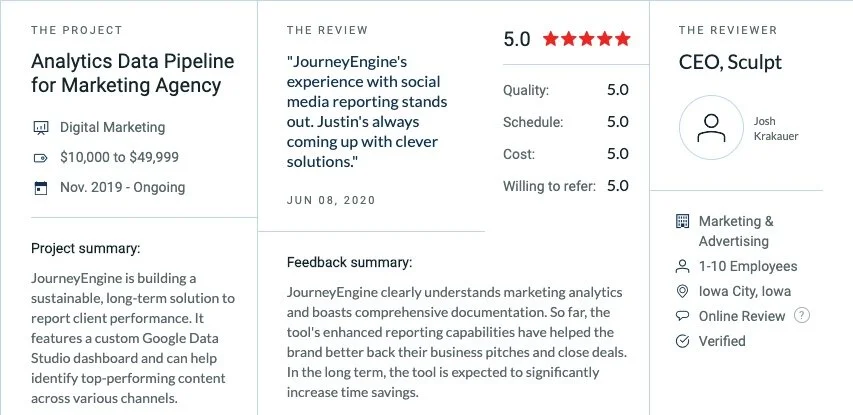
Before we begin, shameless plug. If you want to hire us to build an advanced, streamlined, done-for-you data engine for your agency . . . check out our Analytics Automation Consulting Service.
As promised, you are going to learn how to plug your clients into a simple, value-generating system for agency data analysis in this article.
All right.
Let’s begin . . .
Why You Need to Let Data Drive Your Process
For the remainder of this guide, we’ll walk you through five steps to drive client acquisition and retention with data. Here are the items we’ll cover:
Step 1 – Dissect your client’s market and build trust with a data-driven, deep-dive audit.
Step 2 – Use the “Buyer Journey” Model to create a scalable, transparent, measurable strategy for your client.
Step 3 – Forecast the ROI of your strategy.
Step 4 – Turn one-off projects into long-term partnerships with ongoing data.
Step 5 – Tell the story of your results in authority-building case studies. Then use them to land new business and strengthen relationships with current clients.
First, Let’s Understand Your Agency Sales Cycle
As I mentioned, a repeatable, systematic methodology for high-quality data analysis will drive lifts in EVERY part of your agency’s sales cycle.
To help explain how, let’s first take a deeper look at the typical agency sales cycle.
A. LEAD GENERATION
During the lead gen stage, your job is to find key prospects who are likely to find value in your service, generate their interest, and then land conversations with them.
If your agency handles these conversations well, eventually, your team will get the opportunity to submit formal pitches to many businesses.
B. THE AGENCY PITCH
A good pitch demonstrates the agency’s unique value over its competitors and gives your prospect a taste of what they’ll get with your service.
In my humble (but accurate) opinion, the best way to accomplish this is with a deep-dive audit. This provides us with a concrete, transparent, and data-driven strategy.
*Warning: Even when you streamline, there’s no way around doing serious work here. So it’s important to weed out the “tire-kickers” during part A so that you’re only pitching businesses who are able and likely to do business with you.
The higher-quality your lead is, the more time you’ll likely be willing to spend on the speculative (unpaid) work.
Some or all of your audit process can be moved into a paid engagement. How much is up to you.
C. SERVICE DELIVERY
You’ve won the battle for your client . . . but the WAR is far from over.
Retaining an existing client is 10 times less expensive than finding a new one.
That’s why keeping good clients happy and winning their admiration and repeat business are the most important levers you can pull for long-term agency growth.
And to keep your clients happy, you need to get them results. What’s more, they need to consistently understand the value and impact of those results.
These days, you just can’t leave clients in the dark.
Be transparent, let them in on your process, and continually show them how you are progressing toward the end goal.
How are you going to do that? You got it baby – with DATA! 🙂
You’ll hit clients with regularly scheduled, high-quality reporting and insights to keep them in the loop.
D. REPEAT BUSINESS AND REFERRALS
If you’ve done A–C properly, you’ll more than likely be getting your clients great results.
If clients can understand those results, they’ll give you repeat business.
But that’s not all those results will do.
You have the power to amplify your agency’s authority and win more new business by showcasing the data.
You’ll want to wrap your results up with a bow – in the form of a beautiful case study.
Great case studies can be used as sales collateral with new prospects, submitted for industry awards, and showcased on your site.
If your client is part of the marketing department, they’ll also want to share your case studies with others in their organization.
This makes you and (more importantly) them look awesome.
Everybody wins.
Now that we’re all on the same page — here are the steps to build your agency data analysis engine:
Step 1 – Become the Expert in Your Client’s Industry With Data-Driven Competitive Intelligence
Before we begin, if you’d like to grab customizable Google Sheet and Data Studio templates that aggregate all the data sources below into one sexy report, just click below.
This will walk you through step by step and save you a ton of time formatting your data. Plus, you can easily customize the report to your liking and branding.
Here’s an example of how that report will look (mouse over to flip pages):
Google Data Studio turns your data into informative dashboards and reports that are easy to read, easy to share, and fully customizable.
WHY COMPETITIVE INTELLIGENCE?
Competitive intelligence is crucial to our initial audit process.
By reverse-engineering our competitors, we can uncover whitespace, benchmark performance, and flesh out opportunities our clients should attack to build a winning strategy.
No matter what type of agency you are, getting familiar with the competitive lie of the land will help you master and disrupt your client’s market.
You can tailor your competitive analysis to the services your agency provides.
Here’s what we cover in most competitor audits:
BUSINESS DATA
The goal is to assess the business’s position and actual growth trend.
Pull the business’s number of employees and employee growth trend (usually available from LinkedIn Premium’s company insights report).
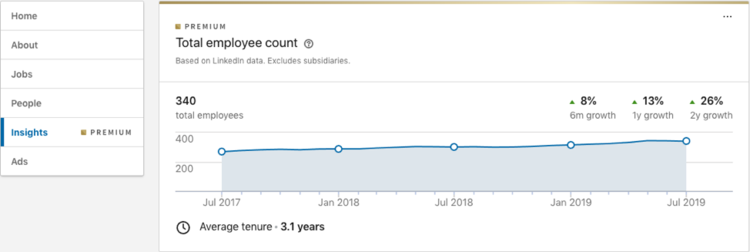
Check the age of their site (we use the SEOQuake plugin), which can be a positive indicator for search engines as well as good general information.
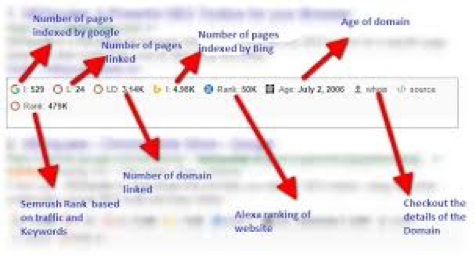
You’ll also evaluate the overall value proposition of their business, products, and services through manual analysis of the copy on their Home, About, and product/service pages.
SHARE OF VOICE (SEARCH AND SOCIAL BRAND MENTIONS)
Analyzing top-line awareness can be a helpful starting point if you’re dealing with brands that already have a decent level of recognition.
In this context, “share of voice” refers to their relative portion of brand name searches or social mentions compared to the competition.
Searching for your client and their competitors’ brand names in Google Trends can give you a good indicator of the historic trend in share of voice.

You can then cross-check for the volume of brand name searches for each competitor by checking Ahrefs’ Keyword Explorer tool.
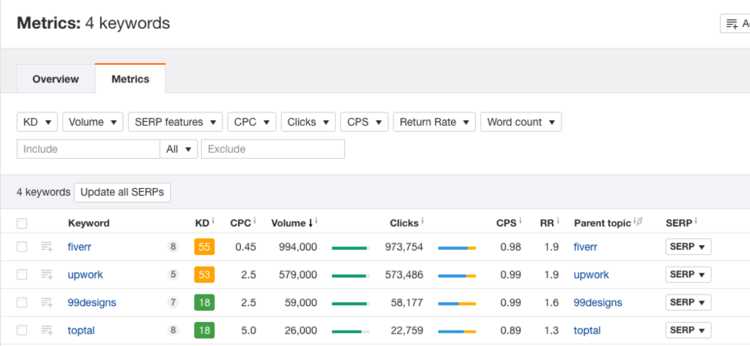
A final “share of voice” indicator is the number of people mentioning each brand on social media. Grab mentions from your social listening tool of choice. For this, we like Awario.
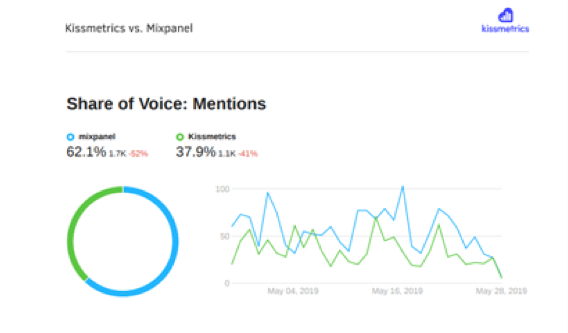
BLOG CONTENT PERFORMANCE
Here, you’ll assess the level of sophistication you’re competing against – when it comes to the written word (blog articles).
One of the first metrics you should check is each site’s frequency of blog articles per month (Google site: search).
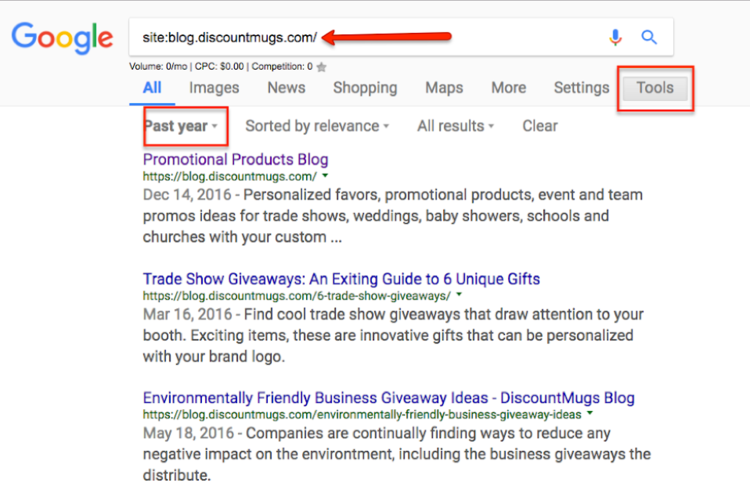
Also assess the average word count (SEOBook), use of images and video, and overall quality of the articles by manual review of their blog.
Determine which articles are drawing the most organic traffic (SEMRush).
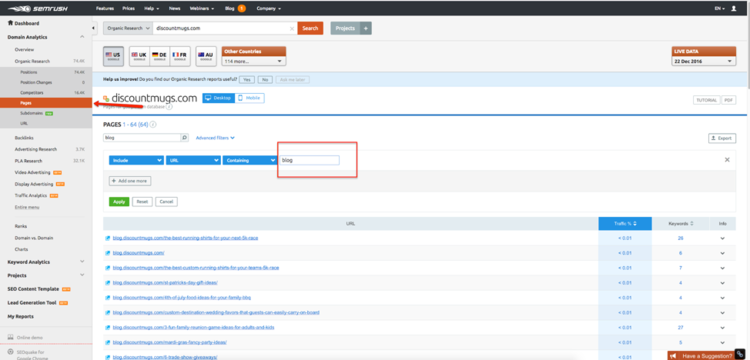
Break those top-performing articles down by the number of backlinks they have pointing to them and the number of social shares they’ve drawn (Ahrefs).
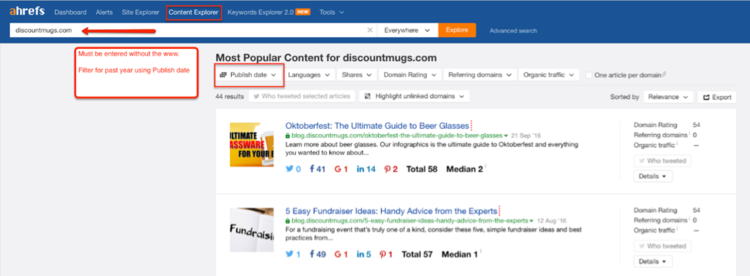
LEAD GENERATION STRATEGY
For lead gen sites like B2Bs, service providers, and SaaS (our bread and butter), it’s helpful to know the tactics competitors are using to generate their leads.
Compare each site’s “opt-in offer” side by side and assess the copy and type of content they’re using to generate their leads, AKA “lead magnets.”
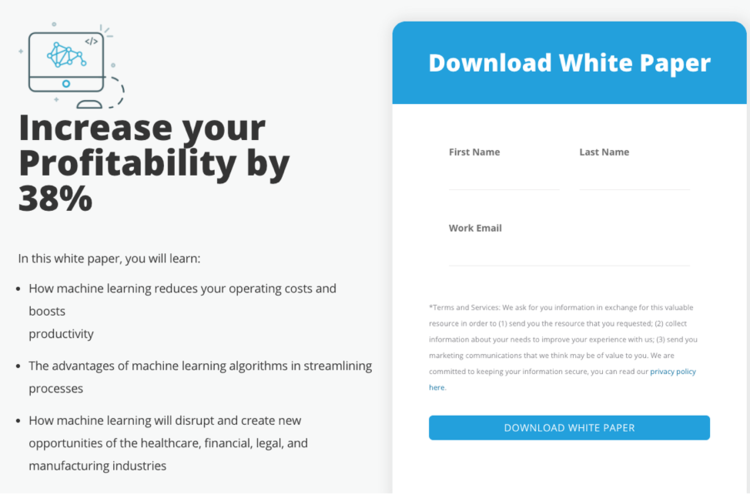
Dig for any landing pages that are dedicated to opt-in, run the seo metrics on those pages and also check how much paid media is driving to those pages (SEMRush).
PAID MEDIA DATA
You can get a read on the amount each competitor spends on search ads (SEMRush) as well as the type of landing pages, copy, and ad imagery they’ve used in the past (SEMRush).
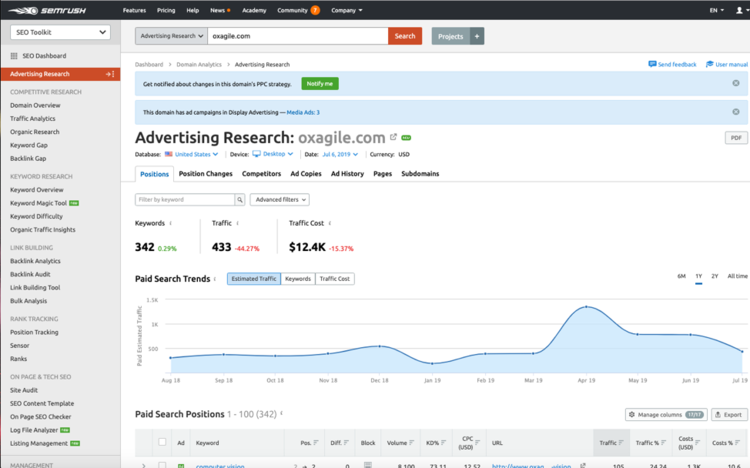
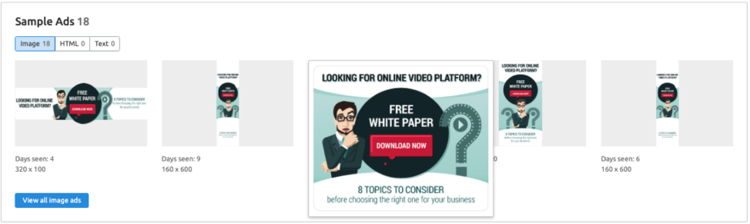
If you already have access to their Google Ads account, the “Auction Insights” report is a great way to gauge how their ads perform compared to competitors’.
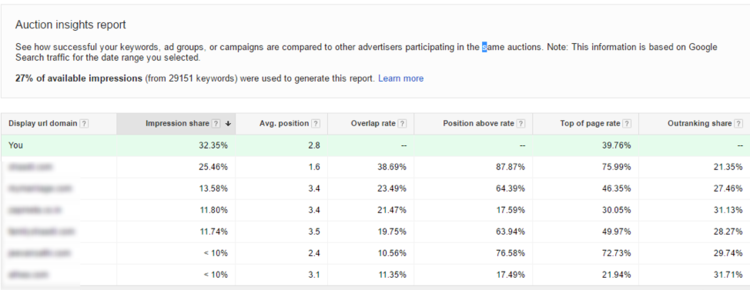
For paid social, we use Power Ads Spy, which allows you to see the Facebook ads that competitors have run and their landing pages.
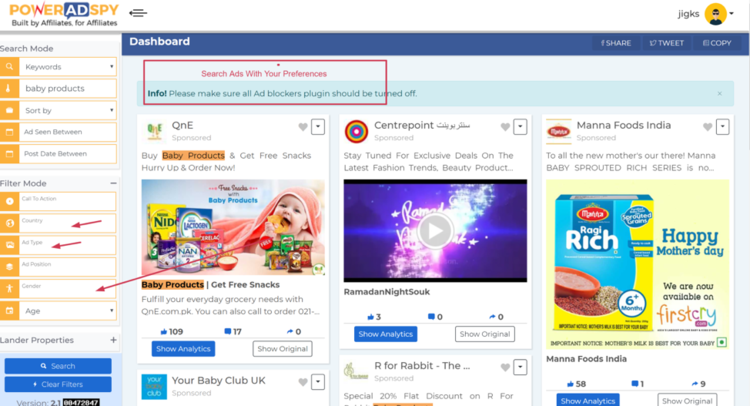
SEO METRICS
Organic traffic volume and organic traffic cost are good base metrics on which to assess SEO for competitor sites (SEMRush Organic Research Report).
Traffic cost tells you how much your organic traffic is worth based on CPC data and is a good indicator of the monetary value of traffic.
Domain authority (mozbar) is another staple metric for your competitive analysis. A recent study on link building from Neil Patel showed DA as one of the top indicators of backlink quality.
If you’re considering a link-building campaign, linking root domains and link velocity or new links per month are crucial metrics to determine where you can realistically compete.
Find these metrics in Ahrefs.
SOCIAL CONTENT PERFORMANCE
Data on competitors’ social content and their audience’s response can give you powerful insights into your client’s brand, no matter what your agency creates.
For each brand’s Facebook, Instagram, YouTube, and LinkedIn accounts, we pull the volume of and trend in followers over time.
But more importantly, we look at three core social media KPIs – conversation, amplification, and applause.
Comparing the above metrics is a surefire spark for strategic thinking for your own content.
The SEMRush social media tracker reports can get you these metrics.

If you can spring for a dedicated tool, True Social Metrics is a great option with a few more bells, like the “posting density matrix,” which helps determine the competitors with the most effective posting schedule.

At the end of your competitive intelligence analysis, you should have a crystal-clear view of what your client’s market looks like and what it’s going to take to dominate that market.
You’ll now have a clear line of sight to the winning strategy.
Step 2 – Build Your Bulletproof, Data-Driven Strategy
S.W.O.T YOUR ANALYSIS
If you’ve crunched and analyzed the data points I’ve mentioned above, you’re now practically an expert on your client’s market. Kudos!
Now the job is to condense everything you’ve learned and pluck out the best opportunities for your client to start attacking in a way that they can easily understand.
Traditional SWOT (Strengths, Weaknesses, Opportunities, Threats) analysis is a great framework for this part.
It can also be helpful to set short-, mid- and long-term plans for your recommendations, since a lot of the time, some of your recommendations will be out of reach in the short term.
MODELING THE BUYER JOURNEY
You’ve identified the competitive whitespace and laid out opportunities in a data-driven and SMART way.
The next step will help demonstrate that you mean business and intend to follow through with your plan transparently.
This part will also set the stage for a healthy relationship with your client.
A relationship in which both parties are educated on how the marketing system works.
The buyer journey is a core, absolutely fundamental concept to any business.
But even the pros need a refresher, so I end up re-explaining the concept during almost every new engagement.
Left to their own devices, clients will default to “judging a fish for its ability to climb a tree.”
That’s why you want to make sure your agency and your clients have a clear understanding of how things work.
They need to understand the way good content and marketing bring customers closer to purchase.
AND precisely how this whole process should be measured.
First, for those who aren’t familiar, let’s break the buyer journey down quickly.
Buyers go through the same six-stage process when they do business with any company.
1. SEE – become aware of the business via content.
2. EXPLORE – research the business/product more deeply.
3. TRUST – decide the business is reputable enough.
4. TRY – give the business a shot.
5. BUY – make that first purchase.
6. ADVOCATE – repeat purchases and refer more business.
Granted, no one is identical, and there are infinite complexities between industries and companies. But in essence, that’s what it all boils down to.
Each of the stages above should have different business objectives, content, and KPI metrics.
You should set quantifiable targets and helpful segments for every KPI.
If you can present this model clearly when you start an engagement, your clients will know not to measure stage 1 content with stage 5 metrics.
If anyone starts judging a fish by its ability to climb trees, you can point right back to that model!
Sounds like a lot of work? No worries – I’ve made a plug-and-play Google Sheets template for you, with examples and video training, to help eliminate all the guesswork. 🙂
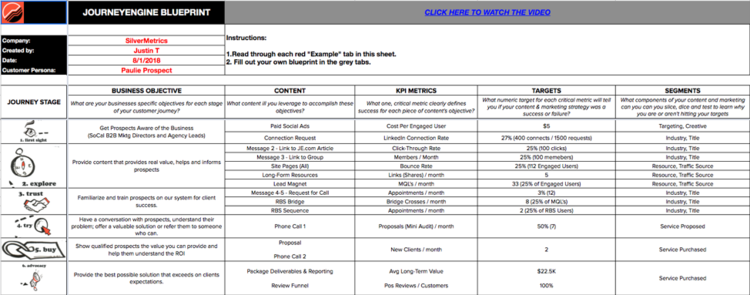
Step 3 – Forecast Marketing ROI for Your Strategy
You can blow smoke all you want. But when it comes down to it, businesses should really care about one thing – ROI.
If they can’t see how you’ll produce that metric for them, you’re not getting the business. Period.
But why then is it that agencies cower at the sound of those three letters? They’d certainly never bring it up proactively.
The avoidance generally comes from two things:
1. They don’t want to set themselves up for failure by overpromising.
2. They think it’s too hard to produce an accurate forecast.
But fortune favors the bold, my friend!
A data-backed, realistic ROI forecast is the absolute best way to overcome objections to investing in your service.
That’s why you’re going to be different and give this a shot.
“But Justin,” you say, “ROI analysis is REALLY hard. We’d need a scientist on board for that!”
No worries — I’ve got your back! Let me show you that projecting ROI doesn’t have to be scary.
If you offer SEO services and you’re looking to get started with forecasting, try this Google Sheets and Google Data Studio template to get you started.
The model lays out multiple scenarios for what you can do for your client, including “Business as Usual,” which lays out normal growth without your service.
Here’s an example of how your projection will look:
*Mouse over the bottom left corner to flip pages
Google Data Studio turns your data into informative dashboards and reports that are easy to read, easy to share, and fully customizable.
Step 4 – Retain More Clients with Ongoing Data Deliverables
WHY YOU NEED REGULAR REPORTING
The first three steps helped you WIN your clients’ trust and land them for ongoing services.
The way you deliver your service will determine whether you KEEP their trust and will determine their lifetime value as clients.
This is everything for your agency’s growth.
In order to stay happy, clients want to know that what you’re doing is having the desired impact.
They need to know that you’re progressing toward the goals/targets you laid out in your strategy.
And they want to see the actions you’re taking to progress toward those goals.
That’s why you need to hit clients with data at regular intervals.
Great reports can be the number-one factor separating AOR retainers from “flash-in-the-pan” projects.
In other words, the best thing you can do to grow your agency’s margins!
Here’s how you can create a reporting system that extends LTV for you and your clients.
TALK TO YOUR REPORT USERS
Your team and clients will love being hit with data deliverables, but only as often as they can provide value.
Otherwise, they might act like they smelled something foul when “reporting” comes up . . .
It’s a waste to create a one-size-fits-all report and deliver it to everyone in the business.
Your reports won’t get appreciated, and you have better use for your time.
Instead, you or your data person should sit down for a one-to-one chat with every individual who’s going to be using the reports.
That means people at your agency team AND with your client. But especially your client.
Probe them for their priorities and problems that can be solved with data.
Determine what’s most important for each of their roles and what they would consider to be a BIG WIN for this project.
Also probe for any potential anxieties about data and reporting. This can be a very sensitive topic for some, and it’s important to nip that in the bud.
This exercise will help the clients see you and your data as their partner and set the stage properly for an awesome relationship that’s driven by data.
DELIVER USERS ONLY THE DATA THEY NEED
The type, frequency, and granularity of data you deliver to people should depend on their role in the business.
The PPC manager, marketing director, and CEO each need a different granularity of data and analysis in order to do their jobs.
In general, the higher up in the org people are, the fewer metrics they should see, and the less frequently. But they need a higher level of strategic insight.
Hands-on PPC specialists, social media managers, etc. tend to need real-time access to data but have less of a need for all the insight.
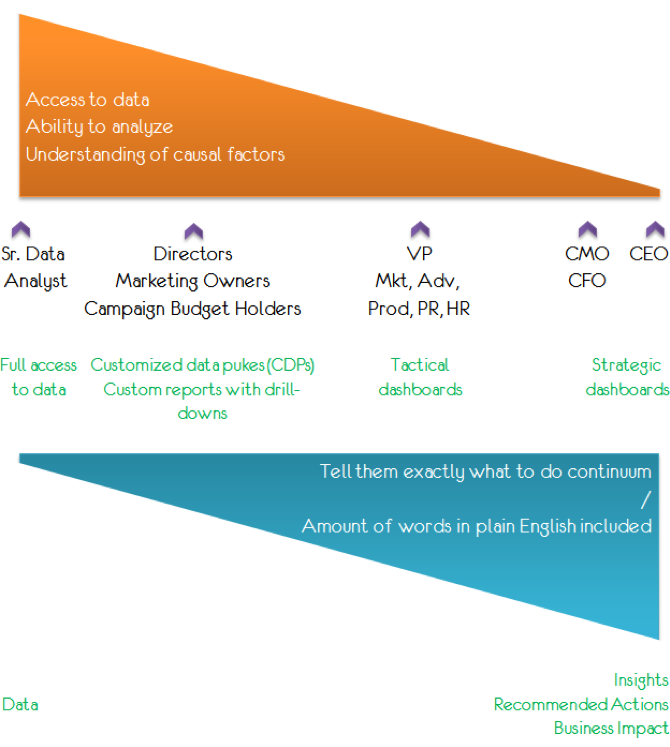
The above graphic is from a classic article I love on tactical dashboards from Avinash Kaushik’s Occam’s Razor.
SET UP YOUR REPORTING CALENDAR
Schedule your reporting calendar based on your findings from stakeholder interviews and the resources you have available for data reporting and analysis.
In your calendar, you’ll want to note which stakeholders receive which reports and lay out the purpose/value of each report.
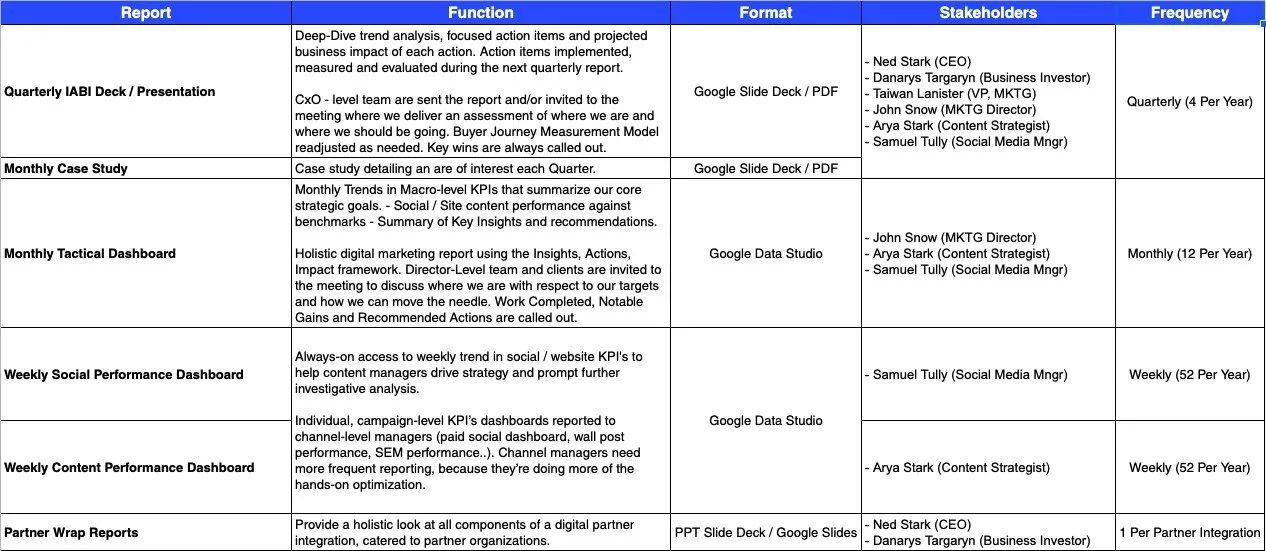
Step 5 – Wrap Up Your Best Results into Case Studies
If you’ve completed steps 1–3, you’ll at some point have recorded some outstanding, measurable wins for your clients.
You’ll want to shout those results out to your internal team, your clients, and the rest of the world!
This is a great way to celebrate success in using data to drive the business, sell data-driven thinking through to clients and prospects, and make your team look good in the process.
Case studies can be fantastic content to present prospective clients in all stages of their journey.
An aptitude for storytelling with your data will come in handy here.
YOUR CASE STUDY FRAMEWORK
1. Background – What state was the business in before your agency came into the picture?
2. Challenge – What was needed in order to put the business in an ideal state?
3. Solution – What specific tactics did your team recommend/employ to solve the challenge?
4. Outcomes – What impact did the solution have on business KPIs? (Include a chart/visual.)
5. Next Steps – How should/will the business use this case to drive further growth?
Here are some examples of how you can use your new case study:
External Promotion (provided client approves)
– Submit the case study for industry awards.
– Include it in a section on your website.
– Put it on service-specific landing pages.
Internal Use
– Company newsletter
– Section on your intranet
– Quarterly meeting
Now Let’s Scale Your Analysis Workflow to the Big Leagues …
How to Build your agency a scalable, automated data engine
This five-step process probably sounds like a decent amount of work . . .
Done properly, it is. At first.
But what if you had a stack of tools that let you easily scale this process to 40, 50, 100+ clients?
A data ENGINE that gets all this done efficiently, without hiring ANY new people or using your people’s time on tedious data tasks?
Well, you can.
With the right process and tools dialed in, you can run clients through the system like clockwork, without batting an eye.
You’ll be able to scale the service infinitely and watch client lifetime value go through the roof. Guaranteed.
If you want to join the data analysis big leagues, the trick is to “codify” your process by tapping into APIs for all the sources we’ve mentioned and automating data scrapes.
Here’s the stack of tools you’ll need:
1. AN ETL (EXTRACT, TRANSFORM, LOAD) TOOL
ETL tools like Supermetrics and Stitch help you run data queries on a schedule, eliminating the need to log into your different sources to manually “pull” data.
2. A DATA VISUALIZATION TOOL
The only way to scale reporting and dashboards in a beautiful, easily understood, and actionable way is through Data Viz Tools like Google Data Studio and Tableau.
3. A DATA WAREHOUSE
If you’re doing data analysis at high volume and need a process joining different data sources together, then you should be using a data warehouse like Google BigQuery.
Once you have these three things properly in place, you’ll NEVER have a problem scaling your services and keeping clients happy with data.
If your team has or wants to hire a full-time data engineer to build this, make sure they are versed in SQL.
Or just hire us to build the engine for you, at a fraction of the cost of a full-time analyst, and never worry about spinning your wheels with data, ever again.
Even if data work isn’t necessarily your team’s kryptonite, please make sure they spend time on what’s important – the INSIGHTS – and as little time as possible on capturing and cleaning data.
If you do that, your data will have the desired impact on your clients, their results, and their lifetime value with your business. As an ancillary benefit, your team gets to keep their sanity — no more data grunt work! Phew.
Again, everybody wins 🙂
Wrapping It Up
By now, you should have all the tools and resources you need to land more big-fish clients, gain their trust, and increase their lifetime value with a highly scalable, data-driven system.
No matter what type of services your agency provides, using data wisely will drive massive lifts in every part of the sales cycle.
Whether you consider yourself left- or right-brained, always remember that data is your friend.
So get out there and leverage it to drive more business!
Happy analyzing!
Is your agency’s process for using data any different? How is it working out for you? Let us know in the comments section below.
Building your data pipeline?
We’re happy to help map out your options.
Book some time to connect with Justin, founder and lead consultant @ JourneyEngine.
With Love,
The JourneyEngine Team